For reflection
Edwards says a creature's fullness comes from God's Spirit, not from itself. Where am I looking for fullness in created things rather than in God?
Day 1 of 1461 · Thursday, January 1
In the Beginning
19 verses · about 11 min · Matthew Henry, Calvin, JFB, Luther, Edwards · About this book
The Bible, and this four-year plan, begin with God. Before there is a nation, a law, or a single human being, there is a Creator who speaks and brings the world into being. Matthew Henry points out why this is the right place to start. Everything else in our faith rests on our relationship to God as our Maker. The first verse, he says, gives us the opening line of the Christian creed: God the Father Almighty is the Maker of heaven and earth.
For reflection
Edwards says a creature's fullness comes from God's Spirit, not from itself. Where am I looking for fullness in created things rather than in God?
1:1In the beginning, God created the heavens and the earth. 2The earth was formless and empty. Darkness was on the surface of the deep and God’s Spirit was hovering over the surface of the waters.
"In the beginning, God created the heavens and the earth." John Calvin draws attention to the verb. Moses chose a word that means to create, not merely to shape something that already existed. Calvin's conclusion is plain: the world was made out of nothing. Henry agrees, and he describes the beginning as the moment time itself started, when the clock was first set going. He also offers a homely picture of what God made: the world is like a great house with upper and lower floors, every room wisely furnished.
At first, though, the earth is "without form and void," dark and empty. Calvin calls it a shapeless chaos. Jonathan Edwards finds a spiritual lesson here. God began this way, he says, to show what a creature is in itself: empty and vain, with all its fullness and goodness coming from God. In his words, "the fulness of the creature is from God's Spirit."
That leads to the beautiful image of the Spirit of God moving over the waters. Jamieson, Fausset and Brown, and Edwards as well, explain that the Hebrew word suggests a bird brooding over its eggs. Martin Luther sees the whole Trinity at work in these two verses. The Father creates through the Son, whom Moses calls the Word, and the Holy Spirit broods over the waters like a hen warming her eggs, because it is the Spirit's work to give life.
3God said, “Let there be light,” and there was light. 4God saw the light, and saw that it was good. God divided the light from the darkness. 5God called the light “day”, and the darkness he called “night”. There was evening and there was morning, the first day. 6God said, “Let there be an expanse in the middle of the waters, and let it divide the waters from the waters.” 7God made the expanse, and divided the waters which were under the expanse from the waters which were above the expanse; and it was so. 8God called the expanse “sky”. There was evening and there was morning, a second day. 9God said, “Let the waters under the sky be gathered together to one place, and let the dry land appear;” and it was so. 10God called the dry land “earth”, and the gathering together of the waters he called “seas”. God saw that it was good. 11God said, “Let the earth yield grass, herbs yielding seeds, and fruit trees bearing fruit after their kind, with their seeds in it, on the earth;” and it was so. 12The earth yielded grass, herbs yielding seed after their kind, and trees bearing fruit, with their seeds in it, after their kind; and God saw that it was good. 13There was evening and there was morning, a third day.
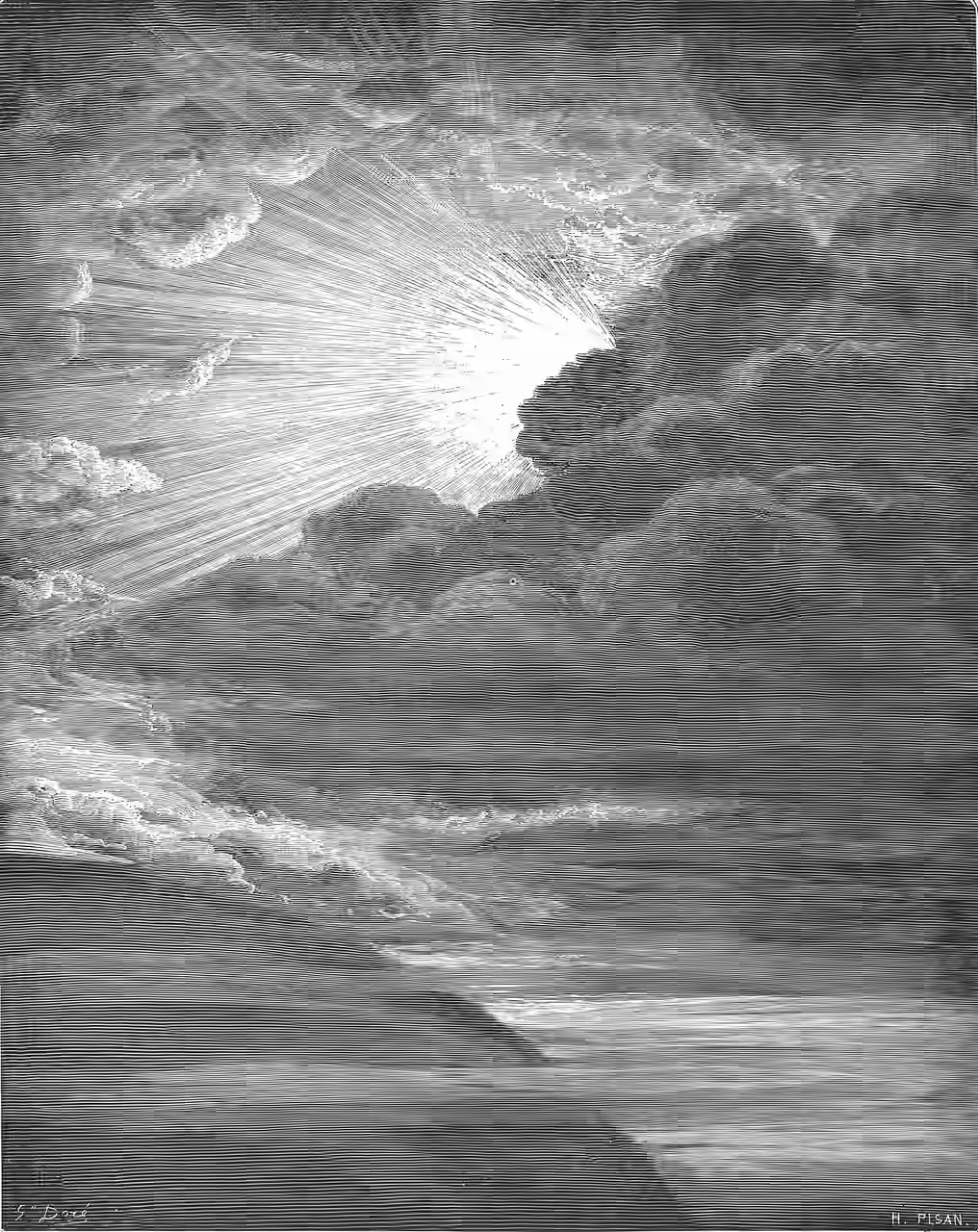
"God said, 'Let there be light,' and there was light." Jamieson, Fausset and Brown note that "God said" means God willed and decreed it, and every time he did, the result followed immediately. Calvin adds that although God's speaking is first mentioned here, the Word was at work from the very beginning, since nothing was made without him.
Why light first? Henry answers that God didn't need light to see his own work. He made it so that we could see his works and his glory in them. He calls light "the great beauty and blessing of the universe."
Over the next days God separates the waters, gathers the seas, and makes dry land appear. Calvin is struck by the gathering of the waters. Even the philosophers of his day thought water should naturally cover the whole earth, so its retreat to make a home for people is a quiet miracle of God's goodness. He also notices that plants were made before the sun. The earth, which depends on the sun today, first bore fruit simply because God spoke.
14God said, “Let there be lights in the expanse of the sky to divide the day from the night; and let them be for signs to mark seasons, days, and years; 15and let them be for lights in the expanse of the sky to give light on the earth;” and it was so. 16God made the two great lights: the greater light to rule the day, and the lesser light to rule the night. He also made the stars. 17God set them in the expanse of the sky to give light to the earth, 18and to rule over the day and over the night, and to divide the light from the darkness. God saw that it was good. 19There was evening and there was morning, a fourth day.
On the fourth day God makes the sun, moon and stars and gives them a job: to light the earth and mark days, seasons and years. Calvin offers a helpful principle for reading this passage. Moses wasn't writing an astronomy textbook. He wrote "in a popular style," describing what ordinary people can see, so the account is about how the lights serve us rather than how big or distant they are. Calvin is careful to add that astronomy is a worthy study; it simply isn't what Moses was doing. Henry agrees that the lights are described in relation to the earth, not to satisfy curiosity, and that this gives us plenty of reason for thanks and praise.
Calvin also sees a lesson in God appointing the sun and moon to their tasks. All creatures are subject to God's will and do what he commands. Even the brightest things in the sky are servants, not gods.
Tomorrow's passage in your inbox at 6 AM MT.
1:1–2
In these verses we have the work of creation in its epitome and in its embryo. I. In its epitome, Gen 1:1, where we find, to our comfort, the first article of our creed, that God the Father Almighty is the Maker of heaven and earth, and as such we believe in him. 1. Observe, in this verse, four things: - (1.) The effect produced - the heaven and the earth, that is, the world, including the whole frame and furniture of the universe, the world and all things therein, Act 17:24. The world is a great house, consisting of upper and lower stories, the structure stately and magnificent, uniform and convenient, and every room well and wisely furnished. It is the visible part of the creation that Moses here designs to account for; therefore he mentions not the creation of angels. But as the earth has not only its surface adorned with grass and flowers, but also its bowels enriched with metals and precious stones (which partake more of its solid nature and more valuable, though the creation of them is not mentioned here), so the heavens are not only beautified to our eye with glorious lamps which garnish its outside, of whose creation we here read, but they are within replenished with glorious beings, out of our sight, more celestial, and more surpassing them in worth and excellency than the gold or sapphires surpass the lilies of the field. In the visible world it is easy to observe, [1.] Great variety, several sorts of beings vastly differing in their nature and constitution from each other. Lord, how manifold are thy works, and all good! [2.] Great beauty. The azure sky and verdant earth are charming to the eye of the curious spectator, much more the ornaments of both. How transcendent then must the beauty of the Creator be! [3.] Great exactness and accuracy. To those that, with the help of microscopes, narrowly look into the works of nature, they appear far more fine than any of the works of art. [4.] Great power. It is not a lump of dead and inactive matter, but there is virtue, more or less, in every creature: the earth itself has a magnetic power. [5.] Great order, a mutual dependence of beings, an exact harmony of motions, and an admirable chain and connection of causes. [6.] Great mystery. There are phenomena in nature which cannot be solved, secrets which cannot be fathomed nor accounted for. But from what we see of heaven and earth we may easily enough infer the eternal power and Godhead of the great Creator, and may furnish ourselves with abundant matter for his praises. And let our make and place, as men, remind us of our duty as Christians, which is always to keep heaven in our eye and the earth under our feet. (2.) The author and cause of this great work - God. The Hebrew word is Elohim, which bespeaks, [1.] The power of God the Creator. El signifies the strong God; and what less than almighty strength could bring all things out of nothing? [2.] The plurality of persons in the Godhead, Father, Son, and Holy Ghost. This plural name of God, in Hebrew, which speaks of him as many though he is one, was to the Gentiles perhaps a savour of death unto death, hardening them in their idolatry; but it is to us a savour of life unto life, confirming our faith in the doctrine of the Trinity, which, though but darkly intimated in the Old Testament, is clearly revealed in the New. The Son of God, the eternal Word and Wisdom of the Father, was with him when he made the world (Pro 8:30), nay, we are often told that the world was made by him, and nothing made without him, Joh 1:3, Joh 1:10; Eph 3:9; Col 1:16; Heb 1:2. O what high thoughts should this form in our minds of that great God whom we draw nigh to in religious worship, and that great Mediator in whose name we draw nigh! (3.) The manner in which this work was effected: God created it, that is, made it out of nothing. There was not any pre-existent matter out of which the world was produced. The fish and fowl were indeed produced out of the waters and the beasts and man out of the earth; but that earth and those waters were made out of nothing. By the ordinary power of nature, it is impossible that any thing should be made out of nothing; no artificer can work, unless he has something to work on. But by the almighty power of God it is not only possible that something should be made of nothing (the God of nature is not subject to the laws of nature), but in the creation it is impossible it should be otherwise, for nothing is more injurious to the honour of the Eternal Mind than the supposition of eternal matter. Thus the excellency of the power is of God and all the glory is to him. (4.) When this work was produced: In the beginning, that is, in the beginning of time, when that clock was first set a going: time began with the production of those beings that are measured by time. Before the beginning of time there was none but that Infinite Being that inhabits eternity. Should we ask why God made the world no sooner, we should but darken counsel by words without knowledge; for how could there be sooner or later in eternity? And he did make it in the beginning of time, according to his eternal counsels before all time. The Jewish Rabbies have a saying, that there were seven things which God created before the world, by which they only mean to express the excellency of these things: - The law, repentance, paradise, hell, the throne of glory, the house of the sanctuary, and the name of the Messiah. But to us it is enough to say, In the beginning was the Word, Joh 1:1. 2. Let us learn hence, (1.) That atheism is folly, and atheists are the greatest fools in nature; for they see there is a world that could not make itself, and yet they will not own there is a God that made it. Doubtless, they are without excuse, but the god of this world has blinded their minds. (2.) That God is sovereign Lord of all by an incontestable right. If he is the Creator, no doubt he is the owner and possessor of heaven and earth. (3.) That with God all things are possible, and therefore happy are the people that have him for their God, and whose help and hope stand in his name, Psa 121:2; Psa 124:8. (4.) That the God we serve is worthy of, and yet is exalted far above, all blessing and praise, Neh 9:5, Neh 9:6. If he made the world, he needs not our services, nor can be benefited by them (Act 17:24, Act 17:25), and yet he justly requires them, and deserves our praise, Rev 4:11. If all is of him, all must be to him. II. Here is the work of creation in its embryo, Gen 1:2, where we have an account of the first matter and the first mover. 1. A chaos was the first matter. It is here called the earth (though the earth, properly taken, was not made till the third day Gen 1:10), because it did most resemble that which afterwards was called earth, mere earth, destitute of its ornaments, such a heavy unwieldy mass was it; it is also called the deep, both for its vastness and because the waters which were afterwards separated from the earth were now mixed with it. This immense mass of matter was it out of which all bodies, even the firmament and visible heavens themselves, were afterwards produced by the power of the Eternal Word. The Creator could have made his work perfect at first, but by this gradual proceeding he would show what is, ordinarily, the method of his providence and grace. Observe the description of this chaos. (1.) There was nothing in it desirable to be seen, for it was without form and void. Toho and Bohu, confusion and emptiness; so these words are rendered, Isa 34:11. It was shapeless, it was useless, it was without inhabitants, without ornaments, the shadow or rough draught of things to come, and not the image of the things, Heb 10:1. The earth is almost reduced to the same condition again by the sin of man, under which the creation groans. See Jer 4:23, I beheld the earth, and lo it was without form, and void. To those who have their hearts in heaven this lower world, in comparison with that upper, still appears to be nothing but confusion and emptiness. There is no true beauty to be seen, no satisfying fulness to be enjoyed, in this earth, but in God only. (2.) If there had been any thing desirable to be seen, yet there was no light to see it by; for darkness, thick darkness, was upon the face of the deep. God did not create this darkness (as he is said to create the darkness of affliction, Isa 45:7), for it was only the want of light, which yet could not be said to be wanted till something was made that might be seen by it; nor needs the want of it be much complained of, when there was nothing to be seen but confusion and emptiness. If the work of grace in the soul is a new creation, this chaos represents the state of an unregenerate graceless soul: there is disorder, confusion, and every evil work; it is empty of all good, for it is without God; it is dark, it is darkness itself. This is our condition by nature, till almighty grace effects a blessed change. 2. The Spirit of God was the first mover: He moved upon the face of the waters. When we consider the earth without form and void, methinks it is like the valley full of dead and dry bones. Can these live? Can this confused mass of matter be formed into a beautiful world? Yes, if a spirit of life from God enter into it, Eze 37:9. Now there is hope concerning this thing; for the Spirit of God begins to work, and, if he work, who or what shall hinder? God is said to make the world by his Spirit, Psa 33:6; Job 26:13; and by the same mighty worker the new creation is effected. He moved upon the face of the deep, as Elijah stretched himself upon the dead child, - as the hen gathers her chickens under her wings, and hovers over them, to warm and cherish them, Mat 23:37, - as the eagle stirs up her nest, and flutters over her young (it is the same world that is here used), Deu 32:11. Learn hence, That God is not only the author of all being, but the fountain of life and spring of motion. Dead matter would be for ever dead if he did not quicken it. And this makes it credible to us that God should raise the dead. That power which brought such a world as this out of confusion, emptiness, and darkness, at the beginning of time, can, at the end of time, bring our vile bodies out of the grave, though it is a land of darkness as darkness itself, and without any order (Job 10:22), and can make them glorious bodies.
Source · CC0-1.0 / Public Domain
1:1
In the beginning. To expound the term "beginning," of Christ, is altogether frivolous. For Moses simply intends to assert that the world was not perfected at its very commencement, in the manner in which it is now seen, but that it was created an empty chaos of heaven and earth. His language therefore may be thus explained. When God in the beginning created the heaven and the earth, the earth was empty and waste. [35] He moreover teaches by the word "created," that what before did not exist was now made; for he has not used the term ytsr, (yatsar,) which signifies to frame or forms but vr', (bara,) which signifies to create. [36] Therefore his meaning is, that the world was made out of nothing. Hence the folly of those is refuted who imagine that unformed matter existed from eternity; and who gather nothing else from the narration of Moses than that the world was furnished with new ornaments, and received a form of which it was before destitute. This indeed was formerly a common fable among heathens, [37] who had received only an obscure report of the creation, and who, according to custom, adulterated the truth of God with strange figments; but for Christian men to labor (as Steuchus does [38] ) in maintaining this gross error is absurd and intolerable. Let this, then be maintained in the first place, [39] that the world is not eternal but was created by God. There is no doubt that Moses gives the name of heaven and earth to that confused mass which he, shortly afterwards, (Genesis 1:2.) denominates waters. The reason of which is, that this matter was to be the seed of the whole world. Besides, this is the generally recognized division of the world. [40] God. Moses has it Elohim, a noun of the plural number. Whence the inference is drawn, that the three Persons of the Godhead are here noted; but since, as a proof of so great a matter, it appears to me to have little solidity, will not insist upon the word; but rather caution readers to beware of violent glosses of this kind. [41] They think that they have testimony against the Arians, to prove the Deity of the Son and of the Spirit, but in the meantime they involve themselves in the error of Sabellius, [42] because Moses afterwards subjoins that the Elohim had spoken, and that the Spirit of the Elohim rested upon the waters. If we suppose three persons to be here denoted, there will be no distinction between them. For it will follow, both that the Son is begotten by himself, and that the Spirit is not of the Father, but of himself. For me it is sufficient that the plural number expresses those powers which God exercised in creating the world. Moreover I acknowledge that the Scripture, although it recites many powers of the Godhead, yet always recalls us to the Father, and his Word, and spirit, as we shall shortly see. But those absurdities, to which I have alluded, forbid us with subtlety to distort what Moses simply declares concerning God himself, by applying it to the separate Persons of the Godhead. This, however, I regard as beyond controversy, that from the peculiar circumstance of the passage itself, a title is here ascribed to God, expressive of that powers which was previously in some way included in his eternal essence. [43]
Source · Public Domain (CC Public Domain Mark 1.0)
1:2
And the earth was without form and void. I shall not be very solicitous about the exposition of these two epithets, tvhv, (tohu,) and vvhv, (bohu.) The Hebrews use them when they designate anything empty and confused, or vain, and nothing worth. Undoubtedly Moses placed them both in opposition to all those created objects which pertain to the form, the ornament and the perfection of the world. Were we now to take away, I say, from the earth all that God added after the time here alluded to, then we should have this rude and unpolished, or rather shapeless chaos. [44] Therefore I regard what he immediately subjoins that "darkness was upon the face of the abyss," [45] as a part of that confused emptiness: because the light began to give some external appearance to the world. For the same reason he calls it the abyss and waters, since in that mass of matter nothing was solid or stable, nothing distinct. And the Spirit of God Interpreters have wrested this passage in various ways. The opinion of some that it means the wind, is too frigid to require refutation. They who understand by it the Eternal Spirit of God, do rightly; yet all do not attain the meaning of Moses in the connection of his discourse; hence arise the various interpretations of the participle mrchpht, (merachepeth.) I will, in the first place, state what (in my judgment) Moses intended. We have already heard that before God had perfected the world it was an undigested mass; he now teaches that the power of the Spirit was necessary in order to sustain it. For this doubt might occur to the mind, how such a disorderly heap could stand; seeing that we now behold the world preserved by government, or order. [46] He therefore asserts that this mass, however confused it might be, was rendered stable, for the time, by the secret efficacy of the Spirit. Now there are two significations of the Hebrew word which suit the present place; either that the spirit moved and agitated itself over the waters, for the sake of putting forth vigor; or that He brooded over them to cherish them. [47] Inasmuch as it makes little difference in the result, whichever of these explanations is preferred, let the reader's judgment be left free. But if that chaos required the secret inspiration of God to prevent its speedy dissolution; how could this order, so fair and distinct, subsist by itself, unless it derived strength elsewhere? Therefore, that Scripture must be fulfilled, Send forth thy Spirit, and they shall be created, and thou shalt renew the face of the earth,' (Psalm 104:30;) so, on the other hand, as soon as the Lord takes away his Spirit, all things return to their dust and vanish away, (Psalm 104:29.)
Source · Public Domain (CC Public Domain Mark 1.0)
1:2
the earth was without form and void--or in "confusion and emptiness," as the words are rendered in Isa 34:11. This globe, at some undescribed period, having been convulsed and broken up, was a dark and watery waste for ages perhaps, till out of this chaotic state, the present fabric of the world was made to arise. the Spirit of God moved--literally, continued brooding over it, as a fowl does, when hatching eggs. The immediate agency of the Spirit, by working on the dead and discordant elements, combined, arranged, and ripened them into a state adapted for being the scene of a new creation. The account of this new creation properly begins at the end of this second verse; and the details of the process are described in the natural way an onlooker would have done, who beheld the changes that successively took place.
Source · Public Domain (CC Public Domain Mark 1.0)
1:2 · Commentary on Genesis
V. 2a. And the earth was waste and void. In the Hebrew words TOHU and BOHU there is no more meaning than can be expressed in any other language, yet these terms are frequently used in the sacred Scriptures. TOHU means "nothing," so that a TOHU earth means, in its simple reality, that which is in itself "empty" or "waste;" where there is no way, no distinction of places, no hill, no vale, no grass, no herbs, no animals, no men. And such was the first appearance of the waste and untilled earth, for while the water was mixed with the earth no distinctions of those various objects could be discerned, which are clearly seen since the earth's formation and cultivation. Thus Isaiah, 34:11, when threatening destruction to the whole earth says "There shall be stretched upon it the line of TOHU, confusion; and the plummet of BOHU, emptiness;" that is, it shall be made so desolate that neither men nor beasts shall be left upon it; all houses shall he devastated and all things hurled into chaos and confusion. Just as Jerusalem was afterwards laid waste by the Romans and Rome by the Goths, so that no vestige of the ancient city as it once was could be pointed out. You now behold the earth standing out of the waters, the heavens adorned with stars, the fields with trees, and cities with houses; but should all these things be taken away and hurled into confusion and into one chaotic heap, the state of things thus produced would be what Moses calls TOHU and BOHU. As the earth was surrounded with darkness or with waters over which darkness brooded, so also the heaven was unformed. It was not only TOHU because it was destitute of the garnishing of the stars, and BOHU because it was not yet separated and distinguished from the earth, but because it was as yet altogether destitute of light and a dark and deep abyss which like a dense cloud enveloped the earth, or that mass of mud; for the division of the waters from the waters follows later. Here then we have the first thing which Moses teaches: that the heavens and the earth were created on the first day; but, that the heaven was as yet unformed, not separated from the waters, destitute of its luminaries, and not elevated to its position; and the earth in like manner was as yet without its animals, its rivers and its mountains.
Source · Public Domain (tr. J. N. Lenker, Luther on Genesis, Lutherans in All Lands, 1904; Project Gutenberg #48193: Public domain in the USA)
1:2 · Commentary on Genesis
As to Lyra's argument that this original matter was mere power and was afterward rendered substance by its own power, or as to what Augustine says in his book of "Confessions," that matter is as it were nothing, and that no medium matter can be thought of between the Creator and the thing created; such subtle disquisitions I by no means approve. For how could that be a mere nothing which was already of such material and substance that Moses calls it "the heavens and the earth"? Unless indeed you would call it artificially the same kind of matter which you call wood, which is not yet wrought into a chest or a bench. But this latter substance is what true philosophers would call matter in a secondary state. We should rather consider the whole subject, as Peter considers it, 2 Pet. 3:5, where speaking of the wicked, he says "For this they wilfully forget, that there were heavens from of old, and an earth compacted out of water and amidst water, by the word of God; by which means the world that then was, being overflowed with water, perished." For Peter seems to intimate that the earth consists of water, and was made out of water, and that after it was produced out of water and placed as it were in the light, it swam as it now seems to do in the water. This, says he, the wicked knew, and therefore being confident of this condition of things, they feared no peril from water, which they knew to be the fundamental substance of the earth. Yet the water destroyed that earth which it preserved, buoyed up and bore; just as at the last it shall be destroyed by fire. From this intimation of Peter, it would appear, that the earth was made to stand in the water, and out of the water. But let this suffice concerning the original matter or material. If any one should discuss the subject with greater subtlety of argument, I do not think he would do so, with any profit. V. 2b. And darkness was upon the face of the deep. The "water," the "deep," and the "heavens," are here put for the same thing; namely, for that dark unformed substance which afterwards was divided by the Word. For it was the office of the second Person of the Trinity, namely Christ, the Son of God, to divide and adorn that chaotic mass produced from nothing. And this may have been the very design of Moses in not mentioning the Word in the first place; that is, in not saying at first, "And God said." For some maintain that this was done by Moses purposely.
Source · Public Domain (tr. J. N. Lenker, Luther on Genesis, Lutherans in All Lands, 1904; Project Gutenberg #48193: Public domain in the USA)
1:2 · Commentary on Genesis
V. 2c. And the Spirit of God moved upon the face of the waters. Some consider "the Spirit of God" here to mean merely the wind. But if anything material is here to be understood by "Spirit," I should rather refer it to the first moving of the original unformed mass of heaven and earth, which is called "the deep," which is always in motion to this day; for water is never still, its surface is always in motion. But I prefer here to understand the Holy Spirit. For the wind is a creature which did not exist, while as yet the heavens and the earth lay in that confused chaotic mass. There is moreover an universal agreement of the Christian Church concerning a revelation of the mystery of the Holy Trinity in this first creative work. The Father through the Son, whom Moses here calls the Word, creates "the heavens and the earth" out of nothing. Over these the Holy Spirit broods. And as a hen sits upon her eggs that she may hatch her young, thus warming her eggs and as it were infusing into them animation, so the Scriptures say the Holy Ghost brooded as it were on the waters; that He might infuse life into these elementary substances which were afterwards to be animated and garnished. For the office of the Holy Spirit is to give life. These explanations, as far as I see, are sufficient for our present purpose. Wherefore casting away all other diverse opinions, let us set down this as the truth, that God created "the heavens and the earth," as yet a rude mass, out of nothing; so that the earth, as an unformed chaotic mass, enveloped the heaven as yet also an unformed mass, like a dark, circumfluent, nebulous cloud.
Source · Public Domain (tr. J. N. Lenker, Luther on Genesis, Lutherans in All Lands, 1904; Project Gutenberg #48193: Public domain in the USA)
1:2 · Commentary on Genesis
It is necessary however that we discuss the terms here used. At the very beginning of this discussion we are met by the expression "In the beginning." Some have expounded the words "In the beginning" as meaning "In the Son," from John 1:1; seeing that Christ also gives to the Jews when they inquired "who He was?" this answer, "The beginning, who also speak unto you," John 8:25. This same exposition is given also from Ps. 110:3, "With thee is the Beginning, in the day of thy power;" which passage nearly all commentators expound as meaning, "With thee is thy Son in divine power." But it is well known to those acquainted with the Greek language that the expression tan Archan should be rendered by an adverbial phraseology "at first" or "in the beginning," etc. It is a figure of speech which we frequently meet in Greek. Wherefore let those who will, amuse themselves by thus interpreting the expression "In the beginning." I prefer the simplest explanation which can be at once understood by the less learned. My belief is therefore that the design of Moses was to signify the beginning of time; so that "In the beginning" has the same meaning as if he had said, "At that time before which there was no time." Or he means that when the world began it so began that the heavens and the earth were created by God out of nothing; but created in a rude shapeless mass, not formed and beautified as they now are. Though they lay not long thus, but began immediately on the first day to be garnished with the light. The Arians imagined that angels and the Son of God were made before "the beginning." But let us pass by this blasphemy. We will omit also another question, "What was God doing before the beginning of the world;" was he in a state of entire inaction or not? To this question Augustine introduced in his Confession the reply, "He was making a hell for all searchers into his secrets." This reply says Augustine was made to ridicule the violent and audacious blasphemy of the question.
Source · Public Domain (tr. J. N. Lenker, Luther on Genesis, Lutherans in All Lands, 1904; Project Gutenberg #48193: Public domain in the USA)
1:2 · Commentary on Genesis
The modesty therefore of Augustine pleases one, who elsewhere candidly says that in all such cases he draws in the sails of his thoughts. For if we speculate and dispute to infinity, these things still remain incomprehensible. Even those things which we see we can understand but little. How much less then shall we grasp in our knowledge such things as these. For what will you determine concerning things that were before and beyond time? Or what can be your thoughts of things God did before time was? Wherefore let us away with all such thoughts and believe that God before the creation of the world was incomprehensible in his essential rest, but that now since the creation he is within and without and above all creatures; that is, he is still incomprehensible. This is all that can be said, because that which was outside of time our intellect can not comprehend. Wherefore God does not manifest himself in anything but in his works and in his Word; because these can in some measure be comprehended, all other things which properly belong to his divinity, cannot be comprehended or understood, as they really are; such as those things which were beyond time and before the world's creation, etc. Perhaps God appeared to Adam unveiled; but after his sin he may have shown himself to him in "a noise," Gen. 3:8, under which he was covered as with a veil. So also later in the tabernacle God was veiled by the sanctuary; and in the desert by the pillar of a cloud and by the pillar of fire. Wherefore Moses also calls these things "appearances" or "shadowings" of God, by which he then manifested himself. And Cain calls that the "face" and the "presence" of God where he had before offered his sacrifices, Gen. 4:14. For our nature is so deformed by sin, yea corrupted and lost, that it cannot understand God naked and unveiled nor comprehend what he really is. Therefore it is that these covering veils are absolutely necessary.
Source · Public Domain (tr. J. N. Lenker, Luther on Genesis, Lutherans in All Lands, 1904; Project Gutenberg #48193: Public domain in the USA)
1:2 · Commentary on Genesis
It is moreover insanity to dispute much concerning God as to what he was beyond and before time, for that is to desire to comprehend naked divinity or the naked divine essence. And it is for this very reason that God has wrapt himself in the veils of his works and under certain visible appearances, just as at this day he veils himself under baptism, absolution, etc. If you depart from these veiling signs, you at once run away beyond measure, beyond place and beyond time into the most absolute nothing; concerning which, as philosophers say, there can be no knowledge. Therefore it is that we with solemn propriety enter not into this question; but rest content with this simple meaning of the expression, "In the beginning." II. But it is more worthy of observation that Moses does not say "In the beginning, ADONI, the Lord created the heavens and the earth;" but he uses a noun of the plural number ELOHIM; by which name, in the Books of Moses, and in other parts of the Scriptures both angels and magistrates are sometimes called. As in Ps. 82:6, "I have said ye are gods." It is certain however that here it signifies the one true God, by whom all things were made. Why therefore does Moses here use a plural noun or name? The Jews cavil at Moses in various ways. To us however it is clear that the intent of Moses is to set forth directly the Trinity; or the plurality of persons in the one divine nature. For as he is speaking of the work of the creation it manifestly follows that he excludes angels, who are creatures, from the creative work. There remains therefore this sacred conclusion of the whole matter; that God is One, and that this most perfect Unity is also a most perfect Trinity. For how otherwise does Moses use the plural number, "In the beginning ELOHIM created." The cold and wicked cavilling of the Jews therefore is to be altogether exploded, when they say that Moses used the plural number for the sake of reverence. For what place is there here for the exercise of reverence? Especially since that which is an idiom among us Germans is not common to all languages; namely, that it should be considered a point of reverence to use the plural number when speaking of one person.
Source · Public Domain (tr. J. N. Lenker, Luther on Genesis, Lutherans in All Lands, 1904; Project Gutenberg #48193: Public domain in the USA)
1:2 · Commentary on Genesis
Although the Jews make so much noise about this term ELOHIM being applied to angels and to men, be it remembered that it is in the plural number in this place where it cannot possibly be applied to any but the one true God, because Moses is treating of the Creation. There were moreover many other singular nouns which Moses might have used had he not purposely intended to show to the spiritually minded, that in the divine nature there is before and independently of all creation and all creatures, a plurality of persons. He does not indeed say in plain terms, there is the Father, there is the Son, and there is the Holy Ghost; and they are the one true God; because that was reserved for the doctrine of the Gospel. It was enough for him by the use of a plural noun though afterwards applied to men also, to set forth this plurality of the divine persons. Nor ought it to offend us that this same term is afterwards applied to creatures. For why should not God communicate his name unto us, seeing that he communicates to us his power, and his office? For us to remit sins, to retain sins, to quicken to spiritual life, etc., are the works of the divine Majesty alone; and yet these same works are a sign to men and they are wrought by the Word which men teach. Thus Paul said, "That I may save some of them that are my flesh," Rom. 11:14. And again, "I am become all things to all men, that I may by all means save some," 1 Cor. 9:22. As therefore these works are truly the works of God, although they are assigned also unto men and are wrought by means of men; so the name of God truly represents God though it is applied also to men. Arius could not deny that Christ existed before the world was created, because Christ himself says, "Before Abraham was, I am," John 8:58. It is written in the Proverbs, 8:22, also, "Before the heavens were, I am." Arius is obliged therefore to confess that Christ or the Word was created before all things, and that he afterwards created all things, and that he was the most perfect of all creatures though he did not exist from everlasting. But to this fanatical and impious opinion we ought to oppose that which Moses so briefly expresses by the term "In the beginning." Nor does Moses place anything before "the beginning" but God himself; and him he here represents by a plural noun.
Source · Public Domain (tr. J. N. Lenker, Luther on Genesis, Lutherans in All Lands, 1904; Project Gutenberg #48193: Public domain in the USA)
1:2 · Commentary on Genesis
Into these absurd opinions do minds fall when they speculate on such mighty things without the Word. We know not ourselves; as Lucretius says, "Man knows not the nature of his own soul." We feel that we can judge, enumerate, distinguish quantities, and, if I may so call them, spiritual creatures, such as truth and falsehood, and yet we cannot to this day define what the soul is. How much less then shall we be able to understand the divine nature! We know not for instance what is the motion of our will; for it is not a motion of quality or of quantity; and yet it is some motion. What then can we know of things divine? It is fanatical therefore to dispute concerning God and the divine nature without the Word and without some veiling representation. Yet thus do all heretics; and they think and dispute respecting God with the same security as they would respecting a hog or a cow. Therefore they receive a reward worthy their temerity; for by these means they are dashed on the rocks of every peril. Hence he who would contemplate such mighty things in safety and without danger must confine himself with all simplicity within those representations, signs and veils of the divine Majesty, his word and his works. For it is in his word and his works that he reveals himself unto us; and such as attain unto the knowledge of these are like the woman laboring under the issue of blood, healed by touching these hems of his garment. Those on the other hand who strive to reach God without these veils and coverings, attempt to scale heaven without a ladder, that is, without the Word; and in so doing are overwhelmed by the majesty of God, which they vainly endeavor to comprehend, and they fall and perish. And so it befell Arius. He conceived the imagination that there was some medium between the Creator and the creature; and that by that medium all things were created. Into this error he necessarily fell the moment he denied contrary to the Scriptures a plurality of persons in the divine nature. But as he discussed these things without the Word of God and depended solely on his own cogitations, he could not but be thus dashed to pieces.
Source · Public Domain (tr. J. N. Lenker, Luther on Genesis, Lutherans in All Lands, 1904; Project Gutenberg #48193: Public domain in the USA)
1:2 · Commentary on Genesis
Thus the monk of the Papists, because he follows not the Word, imagines such a God to be sitting in heaven as will save any one who is covered with a cowl and observes a certain strict rule of life. Such a one also attempts to ascend into heaven by his own cogitations without God as revealed in his Word, or without the revealed face of God for his guide. Thus also the Jews had their idols and their groves. The fall and the destruction of all are alike. They are precipitated and dashed to pieces; because every one leaving the Word follows his own imaginations. If therefore we would walk safely we must embrace those things which the Word teaches, and which God himself has willed us to know; and all other things which are not revealed in the Word we must leave. For what are those things to me, which God did before the world was made, or how can I comprehend them? This is indulging thoughts upon the naked Divinity. And these are the thoughts by which the Jews suffer themselves to be led away from this text; and which thus prevent them from believing in a plurality of persons in the deity; whereas it is evident that Moses employs a plural noun. The papal decree condemned the Anthropomorphists (manlikeners), because they spoke of God as they would of a man, and attributed to him eyes, ears, arms, etc. An unjust condemnation truly! For how otherwise can man talk with man concerning God? If to think thus of God be heresy; then for a certainty is the salvation of all children, who can only think and speak thus as children concerning God, at an end for ever. But to say nothing about children, give me the most learned doctor in all the world; how otherwise will even he speak and teach concerning God?
Source · Public Domain (tr. J. N. Lenker, Luther on Genesis, Lutherans in All Lands, 1904; Project Gutenberg #48193: Public domain in the USA)
1:2 · Commentary on Genesis
An injury therefore was thereby done to good men; who, though they believed God to be omnipotent and the only Saviour, yet were condemned merely because they said God has eyes by which he looks upon the poor and needy, and ears by which he listens to their prayers. For how otherwise can this our nature understand the spiritual reality of God. Moreover the Scriptures use this form of speech. Wherefore such were undeservedly condemned. They should rather have been lauded for the simplicity which they studied; which is so requisite in all teaching. It is absolutely necessary that when God reveals himself unto us, he should do so under some veil of representation, some shadowing manifestation, and should say, "Behold under this veil thou shalt surely discover me." And when we embrace God under this veil or shadow, when we thus adore him, call upon him, and offer to him our sacrifices, we are said rightly to offer our sacrifices unto God! It was thus doubtless that our first parents worshipped God. In the morning when the sun rose they adored the Creator in the creature; or to speak more plainly they were by the creature reminded of the Creator. Their posterity retained the custom, but without the knowledge; and hence the custom lapsed into idolatry. The cause of this idolatry was not the sun; for he is a good creature of God; but the knowledge and the doctrine became by degrees extinct; for Satan cannot endure true doctrine. Thus when Satan had drawn Eve from the Word, she fell immediately into sin.
Source · Public Domain (tr. J. N. Lenker, Luther on Genesis, Lutherans in All Lands, 1904; Project Gutenberg #48193: Public domain in the USA)
1:2 · Commentary on Genesis
To return then to the Anthropomorphists. I consider that they were condemned unjustly and without cause. For the prophets represent God as sitting on a throne. When foolish persons hear this their thoughts are immediately picturing a golden throne, marvellously decorated, etc., though they must all the while know that there can be no such material throne in heaven. Hence Isaiah says "that he saw God sitting on a throne; and his train filled the temple," Is. 6:1. Whereas God cannot absolutely or by real vision appear to be thus represented or seen. But such figures and representations are well-pleasing to the Holy Spirit; and such works of God are set before us by the means of which we may apprehend God by our understanding. Such also are those figures when it is said that "He made the heavens and the earth"; that he sent his Son; that he speaks by his Son; that he baptizes; that he remits sins by the Word. He that does not understand these things will never understand God. But I say no more here; since these things have been frequently and abundantly discussed by me elsewhere; yet it was necessary to touch upon them on the present occasion for Moses' sake, whom the Jews here so severely attack, in the exposition of which we are proving the plurality of the divine persons in the deity. Now let us proceed with the text. III. V. 3. And God said, Let there be light: and there was light. Moses has already said that the rude mass of heaven and earth which he also calls "darkness" and "the deep," was made by the Word; and that work ought to be considered the work of the "first day." Yet, it is now for the first time that Moses uses the expression "God said, Let there be light," etc. A marvelous phraseology this indeed; unknown to any writer of any other language under heaven, that God by speaking causes that to exist, which had no existence before. Here therefore Moses sets before us the medium and instrument which God used in performing his works, namely the Word.
Source · Public Domain (tr. J. N. Lenker, Luther on Genesis, Lutherans in All Lands, 1904; Project Gutenberg #48193: Public domain in the USA)
1:2 · Commentary on Genesis
But we must here carefully mark the distinction in the Hebrew language between the words AMAR and DABAR. We render each by the terms to say or to speak. But, in the Hebrew there is this difference: AMAR only and properly signifies the word uttered. But DABAR means also the thing or substance uttered. As when the prophets say "This is the Word of the Lord," they use the term DABAR not AMAR. Even at this day the new Arians blind the eyes of those unacquainted with the Hebrew language by saying that the term in question implies, and is, "a thing created;" and that in this way it is that Christ is called the Word. Against this impious, and at the same time ignorant, corruption of the term Word, the reader is duly warned, and exhorted to remember that Moses here uses the word AMAR which simply and properly signifies the word uttered; so that the word uttered is something distinct from him who utters it; as here is also a distinction between the person speaking and the thing spoken. Therefore we have before proved from this text a plurality of persons; so here is also an evident distinction of persons; for it affirms that it is God the speaker, if I may so express myself, who creates; and yet he uses no material; but creates the heavens and the earth out of nothing by the sole word he utters. Compare here the Gospel of St. John "In the beginning was the Word." He exactly agrees with Moses. He says that there was no creature whatever before the world was made. Yet God possessed the Word. And what is this Word and what does it do? Hear Moses. The light, says he, as yet was not; but the darkness out of its nothing-state is changed into that most excellent creature, light. By what? By the Word. Therefore, "in the beginning" and before every creature is the Word; and it is so powerful that out of nothing it makes all things. Hence that irrefragably follows, which John eloquently adds, that the Word was and is God! And yet, that the Word is a person different from God the Father; even as the Word, and he who utters the Word, are things absolutely distinct from each other. But at the same time this distinction is of the nature that the most perfect oneness, if I may so speak, of unity remains.
Source · Public Domain (tr. J. N. Lenker, Luther on Genesis, Lutherans in All Lands, 1904; Project Gutenberg #48193: Public domain in the USA)
1:2 · Commentary on Genesis
These are lofty mysteries, nor is it safe to go further into them than the Holy Spirit is pleased to lead us. Wherefore here let us stop; content with the knowledge that when the unformed heaven and unformed earth, each enveloped in mist and darkness, had stood forth created out of nothing by the Word, the light also shone forth out of nothing; and even out of darkness itself by the Word. The first work of the Creator Paul speaks of as a marvellous work; "God that commanded the light to shine out of darkness," etc. The command of God, says he, made that light. This therefore is enough for us and sufficient to confirm our faith, that Christ is truly God, who existed with the Father from all eternity before the world was made; and that by him, who is the wisdom and word of the Father, the Father made all things. It is remarkable also that Paul in his passage makes the conversion of the wicked the work of a new creation, and a work wrought also by the Word. But here reason impiously busies itself with foolish questions. It argues, if the Word ever existed, why did not God create the heavens and the earth before by that Word? And again, Since the heavens and the earth were first made, when God began to speak, it seems to follow that the Word then first had existence, when the creatures began to exist, etc. But these impious cogitations are to be cast from us for concerning these things we can determine nothing nor think aright. For beyond that "beginning" of the creation is nothing but naked and divine essence; naked deity! And since God is incomprehensible that also is incomprehensible which was before the world; because it is nothing less than naked God!
Source · Public Domain (tr. J. N. Lenker, Luther on Genesis, Lutherans in All Lands, 1904; Project Gutenberg #48193: Public domain in the USA)
1:2 · Commentary on Genesis
We believe it right therefore to speak only of "the beginning," because we cannot advance beyond the beginning. But since John and Moses affirm that the Word was "in the beginning," and before every creature, it of necessity follows that the Word was ever in the Creator and in the naked essence of God. Therefore he is the true God; yet so, that the Father begets and the Son is begotten. For Moses establishes this difference when he names God, who spoke and the word which was spoken. And this was enough for Moses to do; for the clearer explanation of this mystery properly belongs to the New Testament and to the Son, who is in the bosom of the Father. In the New Testament therefore we hear the literal names of the sacred persons, the Father, the Son and the Holy Ghost. These indeed are indicated in certain psalms, and in the prophets but not so distinctly expressed. Augustine explains the word somewhat otherwise. For he interprets the expression "said" in this manner. "Said;" that is, it was so defined from all eternity by the word of the Father; it was so appointed of God. Because the Son is the mind, the image and the wisdom of God. But the true and simple meaning is to be retained. "God said;" that is, God by the Word made and created all things. This meaning the apostle also confirms when he says, "By whom also he made the worlds," Heb. 1:2. And again, "All things were made by Him and for Him," Col. 1:16. And within these limits ought to be confined every thought of the creation; our duty is to proceed no further; if we do, we fall headlong into certain darkness and destruction. Let these facts therefore be sufficient for us in any question concerning the world and its creation. With respect to the material of the world that it was made out of nothing; as the light was made out of that which was not light, so the whole heavens and the whole earth were made out of nothing; as the Apostle says, "He calleth those things that are not, as though they were," Rom. 4:17.
Source · Public Domain (tr. J. N. Lenker, Luther on Genesis, Lutherans in All Lands, 1904; Project Gutenberg #48193: Public domain in the USA)
1:2 · Commentary on Genesis
With respect to the instrument or medium which God used, it was his omnipotent word which was with God from the beginning, and as Paul speaks, "before the foundation of the world," Eph. 1:4. Therefore when Paul says in Col. 1:16, "All things were made by him," for he uses the preposition, after the Hebrew manner, for per; the Hebrews thus use their letter BETH; this and all similar passages are taken from this verse of Moses, who is here speaking of the Word uttered, by which anything is commanded or demanded. This Word was God, and was an omnipotent Word, spoken in the divine essence. No one heard this Word uttered but God himself; that is, God the Father, God the Son and God the Holy Ghost. While it was uttered the light was generated; not out of the material of the Word nor out of the material of the speaker, but out of darkness itself. The Father spoke within, the work was immediately wrought without, and the light existed. In the same manner also were all things afterwards created. These facts, I say, concerning the manner of the creation are amply sufficient for us. IV. But here again a well known question is perpetually agitated, namely, of what kind was that light by which the original unformed mass of heaven and earth was illumined, seeing that neither the sun, nor the stars, were then created; and yet the text shows that this light was real and material. This fact has given occasion to some to have recourse to an allegory, who would explain the matter thus: "Let there be light;" that is, the angelic nature. And again, "God divided the light from the darkness;" that is, he separated the holy angels from the wicked angels. But this is to trifle with allegories, utterly out of place and not to interpret Scripture. Moses is here historically recording facts. He is moreover writing and penning a record for unlettered men; that they may have the plainest possible testimonies concerning the great creation. Such absurdities therefore are not here to be tolerated.
Source · Public Domain (tr. J. N. Lenker, Luther on Genesis, Lutherans in All Lands, 1904; Project Gutenberg #48193: Public domain in the USA)
1:2 · Commentary on Genesis
A second question is here also agitated, namely, whether this light moved itself with a circular motion. I confess that I for my part know not the truth of the matter. But if any one desires to know what I consider the nearest to the truth my opinion is, that this light was movable, so that its motion from east to west, or from its rising to its setting formed the natural day. Although it is difficult to describe the kind of light it was, yet I am by no means inclined to think that we should depart, without cause, from the plain grammar of the subject; or that we should use any violence by wresting from their common meaning the plainest terms. For Moses distinctly affirms that "there was light;" and he reckons this as the "first day" of the creation. My opinion is therefore that this was true and real light; and that it revolved with a circular motion as the light of the sun revolves. I believe however that this light was not so clear and splendent as it afterwards was, when augmented, ornamented and beautified by the light of the sun. Even as the sacred Scriptures testify that in the last day God will make the present light of the sun, now unclean, in comparison with its future brightness, far more splendid and glorious; as therefore the present light is as it were a thick and imperfect mass of light, when compared with that light which shall be, so that original light was imperfect when compared with the light that now shines. Such are my sentiments concerning these two questions. Moses then proceeds to say:
Source · Public Domain (tr. J. N. Lenker, Luther on Genesis, Lutherans in All Lands, 1904; Project Gutenberg #48193: Public domain in the USA)
1:2 · Notes on the Bible
[342] Gen. i. 2.“The earth was without form and void.” The first state of the earth, or this lower world, shows what it was to be afterwards, viz. a world of confusion and emptiness, full of evil, vanity of vanities. So in the first state of man in his infancy, is an image of what man always is in himself, a poor, polluted, helpless worm. [427] “And the Spirit of God moved upon the face of the waters.” The word translated moved, in the original is Greek or Hebrew which, as Buxtorf says, the Hebrew note properly signifies to hover as a bird, or to brood as a bird over her young, or her eggs when sitting on them; and both Grotius and Buxtorf observe from the writers of the Talmud, properly signifies the brooding of a dove upon her eggs. See Buxtorf on the Radix am and Grotius de Veritate, B. 1.sec. 16. Notes; where Grotius also asserts more than once, that the word merachepheth signifies love. Hence the many fables among the heathen about the world’s being formed by love, and by the breeding of a dove, &c. Macrobius resembles the world to an egg, in the 7th book and 16th chap. of his Saturnalia. And hence the Syrian gods are called by Arnobius the offspring of eggs, by which gods he means the stars. Orpheus had his opinion from the Phœnicians, one of which was this in Athenagoras, that mud proceeded from water, after which he mentions a great egg split into two parts, heaven and earth. In the Argonauticks, ascribed to Orpheus, we have these lines, In verse he sung the origin of things-How Love, the cause of all things, by his power Creating every thing, gave each his place.” And Aristophanes, in his play called the Birds, in a passage preserved by Lucien, in his Philopatris and Suidas, “First of all was Chaos and Night, dark Erebus and gloomy Tartarus. There was neither earth, nor air, nor heaven, till dusky night, by the wind’s power on the wide bosom of Erebus, brought forth an egg, of which was hatched the god of love; (when time began;) who with his golden wings fixed to his shoulders flew like a mighty whirlwind, and mixing with black Chaos in Tartarus’ dark shades, produced mankind, and brought them into light. For before love joined all things, the very gods themselves had no existence. But upon this conjunction all things being mixed and blended, æther arose, and sea, and earth, and the blessed abodes of the immortal gods.” Grotius. Ibid.
Source · Public Domain (The Works of Jonathan Edwards, ed. E. Hickman, London 1834; CCEL text of the Banner of Truth facsimile reprint)
1:2 · Notes on the Bible
[448] Gen. i. 2. “And the earth was without form and void.” Tohu, Bohu, which last are words signifying vanity and emptiness. Thus God was pleased in the first state of the creation to show what the creature is in itself; that in itself it is wholly empty and vain, that its fulness or goodness is not in itself, but in him, and in the communications of his Spirit, animating, quickening, adorning, replenishing, and blessing all things. The emptiness and vanity here spoken of, is set in opposition to that goodness spoken of afterwards. Through the incubation of the Spirit of God, (as the word translated moved, signifies,) the Spirit of God is here represented as giving form, and life, and perfection to this empty, void, and unformed mass, as a dove that sits infuses life, and brings to form and perfection the unformed mass of the egg. Thus the fulness of the creature is from God’s Spirit. If God withdraws from the creature, it immediately becomes empty and void of all good. The creature as it is in itself is a vessel, and has a capacity, but is empty; but that which fills that emptiness is the Spirit of God. As the Spirit of God here is represented as hovering or brooding as a dove, so it is probable, when the Spirit of God appeared in a bodily shape, descending on Christ like a dove, it was with a hovering motion on his head, signifying the manner in which not only he personally was filled with the fulness of God, but also every individual member of his mystical body. So that this that we have an account of is one instance wherein the old creation was typical of the new. (See note on Eph. iii. 19.)
Source · Public Domain (The Works of Jonathan Edwards, ed. E. Hickman, London 1834; CCEL text of the Banner of Truth facsimile reprint)
1:1
In the beginning God created the heaven and the earth. By the heaven some understand the supreme heaven, the heaven of heavens, the habitation of God, and of the holy angels; and this being made perfect at once, no mention is after made of it, as of the earth; and it is supposed that the angels were at this time created, since they were present at the laying of the foundation of the earth, Job 38:6 but rather the lower and visible heavens are meant, at least are not excluded, that is, the substance of them; as yet being imperfect and unadorned; the expanse not yet made, or the ether and air not yet stretched out; nor any light placed in them, or adorned with the sun, moon, and stars: so the earth is to be understood, not of that properly so called, as separated from the waters, that is, the dry land afterwards made to appear; but the whole mass of earth and water before their separation, and when in their unformed and unadorned state, described in the next verse: in short, these words represent the visible heavens and the terraqueous globe, in their chaotic state, as they were first brought into being by almighty power. The prefixed to both words is, as Aben Ezra observes, expressive of notification or demonstration, as pointing at "those" heavens, and "this earth"; and shows that things visible are here spoken of, whatever is above us, or below us to be seen: for in the Arabic language, as he also observes, the word for "heaven", comes from one which signifies high or above (a); as that for "earth" from one that signifies low and beneath, or under (b). Now it was the matter or substance of these that was first created; for the word set before them signifies substance, as both Aben Ezra and (c) Kimchi affirm. Maimonides (d) observes, that this particle, according to their wise men, is the same as "with"; and then the sense is, God created with the heavens whatsoever are in the heavens, and with the earth whatsoever are in the earth; that is, the substance of all things in them; or all things in them were seminally together: for so he illustrates it by an husbandman sowing seeds of divers kinds in the earth, at one and the same time; some of which come up after one day, and some after two days, and some after three days, though all sown together. These are said to be "created", that is, to be made out of nothing; for what pre-existent matter to this chaos could there be out of which they could be formed? And the apostle says, "through faith we understand that the worlds were framed by the word of God, so that things which are seen were not made of things which do appear", Hebrews 11:3. And though this word is sometimes used, and even in this chapter, of the production of creatures out of pre-existent matter, as in Genesis 1:21 yet, as Nachmanides observes, there is not in the holy language any word but this here used, by which is signified the bringing anything into being out of nothing; and many of the Jewish interpreters, as Aben Ezra, understand by creation here, a production of something into being out of nothing; and Kimchi says (e) that creation is a making some new thing, and a bringing something out of nothing: and it deserves notice, that this word is only used of God; and creation must be the work of God, for none but an almighty power could produce something out of nothing. The word used is Elohimö, which some derive from another, which signifies power, creation being an act of almighty power: but it is rather to be derived from the root in the Arabic language, which signifies to worship (f), God being the object of all religious worship and adoration; and very properly does Moses make use of this appellation here, to teach us, that he who is the Creator of the heavens and the earth is the sole object of worship; as he was of the worship of the Jewish nation, at the head of which Moses was. It is in the plural number, and being joined to a verb of the singular, is thought by many to be designed to point unto us the mystery of a plurality, or trinity of persons in the unity of the divine essence: but whether or no this is sufficient to support that doctrine, which is to be established without it; yet there is no doubt to be made, that all the three Persons in the Godhead were concerned in the creation of all things, see Psalm 33:6. The Heathen poet Orpheus has a notion somewhat similar to this, who writes, that all things were made by one Godhead of three names, and that this God is all things (g): and now all these things, the heaven and the earth, were made by God "in the beginning", either in the beginning of time, or when time began, as it did with the creatures, it being nothing but the measure of a creature's duration, and therefore could not be until such existed; or as Jarchi interprets it, in the beginning of the creation, when God first began to create; and is best explained by our Lord, "the beginning of the creation which God created", Mark 13:19 and the sense is, either that as soon as God created, or the first he did create were the heavens and the earth; to which agrees the Arabic version; not anything was created before them: or in connection with the following words, thus, "when first", or "in the beginning", when "God created the heavens and the earth", then "the earth was without form", &c (h). The Jerusalem Targum renders it, "in wisdom God created"; see Proverbs 3:19 and some of the ancients have interpreted it of the wisdom of God, the Logos and Son of God. From hence we learn, that the world was not eternal, either as to the matter or form of it, as Aristotle, and some other philosophers, have asserted, but had a beginning; and that its being is not owing to the fortuitous motion and conjunction of atoms, but to the power and wisdom of God, the first cause and sole author of all things; and that there was not any thing created before the heaven and the earth were: hence those phrases, before the foundation of the world, and before the world began, &c. are expressive of eternity: this utterly destroys the notion of the pre-existence of the souls of men, or of the soul of the Messiah: false therefore is what the Jews say (i), that paradise, the righteous, Israel, Jerusalem, &c. were created before the world; unless they mean, that these were foreordained by God to be, which perhaps is their sense. (a) "altus fuit, eminuit", Golius, col. 1219. (b) "quicquid humile, inferum et depressum" ib. Colossians 70. Hottinger. Smegma Orient. c. 5. p. 70. & Thesaur. Philolog. l. 1. c. 2. p. 234. (c) Sepher Shorash. rad. (d) Moreh Nevochim, par. 2. c. 30. p. 275, 276. (e) Ut supra. (Sepher Shorash.) rad. (f) "coluit, unde" "numen colendum", Schultens in Job. i. 1. Golius, Colossians 144. Hottinger. Smegma, p. 120. (g) See the Universal History, vol. 1. p. 33. (h) So Vatablus. (i) Targum Jon. & Jerus. in Genesis 3.24. T. Bab. Pesachim, fol. 54. 1. & Nedarim, fol. 39. 2.
Source · Public Domain (CC Public Domain Mark 1.0)
1:2
And the earth was without form, and void,.... It was not in the form it now is, otherwise it must have a form, as all matter has; it was a fluid matter, the watery parts were not separated from the earthy ones; it was not put into the form of a terraqueous globe it is now, the sea apart, and the earth by itself, but were mixed and blended together; it was, as both the Targums of Jonathan and Jerusalem paraphrase it, a waste and desert, empty and destitute of both men and beasts; and it may be added, of fishes and fowls, and also of trees, herbs, and plants. It was, as Ovid (k) calls it, a chaos and an indigested mass of matter; and Hesiod (l) makes a chaos first to exist, and then the wide extended earth, and so Orpheus (m), and others; and this is agreeably to the notion of various nations. The Chinese make a chaos to be the beginning of all things, out of which the immaterial being (God) made all things that consist of matter, which they distinguish into parts they call Yin and Yang, the one signifying hidden or imperfect, the other open or perfect (n): and so the Egyptians, according to Diodorus Siculus (o), whose opinion he is supposed to give, thought the system of the universe had but one form; the heaven and earth, and the nature of them, being mixed and blended together, until by degrees they separated and obtained the form they now have: and the Phoenicians, as Sanchoniatho (p) relates, supposed the principle of the universe to be a dark and windy air, or the blast of a dark air, and a turbid chaos surrounded with darkness, as follows, and darkness was upon the face of the deep: the whole fluid mass of earth and water mixed together. This abyss is explained by waters in the next clause, which seem to be uppermost; and this was all a dark turbid chaos, as before expressed, without any light or motion, till an agitation was made by the Spirit, as is next observed: and the Spirit of God moved upon the face of the waters, which covered the earth, Psalm 104:6 the earthy particles being heaviest sunk lower, and the waters being lighter rose up above the others: hence Thales (q) the philosopher makes water to be the beginning of all things, as do the Indian Brahmans (r): and Aristotle (s) himself owns that this was the most ancient opinion concerning the origin of the universe, and observes, that it was not only the opinion of Thales, but of those that were the most remote from the then present generation in which he lived, and of those that first wrote on divine things; and it is frequent in Hesiod and Homer to make Oceanus, or the ocean, with Tethys, to be the parents of generation: and so the Scriptures represent the original earth as standing out of the water, and consisting of it, 2 Peter 3:5 and upon the surface of these waters, before they were drained off the earth, "the Spirit of God moved"; which is to be understood not of a wind, as Onkelos, Aben Ezra, and many Jewish writers, as well as Christians, interpret it; since the air, which the wind is a motion of, was not made until the second day. The Targums of Jonathan and Jerusalem call it the spirit of mercies; and by it is meant the Spirit of the Messiah, as many Jewish writers (t) call him; that is, the third Person in the blessed Trinity, who was concerned in the creation of all things, as in the garnishing of the heavens, so in bringing the confused matter of the earth and water into form and order; see Job 26:13. This same Spirit "moved" or brooded (u) upon the face of the waters, to impregnate them, as an hen upon eggs to hatch them, so he to separate the parts which were mixed together, and give them a quickening virtue to produce living creatures in them. This sense and idea of the word are finely expressed by our poet (w). Some traces of this appear in the or mind of Anaxagoras, which when all things were mixed together came and set them in order (x); and the "mens" of Thales he calls God, which formed all things out of water (y); and the "spiritus intus alit", &c. of Virgil; and with this agrees what Hermes says, that there was an infinite darkness in the abyss or deep, and water, and a small intelligent spirit, endued with a divine power, were in the chaos (z): and perhaps from hence is the mundane egg, or egg of Orpheus (a): or the firstborn or first laid egg, out of which all things were formed; and which he borrowed from the Egyptians and Phoenicians, and they perhaps from the Jews, and which was reckoned by them a resemblance of the world. The Egyptians had a deity they called Cneph, out of whose mouth went forth an egg, which they interpreted of the world (b): and the Zophasemin of the Phoenicians, which were heavenly birds, were, according to Sanchoniatho (c), of the form of an egg; and in the rites of Bacchus they worshipped an egg, as being an image of the world, as Macrobius (d) says; and therefore he thought the question, whether an hen or an egg was oldest, was of some moment, and deserved consideration: and the Chinese say (e), that the first man was produced out of the chaos as from an egg, the shell of which formed the heavens, the white the air, and the yolk the earth; and to this incubation of the spirit, or wind, as some would have it, is owing the windy egg of Aristophanes (f). (Thomas Chamlers (1780-1847) in 1814 was the first to purpose that there is a gap between verse 1 and 2. Into this gap he places a pre-Adamic age, about which the scriptures say nothing. Some great catastrophe took place, which left the earth "without form and void" or ruined, in which state it remained for as many years as the geologist required. (g) This speculation has been popularised by the 1917 Scofield Reference Bible. However, the numerous rock layers that are the supposed proof for these ages, were mainly laid down by Noah's flood. In Exodus 20:11 we read of a literal six day creation. No gaps, not even for one minute, otherwise these would not be six normal days. Also, in Romans 5:12 we read that death is the result of Adam's sin. Because the rock layers display death on a grand scale, they could not have existed before the fall of Adam. There is no direct evidence that the earth is much older than six thousand years. However, we have the direct eyewitness report of God himself that he made everything in six days. Tracing back through the biblical genealogies we can determine the age of the universe to be about six thousand years with an error of not more than two per cent. (k) "Quem dixere chaos, rudis indigestaque moles", Ovid Metamorph. l. 1. Fab. 1.((l) &c. Hesiodi Theogonia. (m) Orphei Argonautica, ver. 12. (n) Martin. Sinic. Hist. l. 1. p. 5. (o) Bibliothec. l. 1. p. 7. (p) Apud Euseb. Praepar. Evangel. l. 2. c. 10. p. 33. (q) Laert. in Vita Thaletis, p. 18. Cicero do Natura Deorum, l. 1.((r) Strabo. Geograph. l. 15. p. 491. (s) Metaphysic. l. 1. c. 3.((t) Zohar in Gen. fol. 107. 3. and fol. 128. 3. Bereshit Rabba, fol. 2. 4. and 6. 3. Vajikra Rabba, sect. 14. fol. 156. 4. Baal Hatturim in loc. Caphtor Uperah, fol. 113. 2.((u) "incubabat", Junius, Tremellius, Piscator, "as a dove on her young", T. Bab. Chagigah, fol. 15. 1.((w) ----and, with mighty wings outspread, Dovelike satst brooding on the vast abyss, And mad'st it pregnant.---- Milton's Paradise Lost, B. 1. l. 20, 21, 22. The same sentiment is in B. 7. l. 234, 235. (x) Laert. in Vita Anaxagor. p. 91. Euseb. Evangel. Praepar. l. 10. c. 14. p. 504. (y) Cicero de Nat. Deorum, l. 1. Lactant, de falsa Relig. l. 1. c. 5. (z) Apud Drusium in loc. (a) Hymn. ver. 1, 2.((b) Euseb. Praepar. Evangel. l. 3. c. 11. p. 115. (c) Apud Ib. l. 2. c. 10. p. 33. (d) Saturnal. l. 7. c. 16. (e) Martin. Sinic. Hist. l. 1. p. 3, 4. (f) In Avibus. (g) Ian Taylor, p. 363, 364, "In the Minds of Men", 1984, TEF Publishing, P.O. Box 5015, Stn. F, Toronto, Canada.
Source · Public Domain (CC Public Domain Mark 1.0)
1:3–5
We have here a further account of the first day's work, in which observe, 1. That the first of all visible beings which God created was light; not that by it he himself might see to work (for the darkness and light are both alike to him), but that by it we might see his works and his glory in them, and might work our works while it is day. The works of Satan and his servants are works of darkness; but he that doeth truth, and doeth good, cometh to the light, and coveteth it, that his deeds may be made manifest, Joh 3:21. Light is the great beauty and blessing of the universe. Like the first-born, it does, of all visible beings, most resemble its great Parent in purity and power, brightness and beneficence; it is of great affinity with a spirit, and is next to it; though by it we see other things, and are sure that it is, yet we know not its nature, nor can describe what it is, or by what way the light is parted, Job 38:19, Job 38:24. By the sight of it let us be led to, and assisted in, the believing contemplation of him who is light, infinite and eternal light (Jo1 1:5), and the Father of lights (Jam 1:17), and who dwells in inaccessible light, Ti1 6:16. In the new creation, the first thing wrought in the soul is light: the blessed Spirit captives the will and affections by enlightening the understanding, so coming into the heart by the door, like the good shepherd whose own the sheep are, while sin and Satan, like thieves and robbers, climb up some other way. Those that by sin were darkness by grace become light in the world. 2. That the light was made by the word of God's power. He said, Let there be light; he willed and appointed it, and it was done immediately: there was light, such a copy as exactly answered the original idea in the Eternal Mind. O the power of the word of God! He spoke, and it was done, done really, effectually, and for perpetuity, not in show only, and to serve a present turn, for he commanded, and it stood fast: with him it was dictum, factum - a word, and a world. The world of God (that is, his will and the good pleasure of it) is quick and powerful. Christ is the Word, the essential eternal Word, and by him the light was produced, for in him was light, and he is the true light, the light of the world, Joh 1:9; Joh 9:5. The divine light which shines in sanctified souls is wrought by the power of God, the power of his word and of the Spirit of wisdom and revelation, opening the understanding, scattering the mists of ignorance and mistake, and giving the knowledge of the glory of God in the face of Christ, as at first, God commanded the light to shine out of darkness, Co2 4:6. Darkness would have been perpetually upon the face of fallen man if the Son of God had not come, and given us an understanding, Jo1 5:20. 3. That the light which God willed, when it was produced, he approved of: God saw the light that it was good. It was exactly as he designed it, and it was fit to answer the end for which he designed it. It was useful and profitable; the world, which now is a palace, would have been a dungeon without it. It was amiable and pleasant. Truly the light is sweet (Ecc 11:7); it rejoiceth the heart, Pro 15:30. What God commands he will approve and graciously accept; he will be well pleased with the work of his own hands. That is good indeed which is so in the sight of God, for he sees not as man sees. If the light is good, how good is he that is the fountain of light, from whom we receive it, and to whom we owe all praise for it and all the services we do by it! 4. That God divided the light from the darkness, so put them asunder as that they could never be joined together, or reconciled; for what fellowship has light with darkness? Co2 6:14. And yet he divided time between them, the day for light and the night for darkness, in a constant and regular succession to each other. Though the darkness was now scattered by the light, yet it was not condemned to a perpetual banishment, but takes its turn with the light, and has its place, because it has its use; for, as the light of the morning befriends the business of the day, so the shadows of the evening befriend the repose of the night, and draw the curtains about us, that we may sleep the better. See Job 7:2. God has thus divided time between light and darkness, because he would daily remind us that this is a world of mixtures and changes. In heaven there is perfect and perpetual light, and no darkness at all; in hell, utter darkness, and no gleam of light. In that world between these two there is a great gulf fixed; but, in this world, they are counterchanged, and we pass daily from one to another, that we may learn to expect the like vicissitudes in the providence of God, peace and trouble, joy and sorrow, and may set the one over-against the other, accommodating ourselves to both as we do to the light and darkness, bidding both welcome, and making the best of both. 5. That God divided them from each other by distinguishing names: He called the light day, and the darkness he called night. He gave them names, as the Lord of both; for the day is his, the night also is his, Psa 74:16. He is the Lord of time, and will be so, till day and night shall come to an end, and the stream of time be swallowed up in the ocean of eternity. Let us acknowledge God in the constant succession of day and night, and consecrate both to his honour, by working for him every day and resting in him every night, and meditating in his law day and night. 6. That this was the first day's work, and a good day's work it was. The evening and the morning were the first day. The darkness of the evening was before the light of the morning, that it might serve for a foil to it, to set it off, and make it shine the brighter. This was not only the first day of the world, but the first day of the week. I observe it to the honour of that day, because the new world began on the first day of the week likewise, in the resurrection of Christ, as the light of the world, early in the morning. In him the day-spring from on high has visited the world; and happy are we, for ever happy, if that day-star arise in our hearts.
Source · CC0-1.0 / Public Domain
1:3
And God said Moses now, for the first time, introduces God in the act of speaking, as if he had created the mass of heaven and earth without the Word. [48] Yet John testifies that without him nothing was made of the things which were made,' (John 1:3.) And it is certain that the world had been begun by the same efficacy of the Word by which it was completed. God, however, did not put forth his Word until he proceeded to originate light; [49] because in the act of distinguishing [50] his wisdom begins to be conspicuous. Which thing alone is sufficient to confute the blasphemy of Servetus. This impure caviler asserts, [51] that the first beginning of the Word was when God commanded the light to be; as if the cause, truly, were not prior to its effect. Since however by the Word of God things which were not came suddenly into being, we ought rather to infer the eternity of His essence. Wherefore the Apostles rightly prove the Deity of Christ from hence, that since he is the Word of God, all things have been created by him. Servetus imagines a new quality in God when he begins to speak. But far otherwise must we think concerning the Word of God, namely, that he is the Wisdom dwelling in God, [52] and without which God could never be; the effect of which, however, became apparent when the light was created. [53] Let there be light It we proper that the light, by means of which the world was to be adorned with such excellent beauty, should be first created; and this also was the commencement of the distinction, (among the creatures. [54] ) It did not, however, happen from inconsideration or by accident, that the light preceded the sun and the moon. To nothing are we more prone than to tie down the power of God to those instruments the agency of which he employs. The sun an moon supply us with light: And, according to our notions we so include this power to give light in them, that if they were taken away from the world, it would seem impossible for any light to remain. Therefore the Lord, by the very order of the creation, bears witness that he holds in his hand the light, which he is able to impart to us without the sun and moon. Further, it is certain from the context, that the light was so created as to be interchanged with darkness. But it may be asked, whether light and darkness succeeded each other in turn through the whole circuit of the world; or whether the darkness occupied one half of the circle, while light shone in the other. There is, however, no doubt that the order of their succession was alternate, but whether it was everywhere day at the same time, and everywhere night also, I would rather leave undecided; nor is it very necessary to be known. [55]
Source · Public Domain (CC Public Domain Mark 1.0)
1:4
And God saw the light Here God is introduced by Moses as surveying his work, that he might take pleasure in it. But he does it for our sake, to teach us that God has made nothing without a certain reason and design. And we ought not so to understand the words of Moses as if God did not know that his work was good, till it was finished. But the meaning of the passage is, that the work, such as we now see it, was approved by God. Therefore nothing remains for us, but to acquiesce in this judgment of God. And this admonition is very useful. For whereas man ought to apply all his senses to the admiring contemplation of the works of God, [56] we see what license he really allows himself in detracting from them.
Source · Public Domain (CC Public Domain Mark 1.0)
1:5
And God called the light That is, God willed that there should be a regular vicissitude of days and nights; which also followed immediately when the first day was ended. For God removed the light from view, that night might be the commencement of another day. What Moses says however, admits a double interpretation; either that this was the evening and morning belonging to the first day, or that the first day consisted of the evening and the morning. Whichever interpretation be chosen, it makes no difference in the sense, for he simply understands the day to have been made up of two parts. Further, he begins the day, according to the custom of his nation, with the evening. It is to no purpose to dispute whether this be the best and the legitimate order or not. We know that darkness preceded time itself; when God withdrew the light, he closed the day. I do not doubt that the most ancient fathers, to whom the coming night was the end of one day and the beginning of another, followed this mode of reckoning. Although Moses did not intend here to prescribe a rule which it would be criminal to violate; yet (as we have now said) he accommodated his discourse to the received custom. Wherefore, as the Jews foolishly condemn all the reckonings of other people, as if God had sanctioned this alone; so again are they equally foolish who contend that this modest reckoning, which Moses approves, is preposterous. The first day Here the error of those is manifestly refuted, who maintain that the world was made in a moment. For it is too violent a cavil to contend that Moses distributes the work which God perfected at once into six days, for the mere purpose of conveying instruction. Let us rather conclude that God himself took the space of six days, for the purpose of accommodating his works to the capacity of men. We slightingly pass over the infinite glory of God, which here shines forth; whence arises this but from our excessive dullness in considering his greatness? In the meantime, the vanity of our minds carries us away elsewhere. For the correction of this fault, God applied the most suitable remedy when he distributed the creation of the world into successive portions, that he might fix our attention, and compel us, as if he had laid his hand upon us, to pause and to reflect. For the confirmation of the gloss above alluded to, a passage from Ecclesiasticus is unskilfully cited. He who liveth for ever created all things at once,' (Ecclesiasticus 18:1.) For the Greek adverb koinho which the writer uses, means no such thing, nor does it refer to time, but to all things universally. [57]
Source · Public Domain (CC Public Domain Mark 1.0)
1:3
THE FIRST DAY. (Gen 1:3-5) God said--This phrase, which occurs so repeatedly in the account means: willed, decreed, appointed; and the determining will of God was followed in every instance by an immediate result. Whether the sun was created at the same time with, or long before, the earth, the dense accumulation of fogs and vapors which enveloped the chaos had covered the globe with a settled gloom. But by the command of God, light was rendered visible; the thick murky clouds were dispersed, broken, or rarefied, and light diffused over the expanse of waters. The effect is described in the name "day," which in Hebrew signifies "warmth," "heat"; while the name "night" signifies a "rolling up," as night wraps all things in a shady mantle.
Source · Public Domain (CC Public Domain Mark 1.0)
1:4
divided the light from darkness--refers to the alternation or succession of the one to the other, produced by the daily revolution of the earth round its axis.
Source · Public Domain (CC Public Domain Mark 1.0)
1:5
first day--a natural day, as the mention of its two parts clearly determines; and Moses reckons, according to Oriental usage, from sunset to sunset, saying not day and night as we do, but evening and morning.
Source · Public Domain (CC Public Domain Mark 1.0)
1:5 · Commentary on Genesis
V. 5. And there was evening and there was morning one day. We must here first observe that the Jews begin their day differently from us. With them the day commences from the evening and the setting sun and terminates on the evening following. We begin our day with the rising sun. And it is very remarkable that the Jews derive their term evening, which they call AEREF, from ARAF which signifies "to mingle or confound." In the same manner from the term AREF they form their expression AROF, which our countryman renders by Cynomia, "dogfly," which may signify "a confused fly." Because in the evening, the appearances of things are confused and indistinct, and when the light is removed cannot be clearly discerned. V. Moses has taught us concerning the first day. We shall see however that Moses retains this same expression "God said" in the creation of all the other creatures. "And God said let there be a firmament," etc. The very repetition of this same expression ought to be most delightful to us, because as I said, it brings to us a mighty testimony for the confirmation of our faith; that the Son, in these eternal things, is very God; and that in the unity of the divinity there is a plurality of Persons; because the speaker is one Person and the Word spoken another Person. In this manner also the Psalmist speaks, "By the Word of Jehovah were the heavens made," etc., Ps. 33:6. And Solomon implies the force of this wonderful phrase of Moses, when he writes that the divine wisdom was as it were the handmaid of the Creation. "I was set up from everlasting, from the beginning, before the earth was, etc.; when he established the heavens, I was there; when he set a circle upon the face of the deep," Prov. 8:23, 27. Here Solomon shows that he fully understood this doctrine of our religion, so plainly set forth by Moses; and that he understood it in a manner beyond the knowledge of the ignorant multitude, who heard these things, and read them, but understood them not. For had not Solomon fully understood this mystery, he could not have spoken thus. But he drew all these things from this verse of Moses, as from a deep and holy fountain. Another proof of this his divine knowledge is Prov. 30:3, "What is his name, and what is his Son's name, if thou knowest?"
Source · Public Domain (tr. J. N. Lenker, Luther on Genesis, Lutherans in All Lands, 1904; Project Gutenberg #48193: Public domain in the USA)
1:5 · Commentary on Genesis
I believe also that there were similar writings of other holy men, such as of Enoch, Elijah, etc., in which there existed many testimonies of the same kind. But as even at the present day, these things though plainly revealed in the New Testament remain hidden, and are by many not only not received, but fiercely opposed, so to a much greater extent did it happen among the Jewish people, while the holy fathers set these mysteries before the wise in divine things, with the greatest skill and wisdom. To us it is great consolation to know that these divine mysteries were thus shadowed forth by Moses from the beginning of the world; that in these divine beings there is a plurality of persons and yet a unity of the divine essence. And if there are some who do not believe, but fiercely oppose this doctrine, what is that to us? Abraham saw three, and adored one! And the Holy Spirit says, Gen. 19:24, "Then Jehovah rained fire from Jehovah out of heaven." Although fanatics understand not nor regard these words, yet we know that they are the words not of a drunken man, but of God. Many such testimonies as these exist throughout the Old Testament, which that excellent man, Hilary, has diligently collected. If these testimonies are obscure, and to the wicked and unbelieving seem to be unfounded, yet to the godly all things which are revealed and handed down to us in the Holy Scriptures are firmly founded and sufficiently clear. They know that the Person speaking is one Person and that the Word spoken is another Person; not in nature but in Person; and is that Word by which all things were made "in the beginning;" and by which they are all upheld to this day; as Paul says in his Epistle to the Hebrews, "Upholding all things by the Word of his power," Heb. 1:3. But here we are to be admonished that the words, "Let there be light," are the words of God and not of Moses; that is, that they are realities, facts, works! For God "calleth those things that be not as though they were;" and God speaks not grammatical words but very and substantial things. So that what with us is sounding voice, is with God a substantial thing, a reality! Thus, the sun, the moon, the heaven, the earth, Peter, Paul, you, and I, are all and each, words of God! Yea, we are single syllables or single letters as it were of and in comparison to the whole creation.
Source · Public Domain (tr. J. N. Lenker, Luther on Genesis, Lutherans in All Lands, 1904; Project Gutenberg #48193: Public domain in the USA)
1:5 · Commentary on Genesis
We also speak, but we can only speak grammatically, or in letters. That is we give names to created things, etc. But divine grammar is quite another thing! When God says, "Shine thou sun," the sun immediately exists and shines forth. Thus the words of God are things, not mere words! Here therefore there has been rightly made a distinction between the word created and the word uncreated. The word created is a thing, or fact, or work done, by means of the word uncreated. For what is the whole creation but the word of God spoken forth or uttered? But the word uncreated is the divine mind or thought, the internal command of God, flowing from God, and the same as God, and yet it is a distinct Person. And thus God reveals himself unto us as the speaker, having with or in himself, the word increate, by which he created the world and all things with the utmost facility of operation, namely by merely speaking! So that there was no more difficulty with God in creating than with us in speaking. It was in such meditations as these that the pious fathers Augustine and Hilary found their delight. PART II. GOD'S WORK ON THE SECOND DAY. I. V. 6. And God said, Let there be a firmament in the midst of the waters, and let it divide the waters from the waters. Moses may here seem to have forgotten himself in that he treats not at all of two most important themes: the creation and the fall of the angels, but confines his sacred narrative to the creation of corporeal things. Though there is no doubt that angels were created, yet not one word is found in all the Scriptures concerning their creation, their battle, or their fall; except that which Christ briefly utters, John 8:44, in reference to the devil, that he "abode not in the truth;" except also that woful account of the Serpent, which the sacred historian hereafter gives us in the third chapter of Genesis. It is wonderful therefore that Moses is wholly silent on things of such great interest.
Source · Public Domain (tr. J. N. Lenker, Luther on Genesis, Lutherans in All Lands, 1904; Project Gutenberg #48193: Public domain in the USA)
1:5 · Commentary on Genesis
Hence it is that men having nothing certain recorded upon the subject, naturally fell into various fictions and fabrications, that there were nine legions of angels, and that so vast was their multitude that they were nine whole days falling from heaven. Others have indulged imaginations concerning the mighty battle between these superior beings, in what manner the good resisted the evil angels. My belief is that these ideas of the particulars of this battle were taken from the fight which exists in the church, where godly ministers are ever contending against evil and fanatical teachers, and that on this ground they have formed their ideas of the battle of the good angels against the evil ones who wished to usurp Deity. But so it ever is. Where no plain testimonies exist rash men consider themselves at liberty to imagine and invent what they please. In the same manner men form their various opinions concerning the danger and the fear of angels and of the evils they work, all which opinions are founded on Is. 14:12, 13, where Lucifer is represented as having said in his heart, "I will ascend into heaven, I will exalt my throne above the stars of God." But the prophet is there predicting the greatness of the pride of the King of the Babylonians. Bernard again has the idea that Lucifer foresaw in God that his purpose was to exalt man above the nature of angels, that his proud spirit envied man this felicity and that he fell in consequence. But let the Christian man take these things at their own value and at no more. For myself I would by no means urge any one to give his assent to any such opinions. The things that are certain are, that the angels fell, and that the devil from having been an angel of light was made an angel of darkness. Perhaps there was also a conflict between the good angels and the evil.
Source · Public Domain (tr. J. N. Lenker, Luther on Genesis, Lutherans in All Lands, 1904; Project Gutenberg #48193: Public domain in the USA)
1:5 · Commentary on Genesis
As Moses however was writing to a new and uninformed people his object was to write those things only which were useful and necessary to be known. The nature of angels therefore and other kindred subjects which were not necessary to be known he passed by. Wherefore nothing on the whole of this obscure subject, beyond what Moses has plainly recorded, ought to be expected from me. The more especially so, as the New Testament itself treats very sparingly of this deep theme. It says nothing more concerning the angels than that they were condemned and that they are still held as it were in prison and in chains until the judgment of the last day. Let it suffice us therefore to know that there are good angels and bad angels, but that God created them all alike good. Whence it follows of necessity, that the evil angels fell and stood not in the truth. But how they fell and stood not in the truth is unknown. It is nevertheless probable that they fell by pride; because they despised the Word or Son of God, and wished to exalt themselves before him. This is all I have to say. Now let us return to Moses. II. We have heard that the work of the First Day was the rude unformed "heavens and earth," both of which God illumined with a certain impure and imperfect light. We now come to the work of the second day, where we shall see in what manner God produced out of this original rough undigested mist or nebulosity, which he called "heavens," that glorious and beauteous "heaven" which now is, and as it now is; if you except the stars and the greater luminaries. The Hebrews very appropriately derive the term SCHAMAIM the name of the heavens from the word MAIM, which signifies "waters." For the letter SCHIN is often used in composition for a relative, so that SCHAMAIM signifies "watery," or "that which has a watery nature." This indeed appears so from the color of the "heavens." And experience teaches that the air is humid by nature. Philosophers also say that if there were no sun the air would be a perpetual humidity. But they assert that the air is both humid and warm, but that it is humid from its own nature, because the heaven was made out of waters, and that therefore it is, that it rains and contains a fructifying moisture; but because the light and heat of the sun are added to it, the humid nature of the air is so tempered that it is also warm.
Source · Public Domain (tr. J. N. Lenker, Luther on Genesis, Lutherans in All Lands, 1904; Project Gutenberg #48193: Public domain in the USA)
1:5 · Commentary on Genesis
This thick and rude mass of mist or nebulosity, created out of nothing on the first day, God grasps by his Word and commands it to extend itself into the form and with the motion of a sphere. For in the Hebrew the word RAKIA signifies "a something extended;" from the verb RAKA, which means "to unfold or expand." And the heaven was formed by an extension of that original rude body of mist, just as the bladder of a hog is extended into a circular form when it is inflated. I use thus a rustic similitude that the sacred matter may be the more plainly understood. When therefore Job 37:18 says "that the heavens are strengthened with iron," "that the sky is strong as a molten mirror," his mind is not dealing with the material but with the Word of God, which can make a thing the softest by nature the hardest and the firmest. For what is softer than water? What is thinner or more subtile than air? Yet these things, which were the most subtile and the softest by nature, from being created by the Word preserve their form and motion with the greatest perfection and the greatest firmness. Whereas, had the heaven been formed of adamant or of any material infinitely harder still, it would by its rapid, long and continuous motion, have soon been broken in pieces or melted. In the same manner the sun, by his rapid motion, would melt in one day even if formed of the hardest material, were it not for the Word of God by which it was created. For motion is of itself very creative of heat. Hence Aristotle asserts that the lead of the arrow is sometimes melted by the velocity of its motion.
Source · Public Domain (tr. J. N. Lenker, Luther on Genesis, Lutherans in All Lands, 1904; Project Gutenberg #48193: Public domain in the USA)
1:5 · Commentary on Genesis
These facts of nature therefore are miracles of God, in which the omnipotence of his Word is clearly discerned, exhibiting the wonder that the heaven, though softer and more subtile than water, and performing continuously the most rapid revolution, and that too with so vast a variety of bodies and their motions, should have existed and revolved so many thousands of years uninjured and unweakened! It was this that caused Job to say, "that the heavens were molten, as it were, of brass," Job 37:18; that they are by nature the softest of substances. How great the subtility of the air is in which we live, we ourselves know perfectly well; for it is not only not tangible, but not discernible. And the heaven, or ether, is still more subtile and thinner than the air or atmosphere. For its blue or sea-color or water-color appearance is not a proof of its density, but rather of its distance and its thinness; to which its rarified state, if you compare the thicker substances of the clouds, the latter will appear in comparison, like the smoke of wet wood when first ignited. It is to this extreme subtility, yet unaltered durability, that Job alludes as above mentioned. So philosophers have among them this celebrated maxim, "That which is humid is limited by no boundary of its own." Wherefore the heaven which cannot consist by any boundary of its own, being aqueous, consists by the Word of God; as it is taught in the present divine record of Moses, "Let there be a firmament!" Gen. 1:6. Hence philosophers who were more diligent in their inquiries formed their conclusion, and that by no means a light one for nature to form, that all things were ruled and governed, not by chance nor at random, but by a divine providence; seeing that the motions of the heavens and of the superior bodies are so certain and so peculiar to themselves. Who indeed could possibly say that all these things proceeded by chance, or by their own mere undirected nature, when even the workmanship of men proceeds not from chance, but from skillful art and certain design, such as pillars formed round, triangular, hexagonal, etc.?
Source · Public Domain (tr. J. N. Lenker, Luther on Genesis, Lutherans in All Lands, 1904; Project Gutenberg #48193: Public domain in the USA)
1:5 · Commentary on Genesis
All these things therefore are the works of the divine Majesty! By him the sun holds his course so accurately and with so fixed a law, that he deviates not a hair's breadth from his all-certain path in any one part of heaven. This course he holds in the most subtile ether, supported by no substances or bodies whatsoever, but is borne along as a leaf in the air. Though this comparison is neither strictly correct nor appropriate, because the motion of a leaf is irregular and uncertain; but the course of the sun is ever certain, and that too in an ether far more subtile than this atmosphere in which we move and live. This marvelous extension of the original rule and dense nebulosity or cloud or mist is here called by Moses "a firmament," in which the sun with all the planets have their motion round the earth, in that most subtile material. But who is it that gives such firmness to this most volatile and fluctuating substance? Most certainly it is not nature that gives it, which in far less important things than these can exert no such power. It follows therefore that it is the work of him, who "in the beginning" said unto the heavens and unto this volatile substance, "Let there be a firmament," or "Be thou a firmament," and who establishes and preserves all these things by his omnipotent power, put forth through his Word. This Word makes the air with all its thinness and lightness to be harder and firmer than adamant, and to preserve its own boundary; and this Word could on the contrary make adamant to be softer than water, in order that from such works as these we might know what kind of a God our God is; namely, the God omnipotent, who made out of the rude mass of unformed heavens the present all-beauteous, all-glorious heaven; and who did all these things according to his will as well as according to his power.
Source · Public Domain (tr. J. N. Lenker, Luther on Genesis, Lutherans in All Lands, 1904; Project Gutenberg #48193: Public domain in the USA)
1:5 · Commentary on Genesis
But I have said that with the Hebrews the "firmament" derives its name from a verb in their language signifying "to extend." It is to this signification of the Hebrew verb that David beautifully alludes, in his similitude of military hide-coverings and tents which he uses in Ps. 104:2, when he says of God "Who stretcheth out the heavens like a curtain." For as the rolled-up hide-covering of the military tent is unrolled and then stretched out as a canopy to the stakes which are fixed in the earth, so Thou, O God, says David, unrolledst as it were and stretchedst out the first formed, but as yet unformed, rude heaven, into the present glorious "firmament," where Thou sittest invisibly as on a sphere over the whole creation, in the midst of all things and yet out of and above all things. It is a circumstance naturally exciting our particular wonder that Moses evidently makes three distinct parts or divisions of this portion of the creation. He describes "a firmament in the midst of the waters," which "divides the waters from the waters." For myself I am inclined to think that the firmament here mentioned is the highest body of all; and that the waters, not those "above" the firmament, but those which hang and fly about "under" the firmament, are the clouds, which we behold with our natural eyes; so that by the waters which are "divided from the waters," we may understand the clouds which are divided from our waters which are in the earth. Moses however speaks in the plainest possible terms, both of waters "above" and of waters "under" the firmament. Wherefore I here hold my own mind and judgment in captivity and bow to the Word, although I cannot comprehend it.
Source · Public Domain (tr. J. N. Lenker, Luther on Genesis, Lutherans in All Lands, 1904; Project Gutenberg #48193: Public domain in the USA)
1:5 · Commentary on Genesis
But a question here arises, what those waters are and how those bodies of water which are "above" the firmament are distinguished from those which are "under" the firmament. The division and distinction here made by philosophers is well known. They make the elements to be four; and they distinguish and place them according to their qualities. They assign the lowest place to the earth; a second place to the water; a third to the air; and the last and highest place to the fire. Other philosophers add to these four elements ether as a fifth essence. After this division and number of the elements, there are numerated seven spheres or orbs of the planets, and an eighth sphere of the fixed stars. And on these subjects it is agreed among all philosophers that there are four spheres of generating and corruptible principles; and also eight others of non-generating and incorruptible principles. And Aristotle disputes concerning the nature of the heaven; that it is not composed of the elements, but has its own peculiar nature, because if it were composed of the elements it would be corruptible, in that these substances would mingle together and mutually produce and suffer corruption. Therefore he will not attribute to heaven and the heavenly bodies the primary qualities, primas qualitates, that is, the attributes of the elements, and says that they are simply creatures possessing a co-eternal light, and qualities and attributes peculiarly their own, and created with them. Now these things, although they are not certain, yet since they contain principles of a most beautiful theory, gathered from a course of reasoning approaching the truth, are useful for instruction, and it would be barbarous if one should determine to neglect or despise them, since in some respects they harmonize with experience. For we experience it to be the truth that fire by its very nature travels beyond itself, as is seen in the phenomena of the lightning and the fiery meteors in the air. By these principles, learned from experience, they are led to give fire the highest place, next to it the air, after it water comes third, and last the earth in the lowest place, since in weight it surpasses all the others.
Source · Public Domain (tr. J. N. Lenker, Luther on Genesis, Lutherans in All Lands, 1904; Project Gutenberg #48193: Public domain in the USA)
1:5 · Commentary on Genesis
These things have their place and use as rudiments or primary principles, which if any one contend that they are not universally true, yet they are true in general and serve to the end that we may learn and hand down to others the true theories. For though fire can be struck from flint, yet it cannot therefore be denied that in the highest regions there is fire. Therefore theology gives these theorists this rule, which philosophy does not know sufficiently, that although God ordained and created all these things by his Word, yet he is not therefore bound to these rules so that he can not change them according to his good pleasure. For we see that neither grammar nor the other sciences are so perfectly set forth in rules that there are no exceptions; thus the laws of public and secular affairs step in and temper all things with reason. How much more can this be done in divine things, so that, although we indeed experience that the four elements are ordained and disposed by God, yet they can, contrary to this order, also have and maintain fire in the middle of the ocean, just as we saw that it was hidden in flint. Likewise the mathematicians have concluded that there were a definite number of spheres, not that it is necessary to be so, but because one can not teach anything definitely about such things unless one distinguishes the spheres thus, on account of the variety of their motions, about which one can teach nothing without such imagination, if I may so name it. For teachers and professors of these sciences or theories say: We give examples, not because they are in every detail correct, but in order that no one may teach differently concerning those subjects. Therefore it would be the height of folly to despise and ridicule such things as some do, because it is not so sure that it could not be different, for they serve to the end that good arts and sciences may be taught, and that is sufficient. The philosophers in general teach such things, to which the more modern theologians agree and add to these eight spheres two more,--the crystalline, glacial or aqueous heaven, and then the empyreal or fiery heaven. The Greeks however have discussed these themes much more elegantly and prudently than our scholars. For Ambrose and Augustine have had very childish thoughts. Therefore I praise Jerome because he simply passed over them in silence.
Source · Public Domain (tr. J. N. Lenker, Luther on Genesis, Lutherans in All Lands, 1904; Project Gutenberg #48193: Public domain in the USA)
1:5 · Commentary on Genesis
There are some who hold that the crystalline heaven is watery, because they think it is the waters of which Moses here speaks, and there the firmament or eighth sphere is added so that they be not consumed by their rapid and constant motion. But these are puerile thoughts, and I will rather confess that I do not understand Moses in this passage than that I should approve such illiterate thoughts. The seventh heaven they call empyreal; not because it is fiery or burning, but from the light which is lucid and splendid. This heaven in the home of God and of the blessed, because it was filled immediately after creation with angels, and Lucifer, as they affirm, fell from this heaven. These are about all the ideas that theologians have added to the opinions of philosophers. However, our scientists, who have studied astronomy, teach that there are still more spheres; namely, twelve, and three motions in the eight spheres; as, the motum raptum, motum proprium, motum trepidationis, a rending motion, a characteristic motion, and a trembling motion. For of such things indeed one cannot speak, unless he give each motion its own sphere. Averrois had other thoughts, more absurd and far more in agreeable to reason. For he advocated that each sphere was an intellect, or an intelligent nature. The occasion or cause of these foolish thoughts was that he saw the infallibly perfect and most regular motion of the heavenly bodies. Therefore he thought these spheres were intelligent substances, each setting itself in motion in a sure and continuous manner. But from this follows the greatest and worst ignorance of God; wherefore we repudiate the thoughts of Averrois. But the others, which we have mentioned, we approve in so far as they are useful to be taught. For indeed this knowledge of the motion of the heavenly bodies is most worthy of all praise, however little that knowledge may be.
Source · Public Domain (tr. J. N. Lenker, Luther on Genesis, Lutherans in All Lands, 1904; Project Gutenberg #48193: Public domain in the USA)
1:5 · Commentary on Genesis
Moses however proceeds with his narrative of the creation in all simplicity and plainness, as they say; making here three divisions: waters "above" the firmament, waters "under" the firmament, and "the firmament" in the middle. In the term heaven, Moses comprehends all that body which philosophers represent by their eight spheres, by fire and by air. For the sacred historian makes no mention of the flowing of the waters until the third day. And it is manifest that the air in which we live is called in the holy Scriptures the heaven; because the Scriptures speak of the "fowls of heaven," Job 28:21; Ps. 8:8. It also speaks of the heavens being shut when it does not rain, 1 Kings 8:35. And again it speaks of the heavens giving their dew, Zech. 8:12; all these things take place in the air, not in the spheres of the moon or of the other planets. This distinction of the spheres therefore is not Mosaic nor scriptural but is an invention of men as an aid to instruction on these astronomical subjects; and which ought not to be despised as such an assistance. And although they say that the elements are corruptible, yet I doubt it, for I see indeed that they remain. And although a part at times is changed, yet it follows that the whole will be changed; but these changes of the elements are only in part. Thus the air remains unchanged in which the birds live and fly; also the earth upon which the trees and other things grow, though certain parts of the same are changed. Now Aristotle makes the cause of all these things the first mover, primum motorem. Averrois however says the cause of these motions are "formae assistentes a foris;" that is, intelligent natures which move from without. Following Moses we say that all these things are brought forth and governed simply by the Word of God. He spake and it was done. He never commanded that the angels should govern these bodies; just as we ourselves are not governed by the angels, although we are guarded and kept by the angels.
Source · Public Domain (tr. J. N. Lenker, Luther on Genesis, Lutherans in All Lands, 1904; Project Gutenberg #48193: Public domain in the USA)
1:5 · Commentary on Genesis
Thus also that the motion of the planets retrogrades is the work of God created by his Word, which work belongs to God himself, which is greater and higher than can be attributed to angels, but God, who thus distinguished these things, governs and preserves them. And it is the same God who commanded the sun to start in its course but the firmament to stand still, said also to the planets and the stars, thou shaft move so and so. The Word does even this; namely, it makes the most uncertain motion the most certain, even though these heavenly material bodies move in the fluctuating atmosphere, and not in any place or along any material line. For as a fish in the middle of the sea, a bird in the open heavens, so the stars move in their appointed course, but in a motion most secure and very wonderful indeed. Thus also this is clearly the cause why the Elbe river here at Wittenberg and in this district has its fixed and continuous course and dare not become weary. All such works are the works of the Word, which Moses here honors and praises: "He said," etc. But we Christians ought to meditate and think on these things and their causes differently from philosophers. Although there are some things which are beyond our comprehension, as for instance these waters that are "above" the firmament, all such things are rather to be believed with a confession of our ignorance than profanely denied, or arrogantly interpreted according to our shallow comprehension. It behooves us ever to adhere to the phraseology of the holy Scriptures, and to stand by the very words of the Holy Spirit, whom it pleased in this sacred narrative by his servant Moses, so to arrange the different parts of the great work of creation, as to place in the midst "the firmament;" formed out of the original mass of the unshapen heaven and earth, and stretched out and expanded by the Word; and then to represent some waters as being "above" that firmament and other waters "under" that firmament, both waters being also formed out of the same original rude undigested matter. And the whole of this part of the creation is called by the Holy Spirit the heaven; together also with its seven spheres and the whole region of the air; in which are meteors and signs of fire and in which the wandering fowls make their homes.
Source · Public Domain (tr. J. N. Lenker, Luther on Genesis, Lutherans in All Lands, 1904; Project Gutenberg #48193: Public domain in the USA)
1:5 · Commentary on Genesis
Therefore these common principles we will not oppose nor deny, when they say everything by nature sinks under itself, and everything light rises above itself, although we also see that dense heavy vapors arise but by reason of the influence and motion of heat. We say also that all these things were thus created and maintained by the Word, and they can also by virtue of the power in the same Word be changed yet today; as all nature will finally be altogether transformed. Thus also it is contrary to the rule given that waters should be above the heaven or firmament, and yet the text affirms it. To return therefore unto the principal matter before us; when any inquiry is instituted as to the nature of these waters, it cannot be denied that Moses here affirms that waters are "above" the heaven; but of what kind or nature these waters are, I freely confess for myself that I know not; for the Scriptures make no other mention of them than in this verse, and in the Song of the three children, in the Apocrypha, Dan. 3:61; and I can attempt to declare nothing certain on these and similar subjects. Hence I can say nothing whatever as known and understood concerning the heaven where the angels are and where God dwells with the blessed; nor concerning other kindred things, which shall be revealed unto us in the last day, when we shall have been clothed with another body. But I add, for the sake of those who do not understand this, that in the Scriptures the word heaven often signifies what we call the horizon. Hence the whole firmament is called the heaven of heavens, in which are gathered the heaven of all human beings; that is, the horizon. In this respect we have a different heaven here in Germany than the people in France or Italy. But this name helps nothing at all in the explanation of our text. Therefore the greater number of theologians interpret here waters, as also indicated above, the glacial heaven, the cold heaven, which is located where it is that it may moisten and refresh the lower sphere in their great and swift motion, lest they be consumed by their excessive heat. But whether they have thus concluded correctly, I will leave unanswered.
Source · Public Domain (tr. J. N. Lenker, Luther on Genesis, Lutherans in All Lands, 1904; Project Gutenberg #48193: Public domain in the USA)
1:5 · Commentary on Genesis
I freely confess that I do not know what kind of waters these are. For the old teachers of the church did not specially worry about this, as we see Augustine condemned all astrology. Although it contains much superstition, yet it should not be entirely despised, for it is wholly given up to the observation and consideration of divine themes, a zeal and diligence most worthy of human beings. Therefore we find that many most highly talented and excellent persons have exercised themselves in astrology and obtained pleasure from it. Sufficient has been said on this subject to show that on the second day the heaven was separated and located so that it stood in the middle between the waters. III. But here another question presents itself. To the works of all the other days there is added the divine sentence of approbation, "And God saw that it was good." How is it then that the same sentence is not added to the second day's work, when the greatest and most beautiful part of the whole creation was made? To this question it may be replied, that this same divine sentence is added at the end of the creation of all things on the sixth day and more fully expressed thus, "And God saw everything that he had made, and, behold, it was very good." And these words apply to the heaven also. Lyra is inclined to think with Rabbi Solomon, that as this divine expression, "And God saw that it was good," is uttered twice during the third day's work, one of the divine sentences refers to the second day's work; which was perfected on the third day, when the waters which are "under" the heaven were more distinctly divided from the waters which were "above" the heaven. But it is by far the safest way not to be too curious and inquiring on these subjects; because they exceed our human capacity. Others speculate here and give reasons they understand not, that the second number is of an evil omen, because it is the first number that departs from the unity of God, but God was displeased with this digression and approved of the unity, and therefore he did not add the clause "it was good" on the second day. Lyra is however right in calling this a misleading and dangerous explanation. For in this manner all the numbers depart from the Unity.
Source · Public Domain (tr. J. N. Lenker, Luther on Genesis, Lutherans in All Lands, 1904; Project Gutenberg #48193: Public domain in the USA)
1:5 · Commentary on Genesis
Therefore it is far the safest not to be too curious and inquiring in these subjects, because they are placed above our human capacity. For how can we understand that order which God himself establishes and approves. Yes, reason must here be put to shame, for what is order in the eyes of God we judge to be the confusion of order. Thus the stars seem to us to be arranged thoughtlessly in wild disorder in that the bright ones are scattered among those more obscure, and the lesser among the greater. Who would judge this to be order? And yet it is the most perfect harmony, so constituted by the all-wise mind itself. In like manner we judge of other matters. It seems confusing that our Elbe and all rivers flow to the sea in an irregular winding course. Such disorder there seems to be also among trees, yes, between man and wife, where it appears there is no order. But all this only proves that God is a God of order and that his judgment as to order is quite different than ours. We therefore cease to follow more curiously the question why God added twice to the third day, "And God saw," etc., and omitted it on the second day. Nor will we conclude rashly whether the work of the second day was finished in the third day or not. Philosophers have handed down the rudiments of the arts and of the science of astronomy, and in doing so they divided the heaven into various spheres. We have a much simpler theory or science, in that we at once make God the immediate Creator of all things by his Word, Dixit, "And God said." For how can we understand that order which God approves as such? Nay, our natural reason must here of necessity be confounded; for that which is order with God is in our judgment confusion. Hence the stars appear to us to be in a state of wild disorder; the bright being mingled with the more obscure, and the lesser with the greater. Who would judge this to be order? And yet it is consummate harmony; and so constituted by the all-wise Mind. And so we judge of other things. Our river Elbe seems a confusion; as do all other rivers also; because their streams empty themselves into the sea by winding courses. In the same manner trees seem to present a confusion. Nor do males and females in the world and their unions and combinations appear to be a state of order. All here also as to the appearance of things is disorder and confusion. All these things therefore unitedly prove that God possesses an order, and judges of it, differently from ourselves.
Source · Public Domain (tr. J. N. Lenker, Luther on Genesis, Lutherans in All Lands, 1904; Project Gutenberg #48193: Public domain in the USA)
1:5 · Commentary on Genesis
Cease we therefore to penetrate into these things with too much curiosity, why it is that God repeats the divine sentence in question twice during the work of the third day and omits it altogether in the work of the second day? Nor determine we rashly whether the work of the second day was finished on the third day or not. Philosophers laid down the rudiments of the arts and of the science of astronomy; and in so doing they divided the heaven into its various spheres. But we adopt a simpler and more true method of procedure and judgment; for we at once make God the immediate Creator of all things by his Word, "And God said." PART III. GOD'S WORK ON THE THIRD DAY. I. V. 9a. And God said, Let the waters under the heavens be gathered together unto one place. In the foregoing I observed that we do not understand the order of the works of God. Had he therefore asked us our opinion here we should have advised him to use such an order as to add the sentence now in question to the work of the second day. But God will ever be master of his own order and the ruler of the world. Wherefore we ought not to be over curious here. The text plainly declares that God commanded the waters "under the heavens to be gathered together unto one place." It does not say as before, V. 7, "under the firmament," where it is said, and God divided the waters which were "under the firmament" from the waters which were "above the firmament." The heavens therefore, according to the phraseology and definition of the Scriptures, are the whole of the higher region and its machinery, together with the entire body of the air and all its spheres. The Hebrew name is derived from the material of which it is composed; namely, from that confused body of water, by the extension or expansion or multiplication of which it was formed. For that first body of unformed water was not so extensive in itself, but was so expanded or spread out by the Word. Just as Christ, according to the record of the Gospel, so multiplied a few loaves by his blessing as to make them suffice for a great multitude of men. What therefore we philosophically call the air, with all its spheres, Moses here calls the heavens.
Source · Public Domain (tr. J. N. Lenker, Luther on Genesis, Lutherans in All Lands, 1904; Project Gutenberg #48193: Public domain in the USA)
1:5 · Commentary on Genesis
But by waters he means the waters of our seas and rivers, which were also formed out of that original unformed mass of water; or out of the dregs or lees of it, as it were, after the heavens had been formed or expanded out of it by the Word. I believe however that the nature and power of our water are far inferior to those of the heavenly waters. For our waters are, as I have said, the dregs, as it were, of the higher waters. So that they may be said to have been gathered together not only as to their place or position, but as to their body or substance, because these latter waters are heavier than those of the air or heaven. For we can breathe in the air, but we cannot breathe in the water. And when Moses says that these waters were "gathered together unto one place" collectively, he is rather to be understood as speaking in a plural or distributive sense. As if he had said, that they were gathered unto various places; and not that the whole body of the waters was gathered unto one place, as one ocean, but that they were distributed into various seas and rivers; some higher up, and some lower down, some greater, and some less, etc.
Source · Public Domain (tr. J. N. Lenker, Luther on Genesis, Lutherans in All Lands, 1904; Project Gutenberg #48193: Public domain in the USA)
1:3
And God said,.... This phrase is used, nine times in this account of the creation; it is admired by Longinus the Heathen in his treatise "of the Sublime", as a noble instance of it; and it is most beautifully paraphrased and explained in Psalm 33:6 as expressive of the will, power, authority, and efficacy of the divine Being; whose word is clothed with power, and who can do, and does whatever he will, and as soon as he pleases; his orders are always obeyed. Perhaps the divine Person speaking here is the Logos or Word of God, which was in the beginning with God, and was God, and who himself is the light that lightens every creature. The words spoke were, let there be light, and there was light: it at once appeared; "God commanded light to shine out of darkness"; as the apostle says, 2 Corinthians 4:6 this was the first thing made out of the dark chaos; as in the new creation, or work of grace in the heart, light is the first thing produced there: what this light was is not easy to say. Some of the Jewish Rabbins, and also some Christian writers, think the angels are designed by it, which is not at all probable, as the ends and use of this light show: others of them are of opinion, that it is the same with the sun, of which a repetition is made on the fourth day, because of its use and efficacy to the earth, and its plants; but others more rightly take it to be different from the sun, and a more glimmering light, which afterwards was gathered into and perfected in the body of the sun (f). It is the opinion of Zanchius (g), and which is approved of by our countryman, Mr. Fuller (h), that it was a lucid body, or a small lucid cloud, which by its circular motion from east to west made day and night (i); perhaps somewhat like the cloudy pillar of fire that guided the Israelites in the wilderness, and had no doubt heat as well as light; and which two indeed, more or less, go together; and of such fiery particles this body may well be thought to consist. The word "Ur" signifies both fire and light. (f) Vid. Menasseh ben Israel conciliator in Gen. qu. 2.((g) De Operibus Dei, par. 3. l. 1. c. 2. col. 239. and l. 2. c. 1.((h) Miscell. Sacr. l. 1. c. 12. (i) Milton seems to be of the same mind:----- -----and forthwith light. Ethereal, first of things, quintessence pure, Sprung from the deep, and from her native east To journey thro' the airy gloom began, Sphered in a radiant cloud, for yet the sun Was not; she in a cloudy tabernacle Sojourned the while.----- Paradise Lost, B. 7. l. 243, &c.
Source · Public Domain (CC Public Domain Mark 1.0)
1:4
And God saw the light, that it was good,.... Very pleasant and delightful, useful and beneficial; that is, he foresaw it would be good, of great service, as Picherellus (k) interprets it; for as yet there were no inhabitants of the earth to receive any advantage by it; see Ecclesiastes 11:7 besides, it was doubtless good to answer some present purposes, to prepare for the work of the two following days, before the great luminary was formed; as to dispel the darkness of heaven, and that which covered the deep; to rarefy, exhale, and draw up the lighter parts of the chaos, in order to form the wide extended ether, the expanded air, and the surrounding atmosphere, while the Spirit of God was agitating the waters, and separating them from the earthy parts; and which also might serve to unite and harden those which were to form the dry land, and also to warm that when it appeared, that it might bring forth grass, herbs, and fruit trees: and God divided the light from the darkness: by which it should seem that they were mixed together, the particles of light and darkness; but "by what way is the light parted", severed and divided from darkness, is a question put to men by the Lord himself, who only can answer it, Job 38:24 he has so divided one from the other that they are not together at the same place and time; when light is in one hemisphere, darkness is in the other (l); and the one by certain constant revolutions is made to succeed the other; and by the motion of the one, the other gives way; as well as also God has divided and distinguished them by calling them by different names, as Aben Ezra, and is what next follows: (k) In Cosmopoeiam, p. 267. (l) Milton in the place above referred to says, it was divided by the hemisphere. Paradise Lost, B. 7. l. 243, &c.
Source · Public Domain (CC Public Domain Mark 1.0)
1:5
And God called the light day, and the darkness he called night,.... Either by the circulating motion of the above body of light, or by the rotation of the chaos on its own axis towards it, in the space of twenty four hours there was a vicissitude of light and darkness; just as there is now by the like motion either of the sun, or of the earth; and which after this appellation God has given, we call the one, day, and the other, night: and the evening and the morning were the first day: the evening, the first part of the night, or darkness, put for the whole night, which might be about the space of twelve hours; and the morning, which was the first part of the day, or light, put also for the whole, which made the same space, and both together one natural day, consisting of twenty four hours; what Daniel calls an "evening morning", Daniel 8:26 and the apostle a "night day", 2 Corinthians 11:25. Thales being asked which was first made, the night or the day, answered, the night was before one day (m). The Jews begin their day from the preceding evening; so many other nations: the Athenians used to reckon their day from sun setting to sun setting (n); the Romans from the middle of the night, to the middle of the night following, as Gellius (o) relates; and Tacitus (p) reports of the ancient Germans, that they used to compute not the number of days, but of nights, reckoning that the night led the day. Caesar (q) observes of the ancient Druids in Britain, that they counted time not by the number of days, but nights; and observed birthdays, and the beginnings of months and years, so as that the day followed the night; and we have some traces of this still among us, as when we say this day se'nnight, or this day fortnight. This first day of the creation, according to James Capellus, was the eighteenth of April; but, according to Bishop Usher, the twenty third of October; the one beginning the creation in the spring, the other in autumn. It is a notion of Mr. Whiston's, that the six days of the creation were equal to six years, a day and a year being one and the same thing before the fall of man, when the diurnal rotation of the earth about its axis, as he thinks, began; and in agreement with this, very remarkable is the doctrine Empedocles taught, that when mankind sprung originally from the earth, the length of the day, by reason of the slowness of the sun's motion, was equal to ten of our present months (r). The Hebrew word "Ereb", rendered "evening", is retained by some of the Greek poets, as by Hesiod (s), who says, out of the "chaos" came "Erebus", and black night, and out of the night ether and the day; and Aristophanes (t), whose words are, chaos, night, and black "Erebus" were first, and wide Tartarus, but there were neither earth, air, nor heaven, but in the infinite bosom of Erebus, black winged night first brought forth a windy egg, &c. And Orpheus (u) makes night to be the beginning of all things. (Hugh Miller (1802-1856) was the first person to popularise the "Day-Age" theory. In his book, "Testimony of the Rocks", that was published in the year after his untimely death, he speculated that that the days were really long ages. He held that Noah's flood was a local flood and the rock layers were laid down long periods of time. (v) This theory has been popularised by the New Scofield Bible first published in 1967. (m) Laert. in Vita Thaletis. p. 24. (n) Plin. Nat. Hist. l. 2. c. 77. (o) Noct. Attic. l. 3. c. 2.((p) De Mor. German. c. 11. (q) Commentar. l. 6. p. 141. (r) Vid. Universal History, vol. 1. p. 79. (s) ', &c. Hesiod. Theogonia. (t) &c. Aristophanes in Avibus. (u) Hymn. 2. ver. 2.((v) Ian Taylor, p. 360-362, "In the Minds of Men", 1984, TEV Publishing, P.O. Box 5015, Stn. F, Toronto, Ontario, M4Y 2T1.
Source · Public Domain (CC Public Domain Mark 1.0)
1:6–8
We have here an account of the second day's work, the creation of the firmament, in which observe, 1. The command of God concerning it: Let there be a firmament, an expansion, so the Hebrew word signifies, like a sheet spread, or a curtain drawn out. This includes all that is visible above the earth, between it and the third heavens: the air, its higher, middle, and lower, regions - the celestial globe, and all the spheres and orbs of light above: it reaches as high as the place where the stars are fixed, for that is called here the firmament of heaven (Gen 1:14, Gen 1:15), and as low as the place where the birds fly, for that also is called the firmament of heaven, Gen 1:20. When God had made the light, he appointed the air to be the receptacle and vehicle of its beams, and to be as a medium of communication between the invisible and the visible world; for, though between heaven and earth there is an inconceivable distance, yet there is not an impassable gulf, as there is between heaven and hell. This firmament is not a wall of partition, but a way of intercourse. See Job 26:7; Job 37:18; Psa 104:3; Amo 9:6. 2. The creation of it. Lest it should seem as if God had only commanded it to be done, and some one else had done it, he adds, And God made the firmament. What God requires of us he himself works in us, or it is not done. He that commands faith, holiness, and love, creates them by the power of his grace going along with his word, that he may have all the praise. Lord, give what thou commandest, and then command what thou pleasest. The firmament is said to be the work of God's fingers, Psa 8:3. Though the vastness of its extent declares it to be the work of his arm stretched out, yet the admirable fineness of its constitution shows that it is a curious piece of art, the work of his fingers. 3. The use and design of it - to divide the waters from the waters, that is, to distinguish between the waters that are wrapped up in the clouds and those that cover the sea, the waters in the air and those in the earth. See the difference between these two carefully observed, Deu 11:10, Deu 11:11, where Canaan is upon this account preferred to Egypt, that Egypt was moistened and made fruitful with the waters that are under the firmament, but Canaan with waters from above, out of the firmament, even the dew of heaven, which tarrieth not for the sons of men, Mic 5:7. God has, in the firmament of his power, chambers, store-chambers, whence he watereth the earth, Psa 104:13; Psa 65:9, Psa 65:10. He has also treasures, or magazines, of snow and hail, which he hath reserved against the day of battle and war, Job 38:22, Job 38:23. O what a great God is he who has thus provided for the comfort of all that serve him and the confusion of all that hate him! It is good having him our friend, and bad having him our enemy. 4. The naming of it: He called the firmament heaven. It is the visible heaven, the pavement of the holy city; above the firmament God is said to have his throne (Eze 1:26), for he has prepared it in the heavens; the heavens therefore are said to rule, Dan 4:26. Is not God in the height of heaven? Job 22:12. Yes, he is, and we should be led by the contemplation of the heavens that are in our eye to consider our Father who is in heaven. The height of the heavens should remind us of God's supremacy and the infinite distance there is between us and him; the brightness of the heavens and their purity should remind us of his glory, and majesty, and perfect holiness; the vastness of the heavens, their encompassing of the earth, and the influence they have upon it, should remind us of his immensity and universal providence.
Source · CC0-1.0 / Public Domain
1:6
Let there be a firmament [58] The work of the second day is to provide an empty space around the circumference of the earth, that heaven and earth may not be mixed together. For since the proverb, to mingle heaven and earth,' denotes the extreme of disorder, this distinction ought to be regarded as of great importance. Moreover, the word rqy (rakia) comprehends not only the whole region of the air, but whatever is open above us: as the word heaven is sometimes understood by the Latins. Thus the arrangement, as well of the heavens as of the lower atmosphere, is called rqy(rakia) without discrimination between them, but sometimes the word signifies both together sometimes one part only, as will appear more plainly in our progress. I know not why the Greeks have chosen to render the word stereoma, which the Latins have imitated in the term, firmamentum; [59] for literally it means expanse. And to this David alludes when he says that the heavens are stretched out by God like a curtain,' (Psalm 104:2.) If any one should inquire whether this vacuity did not previously exist, I answer, however true it may be that all parts of the earth were not overflowed by the waters; yet now, for the first time, a separation was ordained, whereas a confused admixture had previously existed. Moses describes the special use of this expanse, to divide the waters from the waters from which word arises a great difficulty. For it appears opposed to common sense, and quite incredible, that there should be waters above the heaven. Hence some resort to allegory, and philosophize concerning angels; but quite beside the purpose. For, to my mind, this is a certain principle, that nothing is here treated of but the visible form of the world. He who would learn astronomy, [60] and other recondite arts, let him go elsewhere. Here the Spirit of God would teach all men without exception; and therefore what Gregory declares falsely and in vain respecting statues and pictures is truly applicable to the history of the creation, namely, that it is the book of the unlearned. [61] The things, therefore, which he relates, serve as the garniture of that theater which he places before our eyes. Whence I conclude, that the waters here meant are such as the rude and unlearned may perceive. The assertion of some, that they embrace by faith what they have read concerning the waters above the heavens, notwithstanding their ignorance respecting them, is not in accordance with the design of Moses. And truly a longer inquiry into a matter open and manifest is superfluous. We see that the clouds suspended in the air, which threaten to fall upon our heads, yet leave us space to breathe. [62] They who deny that this is effected by the wonderful providence of God, are vainly inflated with the folly of their own minds. We know, indeed that the rain is naturally produced; but the deluge sufficiently shows how speedily we might be overwhelmed by the bursting of the clouds, unless the cataracts of heaven were closed by the hand of God. Nor does David rashly recount this among His miracles, that God layeth the beams of his chambers in the waters, (Psalm 104:3;) and he elsewhere calls upon the celestial waters to praise God, (Psalm 148:4.) Since, therefore, God has created the clouds, and assigned them a region above us, it ought not to be forgotten that they are restrained by the power of God, lest, gushing forth with sudden violence, they should swallow us up: and especially since no other barrier is opposed to them than the liquid and yielding, air, which would easily give way unless this word prevailed, Let there be an expanse between the waters.' Yet Moses has not affixed to the work of this day the note that God saw that it was good: perhaps because there was no advantage from it till the terrestrial waters were gathered into their proper place, which was done on the next day, and therefore it is there twice repeated. [63]
Source · Public Domain (CC Public Domain Mark 1.0)
1:6
SECOND DAY. (Gen 1:6-8) firmament--an expanse--a beating out as a plate of metal: a name given to the atmosphere from its appearing to an observer to be the vault of heaven, supporting the weight of the watery clouds. By the creation of an atmosphere, the lighter parts of the waters which overspread the earth's surface were drawn up and suspended in the visible heavens, while the larger and heavier mass remained below. The air was thus "in the midst of the waters," that is, separated them; and this being the apparent use of it, is the only one mentioned, although the atmosphere serves other uses, as a medium of life and light.
Source · Public Domain (CC Public Domain Mark 1.0)
1:6
And God said, let there be a firmament in the midst of the waters,.... On which the Spirit of God was sitting and moving, Genesis 1:2 part of which were formed into clouds, and drawn up into heaven by the force of the body of fire and light already produced; and the other part left on the earth, not yet gathered into one place, as afterwards: between these God ordered a "firmament to be", or an "expanse" (v); something stretched out and spread like a curtain, tent, or canopy: and to this all those passages of Scripture refer, which speak of the stretching out of the heavens, as this firmament or expanse is afterwards called; seePsa 104:2 and by it is meant the air, as it is rendered by the Targum on Psalm 19:1 we call it the "firmament" from the (w) word which the Greek interpreter uses, because it is firm, lasting, and durable: and it has the name of an expanse from its wide extent, it reaching from the earth to the third heaven; the lower and thicker parts of it form the atmosphere in which we breathe; the higher and thinner parts of it, the air in which fowls fly, and the ether or sky in which the sun, moon, and stars are placed; for all these are said to be in the firmament or expanse, Genesis 1:17. These are the stories in the heavens the Scriptures speak of, Amos 9:6 and the air is divided by philosophers into higher, middle, and lower regions: and so the Targum of Jonathan places this firmament or expanse between the extremities of the heaven, and the waters of the ocean. The word in the Syriac language has the sense of binding and compressing (x); and so it is used in the Syriac version of Luke 6:38 and may denote the power of the air when formed in compressing the chaos, and dividing and separating the parts of it; and which it now has in compressing the earth, and the several parts that are in it, and by its compression preserves them and retains them in their proper places (y): and let it divide the waters from the waters; the waters under it from those above it, as it is explained in the next verse; of which more there. (v) "expansio", Montanus. Tigurine version; "extensio", Munster, Fagius, Vatablus, Aben Ezra; "expansum", Junius, Tremellius, Piscator, Drusius, Schmidt, Sept. "firmamentum", V. L. (w) Id. (x) Vid. Castell. Lex. col. 3647. Fuller. Miscell. Sacr. l. 1. c. 6. (y) Vid. Dickinson. Physica "vetus et vera", c. 7. sect. 13, 14. p. 88, 89.
Source · Public Domain (CC Public Domain Mark 1.0)
1:7
And God made the firmament,.... By a word speaking, commanding it into being, producing it out of the chaos, and spreading it in that vast space between the heaven of heavens and our earth (z), And divided the waters which were under the firmament from the waters which were above the firmament; the lower part of it, the atmosphere above, which are the clouds full of water, from whence rain descends upon the earth; and which divided between them and those that were left on the earth, and so under it, not yet gathered into one place; as it now does between the clouds of heaven and the waters of the sea. Though Mr. Gregory (a) is of opinion, that an abyss of waters above the most supreme orb is here meant; or a great deep between the heavens and the heaven of heavens, where, as in storehouses, the depth is laid up; and God has his treasures of snow, hail, and rain, and from whence he brought out the waters which drowned the world at the universal deluge. Others suppose the waters above to be the crystalline heaven, which for its clearness resembles water; and which Milton (b) calls the "crystalline ocean", And it was so: the firmament was accordingly made, and answered this purpose, to divide the waters below it from those above it; or "it was firm" (c), stable and durable; and so it has continued. (z) ------and God made The firmament, expanse of liquid, pure, Transparent, elemental air, diffused In circuit to the uttermost convex Of this great round.------ Milton, Paradise Lost, B. 7. l. 263, &c. (a) Notes and Observations, &c. c. 23. p. 110, &c. (b) Ibid. l. 291. (c) "et factum est firmum", Fagius & Nachmanides in ib.
Source · Public Domain (CC Public Domain Mark 1.0)
1:8
And God called the firmament heaven,.... Including the starry and airy heavens: it has its name from its height in the Arabic language, it being above the earth, and reaching to the third heaven; though others take the word "shamaim" to be a compound of two words, "sham" and "maim", that is, there are waters, namely, in the clouds of heaven: and the evening; and the morning were the second day; these together made up the space of twenty four hours, which was another natural day; the body of light, created on the first day, having again moved round the chaos in that space of time; or else the chaos had turned round on its own axis in that time, which revolution produced a second day; and which, according to Capellus, was the nineteenth of April, and according to Bishop Usher the twenty fourth of October. It is an observation that everyone may make, that the phrase, and God saw that it was good, is not used at the close of this day's work, as of the rest: the reason some Jewish writers give is, because the angels fell on this day; but it is a much better which Jarchi gives, and that is, because the work of the waters was not finished; it was begun on the second day, and perfected on the third (d); and therefore the phrase is twice used in the account of the third day's work: the Septuagint version adds it here indeed, but without any foundation. (d) Vid. Maimon. Moreh Nevochim, par. 2. c. 30.
Source · Public Domain (CC Public Domain Mark 1.0)
1:9–13
The third day's work is related in these verses - the forming of the sea and the dry land, and the making of the earth fruitful. Hitherto the power of the Creator had been exerted and employed about the upper part of the visible word; the light of heaven was kindled, and the firmament of heaven fixed: but now he descends to this lower world, the earth, which was designed for the children of men, designed both for their habitation and for their maintenance; and here we have an account of the fitting of it for both, and building of their house and the spreading of their table. Observe, I. How the earth was prepared to be a habitation for man, by the gathering of the waters together, and the making of the dry land to appear. Thus, instead of the confusion which there was (Gen 1:2) when earth and water were mixed in one great mass, behold, now, there is order, by such a separation as rendered them both useful. God said, Let it be so, and it was so; no sooner said than done. 1. The waters which had covered the earth were ordered to retire, and to gather into one place, namely, those hollows which were fitted and appointed for their reception and rest. The waters, thus cleared, thus collected, and thus lodged, in their proper place, he called seas. Though they are many, in distant regions, and washing several shores, yet, either above ground or under ground, they have communication with each other, and so they are one, and the common receptacle of waters, into which all the rivers flow, Ecc 1:7. Waters and seas often, in scripture, signify troubles and afflictions, Psa 42:7; Psa 69:2, Psa 69:14, Psa 69:15. God's own people are not exempted from these in this world; but it is their comfort that they are only waters under the heaven (there are none in heaven), and that they are all in the place that God has appointed them and within the bounds that he has set for them. How the waters were gathered together at first, and how they are still bound and limited by the same Almighty had that first confined them, are elegantly described, Psa 104:6-9, and are there mentioned as matter of praise. Those that go down to the sea in ships ought to acknowledge daily the wisdom, power, and goodness, of the Creator, in making the great waters serviceable to man for trade and commerce; and those that tarry at home must own themselves indebted to him that keeps the sea with bars and doors in its decreed place, and stays its proud waves, Job 38:10, Job 38:11. 2. The dry land was made to appear, and emerge out of the waters, and was called earth, and given to the children of men. The earth, it seems, was in being before; but it was of no use, because it was under water. Thus many of God's gifts are received in vain, because they are buried; make them to appear, and they become serviceable. We who, to this day, enjoy the benefit of the dry land (though, since this, it was once deluged, and dried again) must own ourselves tenants to, and dependents upon, that God whose hands formed the dry land, Psa 95:5; Jon 1:9. II. How the earth was furnished for the maintenance and support of man, Gen 1:11, Gen 1:12. Present provision was now made, by the immediate products of the upstart earth, which, in obedience to God's command, was no sooner made than it became fruitful, and brought forth grass for the cattle and herb for the service of man. Provision was likewise made for time to come, by the perpetuating of the several kinds of vegetables, which are numerous, various, and all curious, and every one having its seed in itself after its kind, that, during the continuance of man upon the earth, food might be fetched out of the earth for his use and benefit. Lord, what is man, that he is thus visited and regarded - that such care should be taken, and such provision made, for the support and preservation of those guilty and obnoxious lives which have been a thousand times forfeited! Observe here, 1. That not only the earth is the Lord's, but the fulness thereof, and he is the rightful owner and sovereign disposer, not only of it, but of all its furniture. The earth was emptiness (Gen 1:2), but now, by a word's speaking, it has become full of God's riches, and his they are still - his corn and his wine, his wool and his flax, Hos 2:9. Though the use of them is allowed to us, the property still remains in him, and to his service and honour they must be used. 2. That common providence is a continued creation, and in it our Father worketh hitherto. The earth still remains under the efficacy of this command, to bring forth grass, and herbs, and its annual products; and though, being according to the common course of nature, these are not standing miracles, yet they are standing instances of the unwearied power and unexhausted goodness of the world's great Maker and Master. 3. That though God, ordinarily, makes use of the agency of second causes, according to their nature, yet he neither needs them nor is tied to them; for, though the precious fruits of the earth are usually brought forth by the influences of the sun and moon (Deu 33:14), yet here we find the earth bearing a great abundance of fruit, probable ripe fruit, before the sun and moon were made. 4. That it is good to provide things necessary before we have occasion to use them: before the beasts and man were made, here were grass and herbs prepared for them. God thus dealt wisely and graciously with man; let not man then be foolish and unwise for himself. 5. That God must have the glory of all the benefit we receive from the products of the earth, either for food or physic. It is he that hears the heavens when they hear the earth, Hos 2:21, Hos 2:22. And if we have, through grace, an interest in him who is the fountain, when the streams are dried up and the fig-tree doth not blossom we may rejoice in him.
Source · CC0-1.0 / Public Domain
1:9
Let the waters... be gathered together This also is an illustrious miracle, that the waters by their departure have given a dwelling-place to men. For even philosophers allow that the natural position of the waters was to cover the whole earth, as Moses declares they did in the beginning; first, because being an element, it must be circular, and because this element is heavier than the air, and lighter than the earth, it ought cover the latter in its whole circumference. [64] But that the seas, being gathered together as on heaps, should give place for man, is seemingly preternatural; and therefore Scripture often extols the goodness of God in this particular. See Psalm 33:7, He has gathered the waters together on a heap, and has laid them up in his treasures.' Also Psalm 78:13, He has collected the waters as into a bottle.' [65] Jeremiah 5:22, Will ye not fear me? will ye not tremble at my presence, who have placed the sand as the boundary of the sea?' Job 38:8, Who has shut up the sea with doors? Have not I surrounded it with gates and bars? I have said, Hitherto shalt thou proceed; here shall thy swelling waves be broken.' Let us, therefore, know that we are dwelling on dry ground, because God, by his command, has removed the waters that they should not overflow the whole earth.
Source · Public Domain (CC Public Domain Mark 1.0)
1:11
Let the earth bring forth grass Hitherto the earth was naked and barren, now the Lord fructifies it by his word. For though it was already destined to bring forth fruit, yet till new virtue proceeded from the mouth of God, it must remain dry and empty. For neither was it naturally fit to produce anything, nor had it a germinating principle from any other source, till the mouth of the Lord was opened. For what David declares concerning the heavens, ought also to be extended to the earth; that it was made by the word of the Lord, and was adorned and furnished by the breath of his mouth,' (Psalm 33:6.) Moreover, it did not happen fortuitously, that herbs and trees were created before the sun and moon. We now see, indeed, that the earth is quickened by the sun to cause it to bring forth its fruits; nor was God ignorant of this law of nature, which he has since ordained: but in order that we might learn to refer all things to him he did not then make use of the sun or moon. [66] He permits us to perceive the efficacy which he infuses into them, so far as he uses their instrumentality; but because we are wont to regard as part of their nature properties which they derive elsewhere, it was necessary that the vigor which they now seem to impart to the earth should be manifest before they were created. We acknowledge, it is true, in words, that the First Cause is self-sufficient, and that intermediate and secondary causes have only what they borrow from this First Cause; but, in reality, we picture God to ourselves as poor or imperfect, unless he is assisted by second causes. How few, indeed, are there who ascend higher than the sun when they treat of the fecundity of the earth? What therefore we declare God to have done designedly, was indispensably necessary; that we may learn from the order of the creation itself, that God acts through the creatures, not as if he needed external help, but because it was his pleasure. When he says, Let the earth bring forth the herb which may produce seed, the tree whose seed is in itself,' he signifies not only that herbs and trees were then created, but that, at the same time, both were endued with the power of propagation, in order that their several species might be perpetuated. Since, therefore, we daily see the earth pouring forth to us such riches from its lap, since we see the herbs producing seed, and this seed received and cherished in the bosom of the earth till it springs forth, and since we see trees shooting from other trees; all this flows from the same Word. If therefore we inquire, how it happens that the earth is fruitful, that the germ is produced from the seed, that fruits come to maturity, and their various kinds are annually reproduced; no other cause will be found, but that God has once spoken, that is, has issued his eternal decree; and that the earth, and all things proceeding from it, yield obedience to the command of God, which they always hear.
Source · Public Domain (CC Public Domain Mark 1.0)
1:9
THIRD DAY. (Gen 1:9-13) let the waters under the heaven be gathered together unto one place--The world was to be rendered a terraqueous globe, and this was effected by a volcanic convulsion on its surface, the upheaving of some parts, the sinking of others, and the formation of vast hollows, into which the waters impetuously rushed, as is graphically described (Psa 104:6-9) [HITCHCOCK]. Thus a large part of the earth was left "dry land," and thus were formed oceans, seas, lakes, and rivers which, though each having its own bed, or channel, are all connected with the sea (Job 38:10; Ecc 1:7).
Source · Public Domain (CC Public Domain Mark 1.0)
1:11
let the earth bring forth--The bare soil was clothed with verdure, and it is noticeable that the trees, plants, and grasses--the three great divisions of the vegetable kingdom here mentioned--were not called into existence in the same way as the light and the air; they were made to grow, and they grew as they do still out of the ground--not, however, by the slow process of vegetation, but through the divine power, without rain, dew, or any process of labor--sprouting up and flourishing in a single day.
Source · Public Domain (CC Public Domain Mark 1.0)
1:9 · Commentary on Genesis
V. 9b. And let the dry (land) appear. These words claim particular attention, because Moses had just before said, that the earth was TOHU and BOHU; that is unformed, rude and uncultivated, mixed with waters and washed by the waters on every side. Here therefore Moses also means that this original mass of earth was sunk under the waters and covered by them. Otherwise, why should he represent God as saying "And let the dry land appear," if it had not been surrounded by the abyss of water and almost covered with these original nebulous mists or waters? For we have here a confirmation of that which I have repeatedly set forth; that the world, at its first formation, was nothing but a rude chaotic mass of water and earth; and now on the third day the earth is brought out and made to appear. As therefore at first the light was brought in upon the waters; so now, the beauty of that light is made to shine upon the earth. For both these qualities were necessary to render the earth habitable; that it should be "dry" and that it should be in the light or illuminated. II. Moses now calls the earth "dry" on account of the removal of the original waters from it. Thus we behold the waters of the ocean rage and boil as if they would swallow up the whole earth. For the ocean stands higher than the earth. But it cannot pass its appointed bounds, for this spot of dry land circumscribes the earth of the first creation; and even opposes an insuperable barrier to original ocean-waters. Hence Job, 38th chapter, and the 104th Psalm bear witness that, although the sea is higher than the earth and is limited by no boundaries of its own, yet it cannot pass its boundaries appointed of God. For the earth, being the center of the world, would naturally be submerged and covered with the sea. But God keeps back the sea by his Word and thus makes the plane of the earth stand forth out of the waters, as far as is necessary for the habitation and life of man.
Source · Public Domain (tr. J. N. Lenker, Luther on Genesis, Lutherans in All Lands, 1904; Project Gutenberg #48193: Public domain in the USA)
1:9 · Commentary on Genesis
Hence it is by the power of God that the waters are prevented from rushing in upon us. God therefore performs for us to this day and will do so to the end of the world, the same miracle which he wrought for the children of Israel in the Red Sea, Ex. 14:21-22. But he made a special manifestation of his power by working the mighty miracle on that occasion, to the intent that he might bind that people, who were few in number, the more devotedly to his worship. And what else is this our life upon earth, but a passage through the Red Sea, where the high and threatening walls of water stand up on each side of us? For it is most certainly true that the sea is much higher than the earth. God therefore to this day commands the waters to hang suspended and holds them up by his Word that they may not break in upon us, as they burst in upon the world at the deluge. Sometimes however signs of God's power are still manifested, whole islands perish under the waters, whereby God shows that the mighty water is still in his hands, and that it is with Him either to hold it fast or to let it rush in upon the wicked and the ungrateful. Philosophers have their disputes also concerning the center of the world and the circumfluent water. Indeed it is wonderful that they go so far as to determine the earth to be the center of the whole creation. And it is from this argument, that they conclude that the earth cannot fall; because it is supported from within by the other spheres surrounding it on every side. Hence according to these philosophers the heaven and all other spheres rest upon this center, by which support they themselves also derive their durability. It is well becoming us to know these arguments. But these philosophers know not that the whole of this stability rests on the power of the Word of God. Although therefore the water of the mighty ocean is higher than the earth, yet it cannot pass its appointed bounds nor cover the earth. But we live and breathe as the Children of Israel existed in the midst of the Red Sea.
Source · Public Domain (tr. J. N. Lenker, Luther on Genesis, Lutherans in All Lands, 1904; Project Gutenberg #48193: Public domain in the USA)
1:10 · Commentary on Genesis
V. 10. And God saw that it was good. Moses here adds this divine commendation although nothing was wrought beside the division of the waters and the bringing out of waters a small particle of the earth. Now above, at the most beautiful part of God's creation, this short divine commendatory sentence was not added. Perhaps it was omitted as an intimation from God that he is more concerned about our habitation than about his own; and that he might by such intimation animate us to higher feelings of gratitude and praise. For we were not destined to exist in the air or in the heaven, but on the earth where we were appointed to support our life by meat and drink. Therefore after God adorned the roof of man's habitation, namely, the heaven, and added the light, he now spreads its floor and makes the earth suitable for the dwelling service of men. This part of his work, God twice declares to be "good" on our account, by which he would intimate that we men form so great a part of his care, that he is desirous to assure us by such a twofold approbation of this portion of his creation-work wrought with so much care that he would ever hold it under his peculiar protection; that he would grant it his perpetual presence, and would prevent our great enemy and our most certain death, the mighty water, from rushing in upon us. Beautifully therefore did God form in "the beginning" the foundation and roof of this house. Now let us see how he furnished and garnished it. III. V. 11. And God said, Let the earth put forth grass, herbs yielding seed, and fruit trees bearing fruit after its kind, etc. God, as we have seen, has now constructed the first and the principal parts of man's house. Its roof, the heaven, is most beautiful, but it is not yet fully adorned. Its foundation is the earth. Its walls are the mighty waters on every side. God next makes provision for our food. He commands the earth to bring forth herbs and trees to bear fruit of every kind. Here you may again see why the earth was before called TOHU and BOHU; because it was as yet not only dark, but altogether barren of fruit.
Source · Public Domain (tr. J. N. Lenker, Luther on Genesis, Lutherans in All Lands, 1904; Project Gutenberg #48193: Public domain in the USA)
1:10 · Commentary on Genesis
But mark what kind of food God prepares for us; namely, herbs and fruits of trees. I believe therefore that our bodies would have been much stronger and healthier if this surfeiting and especially the eating of flesh of all kinds since the flood had not been introduced. For although the earth after the sin of Adam was cursed, and because still more corrupt after the flood, yet our food of herbs would have been much more refining, thin and pure, had we still lived on them, than our gross feeding on flesh is now. It is quite evident that in the beginning of the world the food of man was herbs, and it is equally evident that the herbs were created for the very end that they might be food for man. That the earth produces grain, trees and herbs of every kind is the work of this day. Now indeed, all things spring forth from the seed of their kind. But the original creation was wrought without any seed, by the simple power of the Word. Indeed that seeds now put forth their plants is still the effect of the work of the original creation by the Word, and it is a work full of wonder and admiration. For it is a singular act of God's power that the grain, falling on the earth, springs forth in its time and brings forth fruit after its kind. And that like plants should be put forth from like seeds in an unceasing and unchanging order, is sure proof that it is not the consequence of a chance creation, but the especial operation of divine providence. Hence from wheat grows nothing but wheat; from barley nothing but barley; from the bean nothing but beans; for the same continuous and unaltered nature, order and condition of each plant are constantly preserved. Philosophy knows nothing of the cause of all this and attributes the whole to nature. We however well understand that nature was so created at the first by the power of the Word, that the seeds and forms of all plants might be exactly and perfectly preserved. Wherefore not only are the first-day waters of heaven multiplied, as there is need; but the first seeds are also multiplied, as God sees fit, and they all preserve their original form and nature with the utmost perfection.
Source · Public Domain (tr. J. N. Lenker, Luther on Genesis, Lutherans in All Lands, 1904; Project Gutenberg #48193: Public domain in the USA)
1:10 · Commentary on Genesis
Here again a question is frequently raised as to the time or season of the year, in which the world was created; whether the creation was wrought in the spring or autumn. And although the opinions of men differ on this point, yet each one has his own reasons and conjectures. Those who prefer making autumn the season of creation, consider that they prove their judgment to be correct from the fact that the trees when first created produced their fruit. For Adam and Eve ate of their fruit. They prove their opinion moreover to be the right one, as they think, by the argument that the works of God are perfect! Others will have it, that the spring was the time of the creation, because the spring is the most beautiful season of the year and is, as it were, the infancy and childhood of nature. Hence it is that the ancient poet Ovid describes the spring as being the originating cradle-time of the world. Neither party however has sufficient ground for concluding their arguments to be exclusively right; for the sacred text supports both opinions, because it declares, that the earth "brought or budded forth," which certainly is not the time of autumn, but of spring. It also declares that fruits then existed; which it is equally certain is not the time of spring. Wherefore, my opinion is that such was the miracle wrought of God at the first creation of the world that all these things existed at the one time; the earth budded forth, the trees blossomed, and the fruits, in their perfection, immediately and suddenly followed; and then the miracle ceased; and nature gradually fell into her regular order. Thus, all these herbs and trees are propagated by means of their seeds in the same kinds and forms as those in which they were first created. Hence men reason wrongly, when they argue from the natural to the supernatural effect. For the whole is to be attributed to the Creator and to his first creation-work, in which he at the same time perfected the infant buddings of spring and the mature fruits of autumn, as far as the herbs and the fruits of the trees were concerned.
Source · Public Domain (tr. J. N. Lenker, Luther on Genesis, Lutherans in All Lands, 1904; Project Gutenberg #48193: Public domain in the USA)
1:10 · Commentary on Genesis
Moreover this state of things at the creation induced Hilary and others to conclude that the world stood forth suddenly at the Word of God in all its full perfection; and that God did not employ six whole natural days in the work of creation. For the text compels us to confess that the trees together with their fruits existed on the same day Adam was created. But although all this was indeed wrought of God very much more quickly than it is now for this same work of God in our age generally occupies six months of time, yet the text does not use the verb "to fructify" only but also the verb "to germinate." With reference therefore to this question, concerning the time of the creation, it is most probable that the spring was the season in which the world was first created. Hence the Jews begin their year at this season, making the first month of spring the first of their year, that being the time of the year when the earth begins to open its bosom and all things in nature bud forth. Concerning this part of the creation another question is also raised as to the time when the unfruitful or barren trees and herbs were created. For myself I would not attempt to settle anything as to this point, but I will offer my opinion. I believe that all trees were in the beginning good and fruitful; and that the beasts of the field and Adam had as it were one and the same table; and that they all fed on wheat, pulse and the other nobler fruits; for there was then the greatest possible abundance of all these creatures. After the sin of Adam however God said for the first time to the earth "that it should bring forth thorns and briars." Wherefore there can be no doubt that we have so many trees and herbs which are of no use whatever for food as the divine punishment of that first sin of Adam. Hence it is that many have considered the whole original state of earth paradise, on account of the blessing and the abundance which attended the first creation. Those who held this opinion affirmed that the expulsion of Adam from Paradise was his being deprived of this happy state of the earth and placed among thorns, where frequently after the greatest labor scarcely any benefit is derived. On this matter however we shall speak hereafter. But with respect to the present question, I am quite inclined to think that all the trees were fruitful when first created.
Source · Public Domain (tr. J. N. Lenker, Luther on Genesis, Lutherans in All Lands, 1904; Project Gutenberg #48193: Public domain in the USA)
1:10 · Commentary on Genesis
The curious reasoning of the men of our day is detestable; when they inquire in their arguments, why it was that God adorned the earth with fruits on the third day before he had garnished the heaven with stars? They affirm that such a part of the creation-work belonged rather to the work of the sixth day; and that it would have been more appropriate as the heaven was first expanded before the earth was brought forth, had the heaven been adorned before the earth. For they say that the adorning of the earth belonged more properly to the sixth day. Lyra would make here the subtle distinction that this was not the ornament of the earth but the form of it. However I doubt whether any such distinction can be admitted, as satisfactory. My opinion is that, as I have before said, the order adopted by God in all these things is not to be submitted to the exercise of any judgment of ours. Indeed was not the heaven adorned with that light, which was created on the first day? That light was assuredly the most beautiful ornament of the whole creation. In this sacred matter I therefore much prefer that we consider the divine care and goodness exercised in our especial behalf, in that God prepared a habitation so beautiful for the man, whom he was about to create, before he created him, in order that when created he might find a habitation already prepared and furnished for him, into which thus ready and garnished God led him when created, and commanded him to enjoy all the fruits and provisions of his ample abode. Thus on the third day were prepared the food and the store-room. On the fourth day the sun and the moon were given for the service of man. On the fifth day "dominion" was committed to him over the fishes and the birds. On the sixth day the same "dominion" was intrusted to him over all the beasts, that he might use all the rich blessings of these creatures freely, according to his necessities; and as a return God only required that man should acknowledge the goodness of his Creator and live in his fear and worship. This peculiar care of God over us and for us even before we were created, may be contemplated rightly and with great benefit to our souls, but all conjectures, reasonings and arguments upon the great subject of the creation are uncertain and fruitless.
Source · Public Domain (tr. J. N. Lenker, Luther on Genesis, Lutherans in All Lands, 1904; Project Gutenberg #48193: Public domain in the USA)
1:10 · Commentary on Genesis
The same care for us is manifest in his spiritual gifts. For long before we are converted to faith Christ, our Redeemer, rose and ascended above, and is now in the house of his Father preparing mansions for us; that when we arrive there we may find heaven furnished with everything that can complete our joy. Adam therefore not yet created was much less able to think of his future good than even we are, for he as yet had no existence at all. Whereas we continually hear all these things from the Word of God, as promised to us. Let us look at this first creation of the world therefore as a type and figure of the world to come, and thereby let us learn the exceeding goodness of God, who thus benefits, blesses and enriches us, even before we are capable of thinking for ourselves. This solicitude, care, liberality and beneficence of God, both for our present and future life, are matters more becoming us to contemplate and admire than it is to enter upon speculations and conjectures as to the reason why God began to ornament the earth on the third day. Let these observations suffice concerning the work of the third day in which a house was built and furnished for man. Now follow the remaining days in which we were appointed rulers, to "have dominion over" the whole creation. PART IV. GOD'S WORK ON THE FOURTH DAY. I. V. 14a. And God said, Let there be lights in the firmament of heaven to divide the day from the night. This is the work of the fourth day in which those all-beautiful creatures, the sun and the moon, together with all the stars, were created by the Word. Nor were they created as to their substances and their bodies only, but as to the blessing of God upon them and through them; that is, as to their powers, effects and influence. You heard above that on the first day the "light" was created. This light continued to illumine all things instead of the sun, the moon and the stars until the fourth day. And on the fourth day those authors and rulers of the day and the night were themselves created.
Source · Public Domain (tr. J. N. Lenker, Luther on Genesis, Lutherans in All Lands, 1904; Project Gutenberg #48193: Public domain in the USA)
1:10 · Commentary on Genesis
Hence there has here arisen a question with reference to this first "light;" whether after the sun and the moon were created it disappeared altogether or remained, embodied in the sun. And on this point a great diversity of sentiments and opinions has existed. My simple belief is that the nature of all these works of God is the same. As on the first day the rude unformed heaven and earth were created and afterward completely formed and perfected, as the originally imperfect heaven was afterward stretched out and adorned with light, and as the earth was first called forth from the waters and then clothed with trees and herbs, so the first formed light of the first day, which was then only begun, as it were, and imperfect, was afterwards perfected and completed by the addition of those new creatures, the sun, the moon and the stars. Others say that this original "light" still remains, but is obscured by the brightness of the sun. Both opinions may be true. For it may be that the original light still remains and was as it were the seed-light of the sun and the moon.
Source · Public Domain (tr. J. N. Lenker, Luther on Genesis, Lutherans in All Lands, 1904; Project Gutenberg #48193: Public domain in the USA)
1:10 · Commentary on Genesis
Moses however makes a difference here, calling the sun and the moon the "greater lights." What philosophers say therefore concerning the magnitude of these bodies has properly nothing to do with the text before us. What we have here to do is to observe that the Scriptures do not speak of these bodies with reference to the magnitude of the bodies themselves but with reference to the magnitude of their light! For if you would compare the sun with the stars and collect all the stars into one body, you would have a body perhaps greater than the sun, but that whole body of stars together would not form a light equal to the light of the sun. On the contrary if you could divide the sun into minute particles, the most minute particles would surpass in brightness the brightest star. For all these bodies were created with an essential difference as Paul affirms. "There is one glory of the sun, and another glory of the moon, and another glory of the stars," etc., 1 Cor. 15:41. And this difference does not consist in the nature or magnitude of their bodies, but in the nature and essentiality of their creation itself; so that in this the work of God's creation is more wonderful. Hence marvellous beyond expression or thought is the fact that the rays of the sun should be dispersed through such length and breadth, with such wonderful properties of nourishment and heat to all bodies under their influence; and that, too, while the sun itself revolves with such amazing velocity. Astronomers say also that the stars are lighted as it were by the sun so that they shine. Likewise they say that the moon borrows its light from the sun. And this is beautifully proved in an eclipse of the moon, when the earth comes between the sun and moon and the light of the sun is not transmitted to the moon. I do not deny nor reject this, but I do hold however that it is of divine power that this efficacy is added to the sun to light and illumine even the distant moon and stars with its own light; and likewise that the moon and stars are so created that they have the capacity to receive the light that is projected from the sun so far away.
Source · Public Domain (tr. J. N. Lenker, Luther on Genesis, Lutherans in All Lands, 1904; Project Gutenberg #48193: Public domain in the USA)
1:10 · Commentary on Genesis
Augustine sets forth two opinions about the moon in the beginning of the 12th Psalm, and in his discussions he forces an allegory upon the church, while he himself defines nothing. But I leave this; for from astronomers as from master artists we most readily learn what points are possible to be disputed in this science. I am satisfied that in these bodies so glorious and useful for our life we discern the goodness and power of God, who created such things by his Word and conserved them to the present day for our use. These are matters belonging to our calling or profession; that is, they are theological themes, and they have the efficacy to comfort and strengthen our hearts. What is further discussed concerning the nature and attributes of these creatures, although for the most part approaching the truth and studied with profit, yet I see that the reason is by far too weak to understand these things perfectly. Therefore the greatest men of genius and learning, overwhelmed by the worthiness of these creatures, could not conclude otherwise than that they are eternal, and, as it were, gods. Since, therefore, philosophers define a star to be a denser point within its own orbit, we come much nearer the truth when we define it to be light created by God through his Word. And it is indeed more likely that the stars are bodies round like the sun, little globes fixed to the firmament, so that each gives light by night, according to its gift and its creative functions.
Source · Public Domain (tr. J. N. Lenker, Luther on Genesis, Lutherans in All Lands, 1904; Project Gutenberg #48193: Public domain in the USA)
1:9
And God said, let the waters under the heaven be gathered together unto one place,.... Which are before called the waters under the firmament; and which were either on the surface of the earth, or in the bowels of it, or mixed with it, which by the compressure of the expanse or air were separated from it and these, by apertures and channels made, were caused to flow as by a straight line, as the word (e) used signifies, unto the decreed place that was broke up for them, the great hollow or channel which now contains the waters of the ocean: this was done by the word of the Lord, at his rebuke; and when it seems there was a clap thunder, and perhaps an earthquake, which made the vast cavity for the sea, as well as threw up the hills and mountains, and made the valleys; seeJob 38:10, and let the dry land appear: clear of the waters, dried by the expanded air, hardened by the fiery light, and as yet without any herb or tree upon it: and it was so; immediately done, the waters were drained off the earth, directed to their proper channels, and caused to run as by line to their appointed place; and the solid parts of the earth became dry, and appeared in sight. (e) "congregentur tanquam ad amussim et regulam", Fagius; "recto et equabili cursu contendant et collineant", Junius.
Source · Public Domain (CC Public Domain Mark 1.0)
1:10
And God called the dry land earth,.... The whole chaos, that was a turbid fluid, a mixture of earth and water, a rude unformed mass of matter, was called earth before; but now that part of the terraqueous globe, which was separated from the waters, and they from it, is called "earth": which has its name in the Arabic language from its being low and depressed; the lighter parts having been elevated, and moved upwards, and formed the atmosphere; the grosser parts subsiding and falling downwards, made the earth, which is low with respect to the firmament, which has its name in the same language from its height (f), as before observed, And the gathering together of the waters called he seas; for though there was but one place into which they were collected, and which is the main ocean, with which all other waters have a communication, and so are one; yet there are divers seas, as the Red sea, the Mediterranean, Caspian, Baltic, &c. or which are denominated from the shores they wash, as the German, British, &c. and even lakes and pools of water are called seas, as the sea of Galilee and Tiberias, which was no other than the lake of Gennesaret, And God saw that it was good; that these two should be separate, that the waters should be in one place, and the dry land appear, and both have the names he gave them: and this is here mentioned, because now the affair of the waters, the division aud separation of them, were brought to an end, and to perfection: but because this phrase is here used, and not at the mention of the second day, hence Picherellus, and some others, have thought, that this work is to be ascribed to the second day, and not to the third, and render the beginning of the ninth verse, and "God had said", or "after God had said, let the waters under the heaven", &c. Genesis 1:9. (f) "a verbo", "sublimis, elatus, altus fuit"; "lingua Arabica, humilis, depressus fuit significat", Bottinger. Thesaur, Philolog. l. 1. c. 2. sect. 6. p. 234.
Source · Public Domain (CC Public Domain Mark 1.0)
1:11
And God said, let the earth bring forth grass,.... Which had been impregnated by the Spirit of God that moved upon it when a fluid; and though now become dry land, it retained sufficient moisture in it, and was juicy and fit to produce vegetables; and especially as it had the advantage of the expanded air about it, and the warmth of the primordial light or fire; though all this would have been insufficient to produce plants and trees at full growth, with their seed in them, and fruit on them, without the interposition of almighty power: this seems to intend the germination or budding out of the tender grass, and the numerous spires of it which cover the earth, and by their verdure and greenness give it a delightful aspect, as well as afford food for the creatures: the herb yielding seed; this is distinct from the former; that denotes herbage in general, which grows up of itself without being sown or manured, and is the food of beasts; this in particular, herbs and plants for the use of man, which yield a seed which either falling from it sows itself again, or is taken from it and sown on purpose to reproduce it, being useful or delightful: and the fruit tree yielding fruit after his kind; as apples, pears, plums, apricots, nectars, peaches, oranges, lemons, &c, whose seed is in itself upon the earth; each of which produce a seed according to the nature of them, which being sown produce the like, and so there is a continuance of them upon the earth: and it was so; as God commanded it should, as appears from the following verse.
Source · Public Domain (CC Public Domain Mark 1.0)
1:12
And the earth brought forth grass,.... In great abundance at once; the hills and vales were clothed with it, and so a rich provision was made the beasts and cattle of the earth two or three days before they were created: and herb yielding seed after his kind, and the tree yielding fruit, whose seed was in itself after his kind: wholesome and healthful herbs and plants, and delicious fruit to be meat and food for man, ready prepared for him when created; see Genesis 1:29 on this day, though after related, were made the garden of Eden, and all the trees in it, pleasant for sight, and good for food; and particularly the tree of life, and the tree of knowledge of good and evil, and God saw that it was good; which he had now caused to spring forth, grass, herbs, and fruit trees, which were good for men and beast, and this he foresaw would be so; See Gill on Genesis 1:4.
Source · Public Domain (CC Public Domain Mark 1.0)
1:13
And the evening and the morning were the third day. The space of twenty four hours ran out, and were measured, either by the rotation of the body of light and heat around the earth, or of the earth upon its axis: and this was according to Capellus the twentieth day of April, and, according to Bishop Usher, the twenty fifth of October; though those who suppose the world was created in autumn make the first day to be the first of September, and so this must be the third of that month; the Jews are divided about the season of the creation; some say Nisan or March, others Tisri or September (g). (g) Vid. T. Bab. Roshhashanah, fol. 11. 1.
Source · Public Domain (CC Public Domain Mark 1.0)
1:14–19
This is the history of the fourth day's work, the creating of the sun, moon, and stars, which are here accounted for, not as they are in themselves and in their own nature, to satisfy the curious, but as they are in relation to this earth, to which they serve as lights; and this is enough to furnish us with matter for praise and thanksgiving. Holy Job mentions this as an instance of the glorious power of God, that by the Spirit he hath garnished the heavens (Job 26:13); and here we have an account of that garniture which is not only so much the beauty of the upper world, but so much the blessing of this lower; for though heaven is high, yet has it respect to this earth, and therefore should have respect from it. Of the creation of the lights of heaven we have an account, I. In general, Gen 1:14, Gen 1:15, where we have 1. The command given concerning them: Let there be lights in the firmament of heaven. God had said, Let there be light (Gen 1:3), and there was light; but this was, as it were, a chaos of light, scattered and confused: now it was collected and modelled, and made into several luminaries, and so rendered both more glorious and more serviceable. God is the God of order, and not of confusion; and, as he is light, so he is the Father and former of lights. Those lights were to be in the firmament of heaven, that vast expanse which encloses the earth, and is conspicuous to all; for no man, when he has lighted a candle, puts it under a bushel, but on a candlestick (Luk 8:16), and a stately golden candlestick the firmament of heaven is, from which these candles give light to all that are in the house. The firmament itself is spoken of as having a brightness of its own (Dan 12:3), but this was not sufficient to give light to the earth; and perhaps for this reason it is not expressly said of the second day's work, in which the firmament was made, that it was good, because, till it was adorned with these lights on the fourth day, it had not become serviceable to man. 2. The use they were intended to be of to this earth. (1.) They must be for the distinction of times, of day and night, summer and winter, which are interchanged by the motion of the sun, whose rising makes day, his setting night, his approach towards our tropic summer, his recess to the other winter: and thus, under the sun, there is a season to every purpose, Ecc 3:1. (2.) They must be for the direction of actions. They are for signs of the change of weather, that the husbandman may order his affairs with discretion, foreseeing, by the face of the sky, when second causes have begun to work, whether it will be fair or foul, Mat 16:2, Mat 16:3. They do also give light upon the earth, that we may walk (Joh 11:9), and work (Joh 9:4), according as the duty of every day requires. The lights of heaven do not shine for themselves, nor for the world of spirits above, who need them not; but they shine for us, for our pleasure and advantage. Lord, what is man, that he should be thus regarded! Psa 8:3, Psa 8:4. How ungrateful and inexcusable are we, if, when God has set up these lights for us to work by, we sleep, or play, or trifle away the time of business, and neglect the great work we were sent into the world about! The lights of heaven are made to serve us, and they do it faithfully, and shine in their season, without fail: but we are set as lights in this world to serve God; and do we in like manner answer the end of our creation? No, we do not, our light does not shine before God as his lights shine before us, Mat 5:14. We burn our Master's candles, but do not mind our Master's work. II. In particular, Gen 1:16-18. 1. Observe, The lights of heaven are the sun, moon, and stars; and all these are the work of God's hands. (1.) The sun is the greatest light of all, more than a million times greater than the earth, and the most glorious and useful of all the lamps of heaven, a noble instance of the Creator's wisdom, power, and goodness, and an invaluable blessing to the creatures of this lower world. Let us learn from Psa 19:1-6 how to give unto God the glory due unto his name, as the Maker of the sun. (2.) The moon is a less light, and yet is here reckoned one of the greater lights, because though, in regard to its magnitude and borrowed light, it is inferior to many of the stars, yet, by virtue of its office, as ruler of the night, and in respect of its usefulness to the earth, it is more excellent than they. Those are most valuable that are most serviceable; and those are the greater lights, not that have the best gifts, but that humbly and faithfully do the most good with them. Whosoever will be great among you, let him be your minister, Mat 20:26. (3.) He made the stars also, which are here spoken of as they appear to vulgar eyes, without distinguishing between the planets and the fixed stars, or accounting for their number, nature, place, magnitude, motions, or influences; for the scriptures were written, not to gratify our curiosity and make us astronomers, but to lead us to God, and make us saints. Now these lights are said to rule (Gen 1:16, Gen 1:18); not that they have a supreme dominion, as God has, but they are deputy-governors, rulers under him. Here the less light, the moon, is said to rule the night; but in Psa 136:9 the stars are mentioned as sharers in that government; The moon and stars to rule by night. No more is meant than that they give light, Jer 31:35. The best and most honourable way of ruling is by giving light and doing good: those command respect that live a useful life, and so shine as lights. 2. Learn from all this, (1.) The sin and folly of that ancient idolatry, the worshipping of the sun, moon, and stars, which, some think, took rise, or countenance at least, from some broken traditions in the patriarchal age concerning the rule and dominion of the lights of heaven. But the account here given of them plainly shows that they are both God's creatures and man's servants; and therefore it is both a great affront to God and a great reproach to ourselves to make deities of them and give them divine honours. See Deu 4:19. (2.) The duty and wisdom of daily worshipping that God who made all these things, and made them to be that to us which they are. The revolutions of the day and night oblige us to offer the solemn sacrifice of prayer and praise every morning and evening.
Source · CC0-1.0 / Public Domain
1:14
Let there be lights [67] Moses passes onwards to the fourth day, on which the stars were made. God had before created the light, but he now institutes a new order in nature, that the sun should be the dispenser of diurnal light, and the moon and stars should shine by night. And He assigns them this office, to teach us that all creatures are subject to his will, and execute what he enjoins upon them. For Moses relates nothing else than that God ordained certain instruments to diffuse through the earth, by reciprocal changes, that light which had been previously created. The only difference is this, that the light was before dispersed, but now proceeds from lucid bodies; which in serving this purpose, obey the command of God. To divide the day from the night He means the artificial day, which begins at the rising of the sun and ends at its setting. For the natural day (which he mentions above) includes in itself the night. Hence infer, that the interchange of days and nights shall be continual: because the word of God, who determined that the days should be distinct from the nights, directs the course of the sun to this end. Let them be for signs It must be remembered, that Moses does not speak with philosophical acuteness on occult mysteries, but relates those things which are everywhere observed, even by the uncultivated, and which are in common use. A twofold advantage is chiefly perceived from the course of the sun and moon; the one is natural, the other applies to civil institutions. [68] Under the term nature, I also comprise agriculture. For although sowing and reaping require human art and industry; this, nevertheless, is natural, that the sun, by its nearer approach, warms our earth, that he introduces the vernal season, that he is the cause of summer and autumn. But that, for the sake of assisting their memory, men number among themselves years and months; that of these, they form lustra and olympiads; that they keep stated days; this I say, is peculiar to civil polity. Of each of these mention is here made. I must, however, in a few words, state the reason why Moses calls them signs; because certain inquisitive persons abuse this passages to give color to their frivolous predictions: I call those men Chaldeans and fanatics, who divine everything from the aspects of the stars. [69] Because Moses declares that the sun and moon were appointed for signs, they think themselves entitled to elicit from them anything they please. But confutation is easy: for they are called signs of certain things, not signs to denote whatever is according to our fancy. What indeed does Moses assert to be signified by them, except things belonging to the order of nature? For the same God who here ordains signs testifies by Isaiah that he will dissipate the signs of the diviners,' (Isaiah 44:25;) and forbids us to be dismayed at the signs of heaven,' (Jeremiah 10:2.) But since it is manifest that Moses does not depart from the ordinary custom of men, I desist from a longer discussion. The word mvdym (moadim,) which they translate certain times', is variously understood among the Hebrews: for it signifies both time and place, and also assemblies of persons. The Rabbis commonly explain the passage as referring to their festivals. But I extend it further to mean, in the first place, the opportunities of time, which in French are called saisons, (seasons;) and then all fairs and forensic assemblies. [70] Finally, Moses commemorates the unbounded goodness of God in causing the sun and moon not only to enlighten us, but to afford us various other advantages for the daily use of life. It remains that we, purely enjoying the multiplied bounties of God, should learn not to profane such excellent gifts by our preposterous abuse of them. In the meantime, let us admire this wonderful Artificer, who has so beautifully arranged all things above and beneath, that they may respond to each other in most harmonious concert.
Source · Public Domain (CC Public Domain Mark 1.0)
1:15
Let them be for lights It is well again to repeat what I have said before, that it is not here philosophically discussed, how great the sun is in the heaven, and how great, or how little, is the moon; but how much light comes to us from them. [71] For Moses here addresses himself to our senses, that the knowledge of the gifts of God which we enjoy may not glide away. Therefore, in order to apprehend the meaning of Moses, it is to no purpose to soar above the heavens; let us only open our eyes to behold this light which God enkindles for us in the earth. By this method (as I have before observed) the dishonesty of those men is sufficiently rebuked, who censure Moses for not speaking with greater exactness. For as it became a theologian, he had respect to us rather than to the stars. Nor, in truth, was he ignorant of the fact, that the moon had not sufficient brightness to enlighten the earth, unless it borrowed from the sun; but he deemed it enough to declare what we all may plainly perceive, that the moon is a dispenser of light to us. That it is, as the astronomers assert, an opaque body, I allow to be true, while I deny it to be a dark body. For, first, since it is placed above the element of fire, it must of necessity be a fiery body. Hence it follows, that it is also luminous; but seeing that it has not light sufficient to penetrate to us, it borrows what is wanting from the sun. He calls it a lesser light by comparison; because the portion of light which it emits to us is small compared with the infinite splendor of the sun. [72]
Source · Public Domain (CC Public Domain Mark 1.0)
1:16
The greater light I have said, that Moses does not here subtilely descant, as a philosopher, on the secrets of nature, as may be seen in these words. First, he assigns a place in the expanse of heaven to the planets and stars; but astronomers make a distinction of spheres, and, at the same time, teach that the fixed stars have their proper place in the firmament. Moses makes two great luminaries; but astronomers prove, by conclusive reasons that the star of Saturn, which on account of its great distance, appears the least of all, is greater than the moon. Here lies the difference; Moses wrote in a popular style things which without instruction, all ordinary persons, endued with common sense, are able to understand; but astronomers investigate with great labor whatever the sagacity of the human mind can comprehend. Nevertheless, this study is not to be reprobated, nor this science to be condemned, because some frantic persons are wont boldly to reject whatever is unknown to them. For astronomy is not only pleasant, but also very useful to be known: it cannot be denied that this art unfolds the admirable wisdom of God. Wherefore, as ingenious men are to be honored who have expended useful labor on this subject, so they who have leisure and capacity ought not to neglect this kind of exercise. Nor did Moses truly wish to withdraw us from this pursuit in omitting such things as are peculiar to the art; but because he was ordained a teacher as well of the unlearned and rude as of the learned, he could not otherwise fulfill his office than by descending to this grosser method of instruction. Had he spoken of things generally unknown, the uneducated might have pleaded in excuse that such subjects were beyond their capacity. Lastly since the Spirit of God here opens a common school for all, it is not surprising that he should chiefly choose those subjects which would be intelligible to all. If the astronomer inquires respecting the actual dimensions of the stars, he will find the moon to be less than Saturn; but this is something abstruse, for to the sight it appears differently. Moses, therefore, rather adapts his discourse to common usage. For since the Lord stretches forth, as it were, his hand to us in causing us to enjoy the brightness of the sun and moon, how great would be our ingratitude were we to close our eyes against our own experience? There is therefore no reason why janglers should deride the unskilfulness of Moses in making the moon the second luminary; for he does not call us up into heaven, he only proposes things which lie open before our eyes. Let the astronomers possess their more exalted knowledge; but, in the meantime, they who perceive by the moon the splendor of night, are convicted by its use of perverse ingratitude unless they acknowledge the beneficence of God. To rule [73] He does not ascribe such dominion to the sun and moon as shall, in the least degree, diminish the power of God; but because the sun, in half the circuit of heaven, governs the day, and the moon the night, by turns; he therefore assigns to them a kind of government. Yet let us remember, that it is such a government as implies that the sun is still a servant, and the moon a handmaid. In the meantime, we dismiss the reverie of Plato who ascribes reason and intelligence to the stars. Let us be content with this simple exposition, that God governs the days and nights by the ministry of the sun and moon, because he has them as his charioteers to convey light suited to the season.
Source · Public Domain (CC Public Domain Mark 1.0)
1:14
FOURTH DAY. (Gen 1:14-19) let there be lights in the firmament--The atmosphere being completely purified, the sun, moon, and stars were for the first time unveiled in all their glory in the cloudless sky; and they are described as "in the firmament" which to the eye they appear to be, though we know they are really at vast distances from it.
Source · Public Domain (CC Public Domain Mark 1.0)
1:16
two great lights--In consequence of the day being reckoned as commencing at sunset--the moon, which would be seen first in the horizon, would appear "a great light," compared with the little twinkling stars; while its pale benign radiance would be eclipsed by the dazzling splendor of the sun; when his resplendent orb rose in the morning and gradually attained its meridian blaze of glory, it would appear "the greater light" that ruled the day. Both these lights may be said to be "made" on the fourth day--not created, indeed, for it is a different word that is here used, but constituted, appointed to the important and necessary office of serving as luminaries to the world, and regulating by their motions and their influence the progress and divisions of time.
Source · Public Domain (CC Public Domain Mark 1.0)
1:14 · Commentary on Genesis
What then is the cause of this wonderful and admirable generation or propagation? The hen lays an egg; she cherishes it until a living body is formed in the egg, which at length the hen hatches. Philosophers allege the cause of all this to be the operation of the sun and the heat of the hen's body. I fully grant all this. But divines speak much nearer the truth, when they affirm that the whole generative process takes place by the effective operation of the Word, here spoken by God, "And God blessed them; and said, be fruitful and multiply." This Word of God's blessing is present in the very body of the hen and of all living creatures; and the heat by which the hen cherishes the egg is essentially and effectively the heat of the Word of God; for without this Word the heat of the sun or of the body would be utterly ineffectual and useless. Wherefore to this admirable part of his creation work God adds his peculiar blessing in order that these living bodies now created on the fifth day might be fruitful. From these circumstances may be seen what this divine blessing is, namely, multiplication. Now when we bless we can effect nothing. All we can do is to pray. But this prayer is inoperative. We cannot effect the things for which we pray. But the blessing of God carries with it actual fruitfulness and multiplication. It is at once effectual. On the contrary the divine curse is non-multiplication and diminution. And the curse is also at once effectual. Here again, the phraseology of Moses is to be carefully observed. What Moses calls the blessing of God, philosophers call fecundity; that is, when certain living and sound bodies are produced from other living and sound bodies. Nothing resembles this in trees, for a tree does not generate the like unto itself; it is the seed that produces the like of the tree. This is a great and marvellous miracle, but like all things else in the wonderful works of God, it loses its wonder from our being always accustomed to behold it without reflection or consideration.
Source · Public Domain (tr. J. N. Lenker, Luther on Genesis, Lutherans in All Lands, 1904; Project Gutenberg #48193: Public domain in the USA)
1:14 · Commentary on Genesis
In conclusion therefore that image of God, in which Adam was created, was excellent above all things, in which was included eternal life, eternal security and all good. That image however is so marred and obscured by sin that we cannot even in thought reach the comprehension of it. For though we utter the words "the image of God," who is there that can possibly understand what it is for a man to live a life of security without fears and without perils, and to be wise, righteous, good and free from all calamities or distresses either of soul or of body? What was more than all this Adam was made capable of life eternal. For he was so created that as long as he lived in this corporeal life he might cultivate the earth not as doing a work of trouble, nor as wearying his body with labor, but as enjoying an employment of the highest pleasure; not as "deceiving or killing time," as we say, but as performing a service to God and yielding an obedience to his will. This corporeal life was intended to be succeeded by a spiritual life, in which man was not designed to use corporeal food and aliments nor to perform any of those other things which he must necessarily do in this natural life. But he was designed to live a life spiritual and angelic. For such is the life eternal to come, described to us in the holy Scriptures, a life in which we shall neither eat nor drink, nor exercise any other corporeal functions. Hence Paul says, "The first man Adam became a living soul," that is, he lives an animal life which requires meat, drink, sleep, etc. But the apostle adds, "The last Adam became a live-giving spirit," 1 Cor. 15:45. That is, he shall be a spiritual man, in which state he shall return to the image of God; for he shall be like unto God in life, righteousness, holiness, wisdom, etc. It now follows in the sacred text:
Source · Public Domain (tr. J. N. Lenker, Luther on Genesis, Lutherans in All Lands, 1904; Project Gutenberg #48193: Public domain in the USA)
1:14 · Commentary on Genesis
V. 14b. And let them be for signs and for seasons, and for days and years. When Moses adds above, "And let them divide the day from the night," he intimates that difference between the natural and the artificial day, so universally made by astronomers. For he had before said, "And there was evening and there was morning one day;" "were the second day," etc., where he is speaking of the natural day which consists of 24 hours, during which the first great movable body, the sun, performs his revolution from east to west. But here, when the sacred historian says, "And let them divide the day from the night" he is speaking of the artificial day, the space of time during which the sun is above the horizon. II. These therefore are the primary offices of the sun and the moon: to be the rulers and directors of the night and the day; whereas the stars perform not these offices nor are so appointed of God. But the sun, when he rises, brings in the day without the rising or aid of the other stars. So the moon, even independently of the stars, is the ruler of the night and makes the night; for she is created by God for that very office. As to these changes of the day and the night, they are ordained for the refreshment of our bodies by sleep and rest. The sun shows his brighter light for man's work. The moon has her paler light as more adapted for repose than for work. But what is the meaning of Moses when he says, "And let them be for signs," etc.? Lyra explains it as signifying signs of rains and storms, etc. This in an interpretation which I would not strongly oppose; though I have great doubts whether these "Lights in the firmament of heaven" do, or can, pre-signify rains, tempests, etc., with any certainty, as the poet Virgil and others represent in their writings. The gospel does indeed make a "reddened" evening a sign of "fair weather," and on the contrary a "lowering" morning a sign of "foul weather," Math. 16:2-3. With respect therefore to the common saying that the rising of the constellation of the Pleiades indicates rain and other proverbs of a similar description, I will not with great concern tear them to pieces, nor will I at once admit and confirm them, because I cannot see that they are all uniformly sure and certain.
Source · Public Domain (tr. J. N. Lenker, Luther on Genesis, Lutherans in All Lands, 1904; Project Gutenberg #48193: Public domain in the USA)
1:14 · Commentary on Genesis
I hold the simplest meaning of the text is that he does not speak of such inferior signs, but greater signs, such as eclipses and collisions of heavenly bodies, so that a sign is a wonder, a prophecy or miracle, by which he reveals his wrath or the misfortune of the world. If any think this explanation is too coarse, let us remember that Moses wrote for a rude people. Here belong meteors and the rare phenomena which take place in the air, when stars are seen to fall, when halos surround the sun and moon, when the rainbow appears and similar things happen in the sky. For Moses calls the heaven the whole aqueous mass in which the stars and planets move, also the highest sphere. We speak of spheres and circles to make the explanation plainer. For the Scriptures know nothing of these and say that the moon with the sun and stars are not each in its sphere, but in the firmament of heaven, below and above are the waters. That they are signs of future events, experience teaches concerning planet collisions and meteors. The expression "For seasons" claims particular attention. The term in the Hebrew is LEMOEDIM; and MOED signifies "a stated, fixed, certain time." Hence it is a term commonly used in the Scriptures to signify "a tabernacle of covenant;" because there certain feasts were accustomed to be held in a certain place and time according to certain rites. Therefore it is that Moses describes the sun and the moon as being created "For seasons;" not only because the seasons are ruled and evidently changed by the course of the sun; for we see that most inferior bodies are changed by the access and recess of the sun; and the quality of the air according to which our own bodies are also changed is of one kind in the winter, of another in the summer, of another in the autumn and of another in the spring; but because we observe other differences and distinctions of times and seasons in civil life, all which are derived from the motions and revolutions of these heavenly bodies. Hence at a certain time of the year men make their contracts for building houses, hire their servants and their services, and collect taxes, debts and rents, etc. All these are services rendered us and blessings bestowed upon us by the sun and the moon, that we may by their laws and revolutions divide the times and seasons for the various labors of man and enjoy many other blessings which they confer. It is by them that we divide and number our weeks, months, quarters, etc., etc.
Source · Public Domain (tr. J. N. Lenker, Luther on Genesis, Lutherans in All Lands, 1904; Project Gutenberg #48193: Public domain in the USA)
1:14 · Commentary on Genesis
The next expression, "For days," refers to the natural day, during which the sun performs his revolution round the earth. Our being enabled therefore to number days and also years, are blessings of the creation and are thus ordained of God. Wherefore philosophers define time to be "an enumeration of motions," which numbering could have no existence if the heavenly bodies did not move by a sure and fixed law. If they all stood fixed in a certain place without motion, numbering could have neither commencement nor regulation. And where there is no numbering of days, months, years, etc., there is no time. Hence a man in a sound sleep, being destitute of all sense of number and of all faculty of enumeration, knows not how long he sleeps. In a like manner, though we can in a measure recollect our infancy, yet we are not conscious of the fact of having sucked the breasts of our mothers; and yet we then had natural life. The reason is that we were deficient in the sense of number and the power of annumeration. For this same reason beasts know nothing of time; just as infants have no such knowledge. The sense and faculty of number therefore prove man to be a peculiar and superior creature of God on which account we find Augustine declaring the faculty of annumeration to be an especial gift of our nature, and proving from this very gift the immortality of the soul; because man alone can calculate and understand time. With reference to the future life, some here inquire whether the offices of these heavenly bodies are designed of God to cease. But the life to come will be without time. For the godly will enjoy an eternal day and the ungodly will have an endless night and eternal darkness. The sun therefore makes the day, not only by his light and brightness, but by his motion, which he makes from east to west until he rises again at the end of 24 hours and thus makes another day. Wherefore astronomers make three great benefits to proceed from the sun: his motion, his light and his influence. Concerning his influence however I shall enter upon no subtle inquiry. It is enough for me to know that these heavenly bodies were created for our use; that they may be unto us "For signs of wrath or of grace and for seasons," that we might observe certain distinctions of time, etc. These things, because they are taught us in the Holy Scriptures are sure. All things else, such as the doctrines and predictions of astrologers, are not thus certain.
Source · Public Domain (tr. J. N. Lenker, Luther on Genesis, Lutherans in All Lands, 1904; Project Gutenberg #48193: Public domain in the USA)
1:14 · Commentary on Genesis
One is wont to inquire here concerning the astrological predictions which some confirm and prove from this text. If they are not defended perseveringly and pertinaciously, I will not combat them strongly. For one ought to concede to the ingenious and learned brains their playground. Therefore when one reads of the misuse and unbelief of their superstitions, I would not be greatly offended if one exercise himself in these predictions for the sake of pleasure. As to that which pertains to the practice of astrology I could never he persuaded to count astrology among the sciences, for the reasons that it has no clear demonstration or visible proof. That they cite experiences does not influence me. For all astrological experiences are merely particular. For those, skilled in the practice only, have observed and committed to writing the things that have not failed; the other experiences, however, in which they failed or were not followed by the results they predicted would certainly follow were not committed to writing nor remembered. But just as Aristotle says that one swallow alone does not make summer, so I think one cannot form a true and complete science from such single and particular observations. For just as it is said of hunters, they may hunt every day, but they do not find game every day. The same may be said of astrologers and their predictions, because they fail very often. But now since they indeed contain some truth, what folly it is at the same time that one should be so anxious about the future. For grant that it is possible to know the future through the predictions of astrologers, were it not in many respects far better, if they are evil, to be entirely ignorant of them than to know them, as Cicero contends? Instead it is much better to stand in the fear of God always and to pray than to be tormented and tortured by the fear of future events. But more of this at another time. Wherefore my judgment is that astrological predictions cannot safely and satisfactorily be founded upon this passage of Scripture; for they are, as I have said, signs observed and collected by reason. But the next and proper meaning, if we understand Moses concerning the signs, which God knows and shows, is to the end that men in general may be admonished and terrified by them. Let these observations on the fourth day suffice.
Source · Public Domain (tr. J. N. Lenker, Luther on Genesis, Lutherans in All Lands, 1904; Project Gutenberg #48193: Public domain in the USA)
1:14 · Commentary on Genesis
Now here begins to open upon us and to present itself to our meditation that great subject, the immortality of the soul. For no creature besides man can understand the motion of the heaven or estimate the celestial bodies and their revolutions. The pig, the cow, the dog cannot measure the water they drink. But man can measure even the heaven and form his calculations of all the heavenly bodies. Wherefore a spark of eternal life glitters forth here from the fact that man is naturally exercised in this knowledge of all nature. For this anxious inquiry indicates that men were not created with the design that they should live forever in this small weak portion of God's universe; but that they should occupy the heaven, which in this life they so admire and in the study and contemplation of which they are continually engaged. If heaven were not the destination of man what aim or need was there for his being endowed with this wide capacity for rich knowledge and thought. Indeed the stature and form of the body of man also argues that he was designed for heavenly things, even though his origin was so very mean and humble. For God made the first man from the common earth. After this the human race began to be propagated from the seed of the male and female, in which the embryo is formed in the womb in all its particular members, and there it grows until by its birth it is ushered forth into the light of heaven. From this birth comes the life of sensation, the life of motion and the life of operation. When at length the body has grown and the man has a sound reason and soul in a sound body, then first shines forth in all its brightness that life of intelligence found in no other earthly creature. By this faculty, leaning on the aid of the mathematical sciences, which no one can deny were indicated and taught from above, man mounts in his mind from earth to heaven, and leaving behind him the things below concerns himself about and inquires into heavenly things. Hogs do not do this, nor cows nor any other beasts of the earth, it is the employment of man alone. Man therefore is a being created of God with the design that at an appointed time he should leave the earth, dwell in heavenly mansions and live a life eternal. These great principles of man's creation form the reasons why he is able not only to speak and to judge, which are things pertaining to language and argument, but is capable also of acquiring any science whatever.
Source · Public Domain (tr. J. N. Lenker, Luther on Genesis, Lutherans in All Lands, 1904; Project Gutenberg #48193: Public domain in the USA)
1:14 · Commentary on Genesis
From this fourth day therefore begins to be manifested the peculiar glory of our race. Because God here forms his mind and purpose to create such a being as should be capable of understanding the motions of those heavenly bodies, which are created on this fourth day; and a being who should delight himself in their knowledge, as peculiarly and exclusively adapted to his nature. All these things therefore ought to call forth our thanksgiving and praise; while we reflect that we are the citizens of that heavenly country which we now behold, understand and wonder at, yet understand only as strangers and exiles, but which after this life we shall behold nearer and understand perfectly. Hitherto therefore we have heard the divine historian speak of those creatures only, which are endowed with neither life nor sense; although some philosophers have spoken of the stars and the greater heavenly bodes, as if they were animate and rational. This I think has arisen from the motion of these bodies, which is rational and so certain that there is nothing like it in any other creatures. Hence some philosophers have affirmed that the heavenly creatures were composed of body and intellect, though their bodies were not material. Plato reasons thus in his "Timoeus." All such opinions however are to be utterly exploded and our whole intellect is to be subjected to the Word of God and to what is there written. The Holy Scriptures plainly teach that God made all these things, that he might by them prepare for the man, whom he was about to create, a home and a hospitable reception; and that all these things are governed and preserved by the power of the same Word, by which they were originally created. Wherefore all things being at length prepared pertaining to the furniture of his home, the Scriptures next show us the manner in which man was "formed" and introduced into his possession to the end that we might be taught that the providence of God over us and for us is greater than all our own care and concern for ourselves can possibly be. These things are plainly taught us in the Scriptures. All other things not supported by the authority of the Scriptures are to be repudiated and rejected.
Source · Public Domain (tr. J. N. Lenker, Luther on Genesis, Lutherans in All Lands, 1904; Project Gutenberg #48193: Public domain in the USA)
1:14 · Commentary on Genesis
I have therefore thought it especially becoming and necessary to repeat here that admonition which I have frequently given, that we ought constantly to acquaint and familiarize ourselves with the phraseology of the Holy Spirit. For no one can successfully study any of the human arts unless he first correctly understands the idiom of the language in which its principles are described. For lawyers have their peculiar terms, unknown to the physician and the philosopher. In like manner, the latter have each a phraseology peculiar to themselves with which the professors of other arts have little or no acquaintance. Now one art ought not to perplex another. But every art ought to maintain its own course in its own way and to adopt its own peculiar terms. Accordingly we find the Holy Spirit, to use a language and a phraseology peculiar to his own divine self, declaring that God created all things by his Word or by speaking them into being; "He spake and it was done"; that he wrought all things by his Word; and that all the works of God are certain words of God, certain things created by the uncreated word. As therefore the philosopher uses his own terms, so the Holy Ghost uses his. Hence when the astronomer speaks of his spheres, his cycles and his epicycles, he does so rightly, for it is lawful for him in the profession of his art to use such terms as may enable him the better to instruct his disciples. On the other hand the Holy Ghost will know nothing of such terms in the sacred Scriptures. Hence those Scriptures call the whole of that part of the creation which is above us, "The heaven," nor ought that term to be disapproved by the astronomer; for the astronomer and the Scripture both adopt, as I have said, terms peculiar to themselves. It is in this manner that we are to understand the term "seasons" in the sacred text before us. For the term "season" with the philosopher and with the Hebrew has not the same signification. With the Jews the term "season" signifies, theologically, an appointed feast or festival; and also the intervals of days, which concur and conjoin to form the year, wherefore this term is everywhere rendered by the word "feast" or "festival" or "festivity"; except where it is used to signify a "tabernacle" or "tent."
Source · Public Domain (tr. J. N. Lenker, Luther on Genesis, Lutherans in All Lands, 1904; Project Gutenberg #48193: Public domain in the USA)
1:14 · Commentary on Genesis
I deemed it best to offer these admonitions concerning language and phraseology before we advance further, and I hope they will not be found useless or out of place, as showing the importance that every art should confine itself to its own language and terms; that no one art should condemn or deride another, but that each should rather aid the other and render mutual services. And this indeed the professors of all arts do, in order that the unity of the whole state may be preserved; which, as Aristotle says, "cannot be constituted of a physician and a physician; but must be formed of a physician and a husbandman." PART V. GOD'S WORK ON THE FIFTH DAY. I. V. 20. And God said, Let the waters swarm with swarms of living creatures, and let birds fly above the earth, etc., etc. We see Moses retains invariably the same sacred phraseology, "And God said," etc. Hitherto he has been speaking of the superior creatures; the heaven with all its host of planets and stars, which God created out of water by the Word, and gave light unto it, just as we now see the air around us lucid, with a natural illumination. Moses now proceeds to speak of new creatures also produced out of the waters; namely, of birds and fishes. He connects these two creatures in his narrative on account of their similarity of nature. For as the fish swims in the water, so does the bird swim as it were in the air. Though their flesh differs, yet they have the same origin. For the sacred text is here quite plain, that the birds when created out of the waters immediately flew into the air where they now live. Moses here retains moreover his uniform term in calling the whole region above us, "heaven."
Source · Public Domain (tr. J. N. Lenker, Luther on Genesis, Lutherans in All Lands, 1904; Project Gutenberg #48193: Public domain in the USA)
1:14 · Commentary on Genesis
And first it is worthy of admiration that, although the fishes and the birds were both created out of the same matter, the waters, yet as the bird cannot live in the water, neither can the fish exist, if brought into the air. Physicians rightly argue, when they affirm that the flesh of birds is more wholesome than that of fishes, even though the nature of birds is also aqueous; because they live in a more rarified element; for air is a purer element than water; the latter, in which the fish are generated and live, being constituted of the dregs as it were of the former. Philosophers however do not believe this identity of the nature of birds and of fishes. But the faith of the sacred Scriptures which is far above philosophy and far more certain, assures us that the nature of the fish and of the bird had the same origin. Here again is a further proof of the divine authority and majesty of this book, in that it sets before us under such various forms that power of God by which he created all things, beyond the conception of all reason and understanding. Who for instance could ever have thought, that out of water a nature could be produced, which should by no means endure water? But the Word of God speaks, and in a moment out of water are created birds. If therefore the Word of God but sound, all things are immediately possible; and out of the same water shall be formed either fishes or birds. Every bird therefore and every fish is nothing more or less than a word of divine grammar or language; by which grammar all things, otherwise impossible, immediately become possible and easy; by which also things contrary and conflicting become similar and harmonious; and vice versa.
Source · Public Domain (tr. J. N. Lenker, Luther on Genesis, Lutherans in All Lands, 1904; Project Gutenberg #48193: Public domain in the USA)
1:14 · Commentary on Genesis
But these divine things are thus written and ought to be diligently observed, studied and known by us, that we might learn to admire and adore the power of the Divine Majesty; and that we might edify and strengthen our faith from all these marvellous creation works of God! For if one could raise the dead it would be nothing in comparison to this wonderful work; that a bird was created in a moment out of water! But the reason we do not day by day and continually wonder at these things, is because by our having seen them always before us, they have lost their wonder in our eyes. If however one does but believe these things, he is compelled at once to wonder at them. And that wonder gradually confirms his faith. For if God can form a mass of water, call forth and create the heaven and its stars, each one of which equals or exceeds the earth itself in magnitude; if God can, from a small drop of water, create the sun and the moon, can he not defend my poor body against all enemies and against Satan himself? Can he not after that poor body is laid in the tomb raise it again to another and a new life? Wherefore we are to learn from this book of Genesis the power of God; that we may accustom ourselves to doubt nothing that God promises in his Word! For, in this glorious and marvellous creation work is laid a confirmation of our faith in all the promises of God; that there is nothing so difficult, nothing so impossible, which God cannot do and perfect by his Word. For all this is here proved by God's creation of the heaven, earth, sea and all that is in them.
Source · Public Domain (tr. J. N. Lenker, Luther on Genesis, Lutherans in All Lands, 1904; Project Gutenberg #48193: Public domain in the USA)
1:14 · Commentary on Genesis
But we must here touch upon that which has arrested the attention of the holy fathers, and especially of Augustine; that Moses in this sacred narrative uses these three expressions in reference to God, "God said;" "God made;" and "God saw;" as if God designed by these three expressions, used by His servant Moses, to set forth the three persons of the divine majesty! Thus by the expression "said" is signified the Father. The Father begat the Word from all eternity; and by this same Word he made in time this world. And these holy fathers applied the expression, "God made" to the person of the Son; for the Son has in himself the "express image" of the person of the Father; not only of his majesty, but of his power by which he created all things. Hence the Son gives to all things their existence. And as by the Father things are spoken into being, so are they also by the Son or the Word of the Father, by whom "all things subsist." And to these two persons is also added a third; the person of the Holy Spirit, who "sees" and approves all things which are created. These three expressions therefore, "said," "made," "saw," are spoken by Moses in a beautiful and appropriate manner as attributive of the three divine persons; that we might by these three expressions the more distinctly understand that great article of faith, the Holy Trinity. For the sole reason these props of our faith were religiously sought by the holy fathers was, that the profound subject, the doctrine of the Holy Trinity, so incomprehensible in itself, might in some measure receive aid to its comprehension. Wherefore I by no means condemn these pious attempts, because they are perfectly in harmony with the analogy of faith and most useful also for the instruction and confirmation of faith.
Source · Public Domain (tr. J. N. Lenker, Luther on Genesis, Lutherans in All Lands, 1904; Project Gutenberg #48193: Public domain in the USA)
1:14 · Commentary on Genesis
In this manner Hilary also distinguishes other attributes. "Eternity is in the Father; form, in the image; and use, in the gift." He says that the Holy Spirit is the gift for use, because he gives the use of all things; in that he governs and preserves all things that they perish not. The same fathers hold and affirm also, "The Father is the mind; the Son the understanding; the Holy Ghost the will." Not that the Father is without understanding or the Son without will. But these are attributes; that is terms or expressions, which are not applicable to three divine persons collectively, but to the one or the other divine person, separately or differently. Not, as we have said, that the Father is without wisdom, etc. But we thus portray and present these divine things to our minds that we may better hold and explain the article of faith on the Holy Trinity. When therefore the sacred text says "And God saw that it was good," the divine expression implies God's intended preservation also of the thing which he had in each case just created. For the creature itself, thus newly created, could not stand unless the Holy Spirit should love it, and unless this complacency of God in his own work should preserve that work. For God did not thus create these things, designing to forsake them when created, but he approves them and loves them still. The great Creator by his divine agency still simultaneously stirs, moves and preserves, after his own God-like method all things which he hath made. I deemed it right thus briefly to touch upon these sacred matters; for the godly thoughts of those, who have preceded us in this holy study and whose course we are ourselves pursuing, are well worthy our knowledge. The expression in the above text, which Jerome renders "the creeping creature that hath life," is in the original Hebrew NEPHESCH, and signifies a "soul" or "life" or "something living." Moses calls fishes by this name. With reference to birds, it is well known that they are AMPHIBIOUS; that is they live either on land or in the air. II. V. 21a. And God created the great sea-monsters (whales).
Source · Public Domain (tr. J. N. Lenker, Luther on Genesis, Lutherans in All Lands, 1904; Project Gutenberg #48193: Public domain in the USA)
1:14 · Commentary on Genesis
An inquiry may naturally here be made, why Moses mentions by name, "whales" only. But it is so, that the Scriptures in general make mention only of the greater fishes. The mention of "leviathan" and of "dragons" in the Book of Job, and in other places of the Scriptures is well known. It is certain however that all the large sea-monsters are called by the name, "whales;" some of which have wings as the dolphin, the king of fishes. Not however because it exceeds all other fishes in size. For the eagle, the king of birds, does not surpass all birds, nor is the lion, the king, larger than all other beasts. I believe however the reason of this is that we might know that these huge bodies are really the glorious works of God, and that we might not through any terror at such awe-striking bulks, imagine that these stupendous animals were not works of God, but unreal monsters. These great facts of creation being thus established in our minds, it is easy to conclude, that as these enormous bodies were created by God, the lesser fishes, such as herrings, sprats, minnows, etc., were created also by him. Let him who would contemplate this more deeply read Job, Chap. 41. He will there plainly see in what lofty language the Holy Spirit, by means of the poet-author of that book, lauds that marvellous monster "leviathan," whose strength and confidence is such that he contemns even the force of arrows. Such descriptions open our eyes and encourage our faith to believe the more easily and firmly that God is able to preserve us also, who are so indescribably less in magnitude and strength. A question here also raised concerning mice and doormice; whence and how they originate and are generated. For we find by experience that not even ships, which are perpetually swimming on the ocean, are free from mice, and no house can be thoroughly cleared of mice but that they will still be generated. The same inquiry may be instituted concerning flies. And also whither birds go in the time of autumn. If you ask Aristotle concerning mice, his argument is that some animals are homoigena, "generated from a like kind," and others, heterogena, "generated from a different kind," and that mice are "heterogena," because mice, he says, are not generated from mice only, but from putrid matter; the putridity of which is consumed and gradually becomes a mouse.
Source · Public Domain (tr. J. N. Lenker, Luther on Genesis, Lutherans in All Lands, 1904; Project Gutenberg #48193: Public domain in the USA)
1:14 · Commentary on Genesis
If you ask by what power this generation is effected, Aristotle answers that the putrid humidity of this matter is cherished, generatively, by the heat of the sun; and that by this process a living animal is produced; just as we see the bluebottle fly generated from horse-manure. But this reasoning is far from satisfying me, for the sun warms all things, but generates nothing, unless God speak it into being by his divine power. Even supposing therefore that the mouse were generated from putrid matter, yet the mouse would be a creature of divine power. The mouse is therefore a creature of the divine Word and power; and it is, as I believe of an aqueous nature. Were it not a creature of the divine Word and power, it would have no natural form nor would its species be preserved. Whereas it has a form the most beautiful, in its kind; legs of such exquisite symmetry, hair so smooth, as to make it evident that it was created for a certain order of creatures by the Word of God. In the mouse therefore we admire also the creature and the workmanship of God. And the same may as certainly be said of flies. Concerning the disappearing of birds I have no certain knowledge. For it is not very likely that they retire into regions farther south. Indeed the miracle concerning swallows is known by experience, that they lie as dead in the waters during the winter, and revive at the approach of summer; which fact is indeed a great similitude and proof of our resurrection. For these are operations of the divine Majesty truly wonderful. Hence we see them, but we understand them not. And my belief is that although a single swallow may appear unseasonably, now and then, I doubt however whether it ever can be the case, such swallow is restored from its death-like state by God himself. Unto the creation work of the fifth day therefore belong all crawling, creeping and flying creatures; and all other creatures which move in any way in the air or the water. III. V. 21b and 22. And God saw that it was good. And God blessed them.
Source · Public Domain (tr. J. N. Lenker, Luther on Genesis, Lutherans in All Lands, 1904; Project Gutenberg #48193: Public domain in the USA)
1:14 · Commentary on Genesis
Why did not God pronounce the Word of blessing upon the above inanimate bodies of his creation also? In those cases he only said, that the bodies which he had created pleased him, but he did not bless them. But when he comes to the generation and propagation of living bodies, then he institutes a new mode of their increase and multiplication. Hence the sun and the stars, as we see, do not generate from themselves bodies like unto themselves. But herbs and trees have this blessing upon them, that they grow and bring forth fruit. Still there is nothing in them like unto this present blessing, pronounced by God upon the living bodies. Moses therefore by this Word of the divine blessing makes a glorious distinction between the bodies before created, and these living bodies which were created on the fifth day, because here a new method of generation is instituted. For in this case from living bodies are generated separate kinds of offspring which also live. But this certainly is not the case with trees nor herbs; for unless they be sown anew they bear no fruit, nor does a seed grow simply from a seed, but from a plant. But in the present instance a living body is generated from a living body. This latter operation therefore, that animal bodies should increase and be multiplied from bodies of their own kind, is entirely another and a new work of God. Because a pear-tree does not produce a pear-tree but a pear. But in the latter case, that which a bird produces is a bird. That which a fish generates is a fish. Marvellous indeed and numberless is the multiplication of each species and infinite the fecundity, but it is greatest in marine and aquatic animals.
Source · Public Domain (tr. J. N. Lenker, Luther on Genesis, Lutherans in All Lands, 1904; Project Gutenberg #48193: Public domain in the USA)
1:14 · Commentary on Genesis
Another question here arises concerning worms and various hurtful creeping things; reptiles as toads; and venomous flies and also butterflies. In all these living creatures there is a wonderful fecundity. And it is singular that the more hurtful the creatures the more prolific generally is their generation and the greater their multiplication. But we will leave this question to our subsequent comments on the third chapter of this book. For my belief is that at the time of creation, now under consideration, none of these venomous, hurtful or annoying creatures as yet existed. I believe that they afterwards sprang from the earth, when cursed by God as the punishment of sin, that they might afflict us and compel us to flee unto God in prayer. But more on this subject, as I have just intimated, hereafter. Thus have we then a sight of the living bodies created on the fifth day. And we have seen that the Word of God, spoken on this day, is still effectual; for fishes are still generated from mere and very water. Hence fish-ponds and lakes still generate fishes. Minnows are generated in fish-ponds, in which there were none before. For I see no likelihood of truth in the trifling arguments of some, who will have it that fishes caught by birds, drop their seed into fish-ponds and lakes, while they are being borne along in the air by their feathered captors; and that such dropped fish-seed afterwards increases and furnishes the ponds. I believe therefore the true and sole cause of all this generation and multiplication of fishes, to be God's commanding Word to the water on the fifth day of his creation work to bring forth fishes. I believe that this divine Word is still effectual; and that it still works all these things! PART VI. GOD'S WORK ON THE SIXTH DAY. I. V. 24. And God said, Let the earth bring forth living creatures after their kind, etc. We have now seen created the heaven with all its hosts, the sun, the moon and the stars. We have seen the sea created, with its fishes and birds. For as the fishes swim in the water so do the birds swim as it were in the air. To the earth also we have seen added its ornaments of herbs, trees and fruits. And now, before man is introduced into this his dwelling place, as it were, beasts of the earth are added; and beasts of labor and burden; and also reptiles. After all these things man himself is also created!
Source · Public Domain (tr. J. N. Lenker, Luther on Genesis, Lutherans in All Lands, 1904; Project Gutenberg #48193: Public domain in the USA)
1:14 · Commentary on Genesis
Man however is not created that he might fly with the bird nor that he might swim with the fish. But man has a nature common to all other animals in this respect, that he is designed to live upon the earth. For the use of ships is artificial, in the construction and use of which man attempts to imitate the fishes and the birds. For the ship performs both movements. It flies in the air and swims on the water. We are not however here speaking of things artificial, but of things natural. The Hebrews here make a distinction of names and appellations. They call BEHAMAH, those animals which we denominate "beasts of burden;" and they distinguish by the same appellation the lesser beasts of the wood; such as stags, goats, hares and whatever animals feed on food common to us, and live on herbs and the fruits of trees. But they term carnivorous beasts, such as wolves, lions and bears, etc., HAIESO EREZ; which is generally and correctly rendered, "beasts of the earth." But whether this distinction is uniformly observed I know not. It does not appear to me that the observance of it is uniform. One thing however is quite certain, that Moses here intended to comprehend all terrestrial animals, whether they feed on flesh or on herbs. Of all these he affirms that the earth is the mother, which brought them all forth from herself by the Word, as the sea also brought forth all fishes from herself by the same Word. We have heard above however that God said to the water, "Let the water be moved," etc., in order that by this its motion the sea might be filled with fishes and the air with birds. And we have seen also that afterwards the blessing of generation was first added. But here in the creation of terrestrial animals, another word is used; and God says, "Let the earth bring forth." He does not say, "Let the earth be moved." For the earth is a quiescent body. Therefore in the creation work of the fourth day, God also says, "And let the earth bring forth grass," verse 11. For God wills that the earth should send forth both animals and herbs without any motion.
Source · Public Domain (tr. J. N. Lenker, Luther on Genesis, Lutherans in All Lands, 1904; Project Gutenberg #48193: Public domain in the USA)
1:14 · Commentary on Genesis
But whether these animals were formed after the similitude of the formation of man out of the "ground," or whether they burst forth on a sudden, the Scriptures define nothing on the subject; yet as Moses is here celebrating the formation of man as having been wrought by a peculiar design and contrivance of the mind of God; my own opinion is that all the other animals of the earth stood forth created in a moment, as the fishes were made on a sudden in the sea. The reason God did not here, Vs. 24 and 25, add his blessing is quite plain; because it embraces all the creatures mentioned in these verses, when it is afterwards pronounced on man, V. 28. It was sufficient therefore for Moses to say in this place, "And God saw that it was good," V. 25. But let us now approach the last and most glorious work of God: the creation of man! II. V. 26a. And God said, Let us make man in our image, after our likeness. Here again Moses adopts a new phraseology. The divine expression is not in this place, "Let the sea be moved," or "Let the earth bring forth grass" or "fruits." But the remarkable Word of God here is, "Let us make, or form, or fashion, or fabricate man." Wherefore this expression implies manifest deliberation and counsel; the like of which is found not in the creation of any former creatures. In those cases God says simply without any deliberation, counsel or particular design of mind, "Let the sea be moved;" "Let the earth bring forth," etc. But here where God wills to create man, he turns himself as it were to deep thought and enters into profound counsel and deliberation. First of all then we have here indicated the signal difference between man and every other creature of God and his high exaltation above them all. Beasts do indeed greatly resemble man in many particulars. They live with him; they eat with him; they are brought up with him; they feed on many of the same things with him; they rest with him; they sleep with him, etc. If therefore you consider their food, their bringing up, their housing, their conservation, etc., there is a great similarity between man and beast.
Source · Public Domain (tr. J. N. Lenker, Luther on Genesis, Lutherans in All Lands, 1904; Project Gutenberg #48193: Public domain in the USA)
1:14 · Commentary on Genesis
Moses however here sets before us the striking difference between man and all the animals mentioned; when he affirms that man was created by the peculiar counsel and providence of God; whereby he signifies that man is a creature far excelling all other animals, which live a corporeal life; which excellence was more especially prominent while nature was as yet unfallen and uncorrupted. The opinion of Epicurus was that man was created only to eat and to drink. This was not separating man from beasts; for beasts have also their pleasures, and they pursue them with delight. Whereas the sacred text before us forcibly expresses the distinction and separation of man from beast, when it affirms that God took deep thought and certain counsel in forming man; which counsel was taken, not only to form man, but to form him "in the image and after the likeness of God." This image of God is a far different thing from the care of the belly and the indulgence of the appetite; for these things beasts well understand and eagerly crave.
Source · Public Domain (tr. J. N. Lenker, Luther on Genesis, Lutherans in All Lands, 1904; Project Gutenberg #48193: Public domain in the USA)
1:14 · Commentary on Genesis
Moses therefore in this place signifies to the spiritually minded that we were created unto a life far more excellent than, and high above, anything which this corporeal life could ever have been, even if nature had remained perfect and uncorrupted by sin. For godly teachers well affirm that if Adam had not fallen God would have translated him from an animal life to spiritual life after a certain number of saints had been perfected. For Adam was not designed by his creation to live without food, drink and procreation. But all these corporeal things would have ceased at an appointed time; after a number of saints had been completed; and Adam, together with his posterity, would have been translated to a life spiritual and eternal. These natural works of our corporeal life, eating, drinking, procreation, etc., would still have existed and would have been a service of gratitude to God; which service we should have performed without any of that corrupt concupiscence which cleaves to us since the sin of the fall and without any sin of our own or any fear of death. This would indeed have been a life of pleasure and of sweetness. Of such a life it is lawful for us to think; but such a life is not now possible for us to live. This however we have still left to us: We can believe and with all assurance look for a spiritual life after this present life; an end of this life in paradise; thought for us and destined for us by God through the merits of Christ. Wherefore the portion of the sacred text before us claims our especial meditation in which the Holy Spirit so magnificently extols the human nature and so distinctly separates it from all the other creatures of God. For the mere corporeal or animal life of man was designed to resemble in a great measure the life of the beasts of the earth. Because as beasts require food, drink and sleep for the refreshment and restoration of their bodies, so Adam was designed also to use these even in his state of innocence. But that which Moses moreover affirms, that man was so created unto this animal life that he was also "made" in the "image" and "after the likeness" of God, this is a manifest indication of a life different from and far above a mere animal life.
Source · Public Domain (tr. J. N. Lenker, Luther on Genesis, Lutherans in All Lands, 1904; Project Gutenberg #48193: Public domain in the USA)
1:14 · Commentary on Genesis
Adam was endowed therefore with a twofold life: an animal and an immortal life. The latter however was not as yet plainly revealed, but held in hope. Had he not fallen by sin therefore, he would have eaten and drunk, worked and generated in all innocence, sinlessness and happiness. I have thought proper to make these admonitory observations upon that difference which God made by his deep counsel between us men and all other animals among which he permits us to live. I shall return to this subject hereafter and shall dilate upon it to a greater extent. Secondly, I would remark upon this divine Word "Let us make," that it pertains to the mystery and confirmation of our faith; by which we believe that there is one God from all eternity and three distinct Persons in one divinity or divine essence, the Father, the Son and the Holy Ghost. The Jews indeed attempt in various ways to elude this passage; but they can bring nothing solidly or effectually against it. For this passage plagues them to death, to use the expression of Occa. That author so describes all trying and tormenting questions, which he finds he cannot solve. The Jews assert that God uses the same expression elsewhere, when he includes the angels with himself; and also where he includes with himself the earth and other creatures. But I would here ask in the first place, why God did not use this same expression before in the creation of the previous creatures? I would demand secondly what the creation of man had to do with angels or angels with it? And I would thirdly call attention to the fact, that God makes here no mention of angels whatever but simply says, "Let us." Wherefore God speaks here of makers or creators. This expression therefore could not design or imply angels. In the fourth place, it is quite certain that it was not, could not, and cannot, be said that we were created "in the image" of angels. And fifthly and lastly, we have the divine Word in both forms of expression in the plural and also in the singular number, "Let us make" and "God made." Moses therefore here most clearly and most forcibly indicates to us, that there is internally in the very divinity itself and in the very creative essence, an inseparable and eternal plurality. Suffer we not the gates of hell themselves to wrest this truth from the grasp of our faith!
Source · Public Domain (tr. J. N. Lenker, Luther on Genesis, Lutherans in All Lands, 1904; Project Gutenberg #48193: Public domain in the USA)
1:14 · Commentary on Genesis
And as to what the Jews say about God's joining the earth with himself when he speaks by the pronoun we or us, that is frivolous and absurd. For surely the earth is not our maker or creator. Why did not the adorable God rather join the sun with himself, when he spoke. For Aristotle affirms that man and the sun generate man. But neither would this invention succeed; because we are not made in the image of the earth but we are made "in the image" and "after the likeness" of those glorious makers and creators who here speak and say, "Let us make," etc. These makers are three distinct persons in one divine essence. It is in the image of these three divine and glorious Persons that we are created, as we shall hereafter further hear. And again, it is extremely absurd for the Jews to assert with reference to this passage that God adopts, in the words he here uses, the custom of princes; who, for the sake of reverence and dignity, use the plural number when they speak. But the Holy Spirit does not imitate this distancing pomp of terms, if I may so term it; nor do the Scriptures know anything of such a manner of speech. Wherefore most assuredly the Holy Trinity is here intended of God; that in the one divine essence there are three divine Persons, the Father, the Son and the Holy Spirit; so that the Deity is not separated here, even in this case of action or agency. For all three Persons here concur and speak unitedly when they say, "Let us make." For neither does the Father make any other man than the Son makes; nor does the Son make any other man than the Holy Ghost makes. But the Father, the Son and the Holy Ghost, the one same God, are the one same author of the one same work and are the one same creator. Wherefore according to this scriptural argument and this holy statement of the truth, the Deity or Godhead cannot be separated objectively, as the object of divine worship, nor actively as the creative agent. For the Father is not known, but in the Son through the Holy Ghost. Hence as actively, so objectively, there is but one adorable God; who nevertheless is in and within himself, substantially or essentially Father, Son and Holy Spirit; three distinct persons in one Godhead or Deity.
Source · Public Domain (tr. J. N. Lenker, Luther on Genesis, Lutherans in All Lands, 1904; Project Gutenberg #48193: Public domain in the USA)
1:14 · Commentary on Genesis
These divine testimonies of this book of Genesis ought to be dear and delightful to us. For although both Jews and Turks deride us, because we believe that there is one God, but three Persons in the Godhead, yet unless they are prepared impudently to deny the authority of the Scriptures, they must be compelled by the present text as well as by the passages above cited to fall in with our doctrine. They may indeed attempt to elude and avoid these testimonies, nevertheless the sting of this passage still sticks fast in their hearts; they cannot get rid of the divine expression "Let us make." They can assign no other reason for it than we have here given. Nor can they otherwise explain why Moses uses the plural noun ELOHIM. The reflections and natural convictions arising from these divine expressions they cannot shut out from their hearts and consciences, notwithstanding all the various means which they adopt in order to do so. And if they deem it the height of their wisdom to elude and get rid of these testimonies, do they think that we are destitute of ability, and cannot find wisdom enough to defend them? But the authority of the Scriptures on our side is far mightier than all wisdom on theirs; especially since the New Testament reveals the whole divine matter more clearly still. For there the Son which is in the bosom of the Father teaches us all these things with a clearness far surpassing all other testimony; whom not to believe is the highest blasphemy and eternal death. Wherefore, bid we farewell to all these blind corrupters of divine doctrines until we meet them at the day of judgment!
Source · Public Domain (tr. J. N. Lenker, Luther on Genesis, Lutherans in All Lands, 1904; Project Gutenberg #48193: Public domain in the USA)
1:14 · Commentary on Genesis
But you will say perhaps that these testimonies are too obscure to be appealed to as proofs of so important an article of faith. I reply, these divine things were spoken at this time, thus obscurely, according to the counsel and purpose of God; and for this very reason, because they were all left to that Great Lord and Teacher, who was to come; until whose advent the restitution of all things was reserved; even the restitution of all knowledge and of all revelations. Those mysteries therefore which "in the beginning" were set before us thus obscurely, Christ when he came revealed, made known and commanded to be preached. Nevertheless the holy fathers were in possession of this knowledge by the Holy Spirit; though not so clearly as we possess it now, who hear in the New Testament the names of the Father, and of the Son and of the Holy Ghost plainly declared. For when Christ came it was necessary that all those seals should be unloosed, and all those things openly preached, which "in the beginning" had been purposely delivered to us in obscure words in reverence to the Great Teacher who was to come. And had not the Holy Spirit deferred this clear knowledge to the time of the New Testament, Arians would have existed long before the birth of Christ. Wherefore the Holy Spirit willed that this sun of knowledge should be opposed to the devil in these "last times," that his eyes might be the more intolerably dazzled, that he might the more virulently envy men such a brightness of knowledge, and be thus the more terribly tormented. Thirdly. A whole sea of questions is here agitated as to what that "image" of God was in which Moses here says man was formed. Augustine has dwelt largely on the explanation of this passage in his book "On the Trinity." Those divines in general, who retain the division and definition of Aristotle, follow Augustine. They consider the image of God to be those powers of soul, memory, mind or intellect and will. They affirm that the image of God consists in these three qualities; which image, they say, is found in all men. And their argument is, that as in divine things the Word is begotten of the substance of the Father, and as the Holy Spirit is the complacency or good pleasure of the Father, so in man from the memory proceeds the word of the heart, which is the mind of the man; which word being uttered there is developed the will, which will the mind beholds and with which it is delighted.
Source · Public Domain (tr. J. N. Lenker, Luther on Genesis, Lutherans in All Lands, 1904; Project Gutenberg #48193: Public domain in the USA)
1:14 · Commentary on Genesis
These divines affirm moreover that "the similitude," after which man was formed, stands in gratuitous gifts. For as a similitude is a certain perfectness of an image, so, they say, the created nature of man is perfected by grace. According to their views therefore the "similitude" of God in man consists in his memory being adorned with hope, his intellect with faith and his will with love. It is in this manner, they assert, that man is created in the image of God; that man has a mind, a memory and a will. Again they state the sacred matter thus: Man is created after the "similitude" of God; that is, his intellect is illuminated by faith, his memory is confirmed by hope and constancy, and his will is adorned with love. Fourthly. Divines give other divisions and definitions of the qualities of this "image" of God, in which man was originally created. They hold that memory is the image of the power of God, mind the image of his wisdom and will the image of his justice. It was after this manner that Augustine, and after him others, bent their minds on the discovery of certain trinities of natural qualities or endowments in man. For they thought that by this mode of explanation, the image of God in man would be the more clearly seen. These not unpleasing speculations do indeed argue faithful employment and great acuteness of mental ability, but they by no means aid the right explanation of this "image" of God.
Source · Public Domain (tr. J. N. Lenker, Luther on Genesis, Lutherans in All Lands, 1904; Project Gutenberg #48193: Public domain in the USA)
1:14 · Commentary on Genesis
Wherefore though I do not altogether condemn and reprobate this diligence and these deep thoughts, by which divines desire to reduce all things to a kind of sacred trinity, yet I doubt whether such attempts are very useful, especially seeing that others may push them too far. For it is on these grounds that some rest their disputes in favor of free-will; which, they say, naturally follows from this "image of God." They argue thus: God is free. Since therefore man is created in the image of God, man also has a free memory, a free mind and a free will. Out of this kind of reasoning therefore many things fall, which are either spoken untruly at first, or are afterwards wrongly understood or wickedly perverted. It is from this source that the dangerous doctrine has arisen, according to which men affirm, that God so rules and governs men that he permits them to use their own mind and movement. By this sentiment and teaching many most objectionable opinions have been generated. From this same source has originated that pernicious saying, "God who made thee without thyself will not save thee without thyself." Such men conclude that free-will concurs with the grace and work of God, as a preceding and efficient cause of salvation. Not unlike this is the saying of Dionysius, which is more pernicious still: "Although devils and man fell, yet all their natural faculties remained whole and entire; their mind, their memory, their will," etc. If this be true therefore it will follow, that man by his own natural powers can save himself. These perilous opinions of some of the fathers are agitated in all churches and schools, and I do not really see what the fathers wished to effect by them. Therefore I advise that they be read with caution and judgment. They were often spoken in a mood and with a peculiar feeling, which we have not and cannot have, since we have not similar occasions. Inexperienced persons therefore seize them all, without any judgment, in their own sense, and not in the meaning the fathers had at the time they were uttered. But I leave this and return to our theme.
Source · Public Domain (tr. J. N. Lenker, Luther on Genesis, Lutherans in All Lands, 1904; Project Gutenberg #48193: Public domain in the USA)
1:14 · Commentary on Genesis
I fear however that since this "image of God" has been lost by sin, we can never fully attain to the knowledge of what it was. Memory, mind and will we do most certainly possess, but wholly corrupted, most miserably weakened; nay, that I may speak with greater plainness, utterly leprous and unclean. If these natural endowments therefore constitute the image of God it will inevitably follow that Satan also was created in the image of God; for he possesses all these natural qualities, and to an extent and strength far beyond our own. For he has a memory and an intellect the most powerful and a will the most obstinate. The image of God therefore is something far different from all this. It is a peculiar work of God. If there be those however who are yet disposed to contend that the above natural endowments and powers do constitute the image of God, they must of necessity confess that they are all leprous and unclean. Even as we still call a leprous man a man, though all the parts of his leprous flesh be stupefied and dead, as it were, with disease, except that his whole nature is vehemently excited to lust. Wherefore that image of God created in Adam was a workmanship the most beautiful, the most excellent and the most noble, while as yet no leprosy of sin adhered either to his reason or to his will. Then all his senses, both internal and external, were the most perfect and pure. His intellect was most clear, his memory most complete and his will the most sincere, accompanied with the most charming security, without any fear of death and without any care or anxiety whatever. To these internal perfections of Adam was added a power of body and of all his limbs, so beautiful and so excellent that he surpassed all other animate natural creatures. For I fully believe that before his sin the eyes of Adam were so clear and their sight so acute that his powers of vision exceeded those of the lynx. Adam, I believe, being stronger than they, handled lions and bears, whose strength is so great, as we handle the young of any animal. I believe also that to Adam the sweetness and the virtue of the fruits which he ate were far beyond our enjoyment of them now.
Source · Public Domain (tr. J. N. Lenker, Luther on Genesis, Lutherans in All Lands, 1904; Project Gutenberg #48193: Public domain in the USA)
1:14 · Commentary on Genesis
After the fall however death crept in like leprosy over all the senses. So that now we cannot comprehend this image of God by our intellect. Adam moreover in his innocency could not have known his wife Eve, but with the most pure and confident mind towards God; with a will the most obedient to God and a soul the most free from all impurity of thought. But now since the sin of the fall all know how great is the excitement of the flesh, which is not only furious in concupiscence, but also in disgust after it has satisfied its desire. In neither case therefore is the reason or the will sound or whole. Both are fallen and corrupt. And the fury of the desire is more brutish than human. Is not this our leprosy then grievous and destructive? But of all this Adam knew nothing before the sin of his fall. His only peculiarity then was that he had greater powers and more acute and exquisite senses than any other living creature. But now how far does the wild boar exceed man in the sense of hearing, the eagle in sight, and the lion in strength? No one therefore can now conceive, even in thought, how far the excellency of man when first created surpasses what he is now. Wherefore I for my part understand the image of God to be this: that Adam possessed it in its moral substance or nature; that he not only knew God and believed him to be good, but that he lived also a life truly divine; that is, free from the fear of death and of all dangers and happy in the favor of God. This is apparent in Eve, who we find talks with the serpent, devoid of all fear; just as we do with a lamb or a dog. Therefore God sets before Adam and Eve this, as a punishment, if they should transgress his command: "In the day that thou eatest of this tree thou shalt surely die the death." As if he had said, "Adam and Eve, ye now live in all security. Ye neither see nor fear death. This is my image in which ye now live. Ye live as God lives. But if ye sin ye shall lose this image; ye shall die."
Source · Public Domain (tr. J. N. Lenker, Luther on Genesis, Lutherans in All Lands, 1904; Project Gutenberg #48193: Public domain in the USA)
1:14 · Commentary on Genesis
Hence we see and feel the mighty perils in which we now live; how many forms and threatenings of death this miserable nature of ours is doomed to experience and endure, in addition to that unclean concupiscence and those other ragings of sin and those inordinate emotions and affections, which are engendered in the minds of all men. We are never confident and happy in God, fear and dread in the highest are perpetually trying us. These and like evils are the image of the devil, who has impressed that image upon us. But Adam lived in the highest pleasure and in the most peaceful security. He feared not fire nor water, nor dreaded any of those other evils with which this life is filled and which we dread too much continually. Let those who are disposed to do so therefore extenuate original sin. It plainly appears, and with awful certainty, both in sins and in the punishment of them that original sin is great and terrible indeed. Look only at lust. Is it not most mighty, both in concupiscence and in disgust? And what shall we further say of hatred toward God and blasphemies of all kinds? These are sad evidences of the fall, which do indeed prove that the image of God in us is lost. Wherefore when we now attempt to speak of that image we speak of a thing unknown, an image which we not only have never experienced, but the contrary to which we have experienced all our lives and experience still. Of this image therefore all we now possess are the mere terms, "the image of God!" These naked words are all we now hear and all we know. But there was in Adam an illumined reason, a true knowledge of God, and a will the most upright to love both God and his neighbor. Hence Adam embraced his Eve, and immediately knew his own flesh. To all these endowments were added others of less excellency, but surpassingly excellent if compared with our present weakness. Adam had a perfect knowledge of all nature, of animals, of herbs, of trees, of fruits and of all other creatures.
Source · Public Domain (tr. J. N. Lenker, Luther on Genesis, Lutherans in All Lands, 1904; Project Gutenberg #48193: Public domain in the USA)
1:14 · Commentary on Genesis
When all these endowments are put together they do not compose a man in whom you can at once behold the image of God shining forth, and more especially so when to all these endowments you add "dominion" over the whole creation. For as Adam and Eve acknowledged God to be Lord, so afterwards they themselves held dominion over all creatures in the air, on the earth and in the sea. Who can express in words the excellency and majesty of this "dominion?" For my belief is that Adam could by one word command the lion as we command a favorite dog. He possessed a freedom of will and pleasure to cultivate the earth, that it might bring forth whatever he wished. For the following chapters of this book prove that there were at the time of which we are now speaking neither thorns nor thistles, Chap. 3:18. Neither do I believe that wild beasts were so savage and fierce as they are now. But all these thorns and thistles, and this ferocity of beasts, are the consequences of original sin, by which all the rest of the creation contracted a corruption and a loss of its original excellency. Hence it is my belief also that before the sin of Adam, the sun was more bright, the water more pure, the trees more fruitful and the earth more productive than since he fell. But through that dreadful sin and that horrible fall, not only are the soul and the body deformed by the leprosy of sin, but all things we use in this life are corrupted; as we shall more plainly show hereafter. Now the very intent of the gospel is to restore this image of God. Man's intellect and will have indeed remained, but wholly corrupted. The divine object of the gospel is that we might be restored to that original and indeed better and higher image; an image, in which we are born again unto eternal life, or rather unto the hope of eternal life by faith, in order that we might live in God and with God and might be "one" with him, as Christ so beautifully and largely sets it forth in the seventeenth chapter of St. John.
Source · Public Domain (tr. J. N. Lenker, Luther on Genesis, Lutherans in All Lands, 1904; Project Gutenberg #48193: Public domain in the USA)
1:14 · Commentary on Genesis
Nor are we born again unto life only, but unto righteousness also, because faith lays hold of the merit of Christ and sets us free through the death of Christ. Hence arises another righteousness in us; namely, that "newness of life," in which we study to obey God as taught by the Word and helped by the Holy Spirit. This righteousness however begins only in this life and can never be perfected in the flesh. Nevertheless this newness of righteousness pleases God, not as being perfect in itself nor as being any price for our sins, but because it proceedeth from the heart and rests on a confidence in the mercy of God through Christ. And further, through the Gospel comes unto us this other blessing also conferred upon us through the Holy Spirit, who resists in us unbelief, envy and other sins and corruptions, to the intent that we may solemnly desire to adorn the name of the Lord and his holy Word. In this manner does the image of God begin to be restored in us through the Gospel by this new creation in this life. But in this life it is not perfected. When however it is perfected in the kingdom of the Father, then will our will be truly free and good, our mind truly illuminated and our memory constant and perfect. Then will it come to pass also that all creatures shall be more subject unto us than ever they were unto Adam in paradise. Until all this shall be fulfilled in us, we shall never be able fully to understand what that image of God was, which was lost by Adam in paradise. This however which we now utter concerning it, faith and the Word teach us, which discover unto us at a distance as it were the glory of this image of God. But as the heaven and the earth "in the beginning," were of rude unformed bodies, as we have shown before the created light was added to them; so the godly possess within themselves that unformed and imperfect image of God, which God will perfect at the last day in those who believe his Word.
Source · Public Domain (tr. J. N. Lenker, Luther on Genesis, Lutherans in All Lands, 1904; Project Gutenberg #48193: Public domain in the USA)
1:14
And God said, let there be lights in the firmament of the heaven,.... In the upper part of it, commonly called the starry heaven: some writers, both Jewish and Christian, and even modern astronomers, understand this only of the appearance of them, and not of the formation of them; they suppose they were made on the first day, but did not appear or shine out so clearly and visibly as now on the fourth day: but it seems rather, that the body of fire and light produced on the first day was now distributed and formed into several luminous bodies of sun, moon, and stars, for these were "from light"; lights produced from that light, or made out of it; or were instruments of communicating and letting down that light upon the earth (h), which was collected and put together in them, especially in the sun: and the uses of them wero divide the day from the night; which is the peculiar use of the sun, which by its appearance and continuance makes the day, and by withdrawing itself, or not appearing for a certain time, makes the night; as the light by its circular motion did for the first three days, or the diurnal motion of the earth on its axis, then and now: and let them be for signs, and for seasons, and for days and years; for "signs" of good and bad weather; for the times of ploughing, sowing, reaping, &c. and for the "seasons" of summer and winter, spring and autumn; for "days" by a circular motion for the space of twenty four hours; and for "years" by annual motion for the space of three hundred sixty five days and odd hours. The Targum of Jonathan is, and let them be for signs and the times of the feasts, and to reckon with them the number of days, and, sanctify the beginnings of the months, and the beginnings of the years, and the intercalations of months and years, the revolutions of the sun, and the new moons, and cycles. And so Jarchi interprets "seasons" of the solemn festivals, that would hereafter be commanded the children of Israel; but those uses were not for a certain people, and for a certain time, but for all mankind, as long as the world should stand. (h) "significat lucem illam primam per sese lucentem"; "vero corpus per quod lux illa prima splendorem suum demittit". Nachmanides, apud Fagium in loc.
Source · Public Domain (CC Public Domain Mark 1.0)
1:15
And let them be for lights in the firmament of the heaven,.... To continue there as luminous bodies; as enlighteners, as the word signifies, causing light, or as being the instruments of conveying it, particularly to the earth, as follows: to give light upon the earth; and the inhabitants of it, when formed: and it was so: these lights were formed and placed in the firmament of the heaven for such uses, and served such purposes as God willed and ordered they should.
Source · Public Domain (CC Public Domain Mark 1.0)
1:16
And God made two great lights,.... This was his own work which he himself did, and not by another; and may be particularly observed to express the folly of idolaters in worshipping these luminaries which were the creations of God, and were placed by him in the heaven to serve some purposes on earth beneficial to men, but not to be worshipped. These two "great lights" are the sun and the moon; and they may well be called great, especially the former, for the diameter of the sun is reckoned to be about eight hundred thousand miles. According to Mr. Derham (i) its apparent diameter is computed at 822,145 English miles, its ambit at 2,582,873 miles, and its solid contents at 290,971,000,000,000,000: the lowest account makes the sun a hundred thousand times bigger than the earth; and according to Sir Isaac Newton it is 900,000 bigger. The moon's diameter is to that of the earth is about twenty seven per cent, or 2175 miles, its surface contains fourteen hundred thousand square miles (k): it is called great, not on account of its corporeal quantity, for it is the least of all the planets excepting Mercury, but because of its quality, as a light, it reflecting more light upon the earth than any besides the sun, The greater light to rule the day: not to rule men, though the heathens have worshipped it under the names of Molech and Baal, which signify king and lord, as if it was their lord and king to whom they were to pay homage; but to rule the day, to preside over it, to make it, give light in it, and continue it to its proper length; and in which it rules alone, the moon, nor any of the other planets then appearing: this is called the "greater" light, in comparison of the moon, not only with respect to its body or substance, but on account of its light, which is far greater and stronger than that of the moon; and which indeed receives its light from it, the moon being, as is generally said, an opaque body: and the lesser light to rule the night; to give light then, though in a fainter, dimmer way, by reflecting it from the sun; and it rules alone, the sun being absent from the earth, and is of great use to travellers and sailors; it is called the lesser light, in comparison of the sun. Astronomers are of opinion, as Calmet (l) observes, that it is about fifty two times smaller than the earth, and four thousand one hundred and fifty times smaller than the sun; but these proportions are otherwise determined by the generality of modern astronomers: however, they all agree that the moon is abundantly less than the sun; and that it is as a light, we all know, He made the stars also; to rule by night, Psalm 136:9 not only the planets, Saturn, Jupiter, Mars, Mercury, Venus, but the vast numbers of stars with which the heavens are bespangled, and which reflect some degree of light upon the earth; with the several constellations, some of which the Scriptures speak of, as Arcturus, Orion, Pleiades, and the chambers of the south, Job 9:9, Job 38:31 though some restrain this to the five planets only. Ed. Contrast the foolishness of modern cosmology with the writings of the early church father, Theophilus when he states (j): On the fourth day the luminaries came into existence. Since God has foreknowledge, he understood the nonsense of the foolish philosophers who were going to say that the things produced on earth came from the stars, so that they might set God aside. In order therefore that the truth might be demonstrated, plants and seeds came into existence before stars. For what comes into existence later cannot cause what is prior to it.'' (i) Astro-Theology, B. 1. c. 2. & B. 6. c. 2.((j) Cited from Impact 251. ICR "Acts and Facts" (May 1994); Theophilus, "To Autolycus" 2. 4, Oxford Early Christian Texts, as cited in Louis Lavalle, "The Early Church Defended Creation Science" Impact 160. ICR "Acts and Facts" (October 1986): ii.((k) Chambers's Dictionary in the word "Moon". (l) Dictionary in the word "Moon".
Source · Public Domain (CC Public Domain Mark 1.0)
1:17
And God set them in the firmament of the heaven,.... He not only ordered that there they should be, and made them that there they might be, but he placed them there with his own hands; and they are placed, particularly the sun, at such a particular distance as to be beneficial and not hurtful: had it been set nearer to the earth, its heat would have been intolerable; and had it been further off it would have been of no use; in the one case we should have been scorched with its heat, and in the other been frozen up for the want of it. The various expressions used seem to be designed on purpose to guard against and expose the vanity of the worship of the sun and moon; which being visible, and of such great influence and usefulness to the earth, were the first the Heathens paid adoration to, and was as early as the times of Job, Job 31:26 and yet these were but creatures made by God, his servants and agents under him, and therefore to worship them was to serve the creature besides the Creator, To give light upon the earth; this is repeated from Genesis 1:15 to show the end for which they were made, and set up, and the use they were to be of to the earth; being hung up like so many lamps or chandeliers, to contain and send forth light unto the earth, to the inhabitants of it, that they may see to walk and work by, and do all the business of life, as well as be warmed and comforted thereby, and the earth made fertile to bring forth its precious fruits for the use of creatures in it: and it is marvellous that such light should be emitted from the sun, when it is at such a vast distance from the earth, and should reach it in so short a space. A modern astronomer (m) observes, that a bullet discharged from a cannon would be near twenty five years, before it could finish its journey from the sun to the earth: and yet the rays of light reach the earth in seven minutes and a half, and are said to pass ten millions of miles in a minute. (m) Huygen. Cosmotheoros. l. 2. p. 125.
Source · Public Domain (CC Public Domain Mark 1.0)
1:18
And to rule over the day, and over the night,.... The one, namely the sun, or greater light, to rule over the day, and the moon and stars, the lesser lights, to rule over the night: this is repeated from Genesis 1:16 to show the certainty of it, and that the proper uses of these lights might be observed, and that a just value might be put upon them, but not carried beyond due bounds: and to divide the light from the darkness; as the day from the night, which is done by the sun, Genesis 1:14 and to dissipate and scatter the darkness of the night, and give some degree of light, though in a more feeble manner, which is done by the moon and stars: and God saw that it was good; or foresaw it would be, that there should be such lights in the heaven, which would be exceeding beneficial to the inhabitants of the earth, as they find by good experience it is, and therefore have great reason to be thankful, and to adore the wisdom and goodness of God; see Psalm 136:1. See Gill on Genesis 1:4.
Source · Public Domain (CC Public Domain Mark 1.0)
1:19
And the evening and the morning were the fourth day. Made by the rotation of the earth on its own axis, in the space of twenty four hours: this according to Capellus was the twenty first of April, and according to Bishop Usher the twenty sixth of October; or, as others, the fourth of September: and thus, as on the fourth day of the creation the sun was made, or appeared, so in the fourth millennium the sun of righteousness arose on our earth.
Source · Public Domain (CC Public Domain Mark 1.0)
ch. 1
The foundation of all religion being laid in our relation to God as our Creator, it was fit that the book of divine revelations which was intended to be the guide, support, and rule, of religion in the world, should begin, as it does, with a plain and full account of the creation of the world - in answer to that first enquiry of a good conscience, "Where is God my Maker?" (Job 35:10). Concerning this the pagan philosophers wretchedly blundered, and became vain in their imaginations, some asserting the world's eternity and self-existence, others ascribing it to a fortuitous concourse of atoms: thus "the world by wisdom knew not God," but took a great deal of pains to lose him.…
The holy scripture therefore, designing by revealed religion to maintain and improve natural religion, to repair the decays of it and supply the defects of it, since the fall, for the reviving of the precepts of the law of nature, lays down, at first, this principle of the unclouded light of nature, That this world was, in the beginning of time, created by a Being of infinite wisdom and power, who was himself before all time and all worlds. The entrance into God's word gives this light, Psa 119:130. The first verse of the Bible gives us a surer and better, a more satisfying and useful, knowledge of the origin of the universe, than all the volumes of the philosophers. The lively faith of humble Christians understands this matter better than the elevated fancy of the greatest wits, Heb 11:3. We have three things in this chapter: - I. A general idea given us of the work of creation (Gen 1:1, Gen 1:2). II. A particular account of the several days' work, registered, as in a journal, distinctly and in order. The creation of the light the first day (Gen 1:3-5); of the firmament the second day (Gen 1:6-8); of the sea, the earth, and its fruits, the third day (Gen 1:9-13); of the lights of heaven the fourth day (Gen 1:14-19); of the fish and fowl the fifth day (Gen 1:20-23); of the beasts (Gen 1:24, Gen 1:25); of man (Gen 1:26-28); and of food for both the sixth day (Gen 1:29, Gen 1:30). III. The review and approbation of the whole work (Gen 1:31).
Source · CC0-1.0 / Public Domain
ch. 1 · Commentary on Genesis
I. INTRODUCTION. This first chapter of our Holy Bible is written in the simplest and plainest language, and yet it contains the greatest and at the same time the most difficult themes. Therefore the Jews, as Jerome testifies, were forbidden to read it or hear it read before they were thirty years of age. The Jews required that all the other Scriptures be well known by every one before they were permitted to approach this chapter. Their Rabbins however accomplished little good by this, for even many of the Rabbins themselves, whose years were more than twice thirty, give in their commentaries and Talmuds the most childish and foolish explanations of these, the greatest of all subjects. Nor has any one yet in the church to the present day explained all these momentous things correctly and satisfactorily in every respect.…
For interpreters have confused and entangled every thing with such a variety, diversity and infinity of questions that it is very clear that God reserved to himself the majesty of this wisdom, and the correct understanding of this chapter, leaving to us only the general ideas that the world had a beginning and was created by God out of nothing. This general knowledge may clearly be taken from the text. But with respect to the particulars, there is so much that one cannot be clear about and hence innumerable questions have continually been raised in commentaries. From Moses however we know that 6000 years ago the world did not exist. But of this no philosopher can in any way be persuaded; because, according to Aristotle the first and the last man cannot in any way be determined, although however Aristotle leaves the problem in doubt whether or not the world is eternal, yet he is inclined to the opinion that it is eternal. For human reason cannot ascend higher than to declare that the world is eternal, and an infinite generation preceded us and will follow us. Here human reason is forced to stand still. However from this belief follows as a consequence the perilous opinion that the soul is mortal, because philosophy knows no plurality of infinities. For it cannot be, but that human reason must be overwhelmed and shipwrecked in the sea of the majesty of these themes.
Source · Public Domain (tr. J. N. Lenker, Luther on Genesis, Lutherans in All Lands, 1904; Project Gutenberg #48193: Public domain in the USA)
ch. 1 · Commentary on Genesis
Plato collected, perhaps in Egypt, some traditional sparks as it were from the sermons of the fathers and prophets, and therefore he came nearer the truth than others. He holds that matter and mind are eternal; but he says that the world had a beginning and that it was made out of matter. But I cease to mention the opinions of philosophers, for Lyra cites these although he does not explain them. Thus neither among the Hebrews, Greeks nor Latins is there a leading teacher whom we can follow here with safety. Therefore I shall be pardoned if I shall see what I can say on the subject.…
For except the one general opinion that the world was created out of nothing there is scarcely another thing connected with the subject on which there is entire agreement among all theologians. Hilary and Augustine, two great lights in the church, believed that the world was made on a sudden and all at once, not successively during the space of six days. Augustine plays upon these six days in a marvelous manner in explaining them. He considers them to be mystical days of knowledge in the angels, and not natural days. Hence have arisen those continual discussions in the schools and in churches concerning the evening and morning knowledge, which Augustine was the cause of being introduced. These are all diligently collected and particularly mentioned by Lyra. Let those therefore who wish to know more about them consult Lyra.
Source · Public Domain (tr. J. N. Lenker, Luther on Genesis, Lutherans in All Lands, 1904; Project Gutenberg #48193: Public domain in the USA)
ch. 1 · Commentary on Genesis
But all these disputations, though subtle and clever, are not to the point in question. For what need is there to make a two-fold knowledge. Equally useless is it to consider Moses in the beginning of his history as speaking mystically or allegorically. For as he is not instructing us concerning allegorical creatures and an allegorical world, but concerning essential creatures and a world visible and apprehensive by the senses, he calls, as we say in our trite proverb, "a post, a post;" that is, when he says morning or day or evening, his meaning is the same as ours when we use those terms, without any allegory whatever. Thus the Evangelist Matthew, in his last chapter, uses the same manner of expression when he says that Christ arose on the evening of the Sabbath; that is, at that time of one of the Sabbath days which was formed by the evening light.…
But if we cannot fully comprehend the days here mentioned nor understand why God chose to use these intervals of time, let us rather confess our ignorance in the matter than wrest the words of Moses from the circumstances which he is recording to a meaning, which has nothing to do with those circumstances. With respect therefore to this opinion of Augustine, we conclude that Moses spoke literally and plainly and neither allegorically nor figuratively; that is, he means that the world with all creatures was created in six days as he himself expresses it. If we cannot attain unto a comprehension of the reason why it was so, let us still remain scholars and leave all the preceptorship to the Holy Spirit! These days were distinguished thus. On the first day the unformed mass of heaven and earth was created to which light was then added. On the second day the firmament. On the third day the earth was produced out of the waters and its fruits created. On the fourth day the heavens were adorned by the creation of the sun, moon and stars. On the fifth day the fishes of the sea and the fowls of the air. On the sixth day the beasts of the earth were created, and Man was made. I say nothing of the other views which divide these sacred matters into the work of creation, of distinction, and of ornation, because I do not think such divisions of the subject can be made to harmonize in all respects with each other. If any one admire such views let him consult Lyra.
Source · Public Domain (tr. J. N. Lenker, Luther on Genesis, Lutherans in All Lands, 1904; Project Gutenberg #48193: Public domain in the USA)
ch. 1 · Commentary on Genesis
As to Lyra thinking that a knowledge of the opinion of philosophers concerning matter is necessary, and that on such knowledge must depend a man's understanding the six days' work of creation, I question whether Lyra himself really understood what Aristotle calls matter. For Aristotle does not, like Ovid, call the original unformed chaotic mass matter. Wherefore omitting these unnecessary subjects altogether, let us come at once to Moses as a far better teacher, whom we may more safely follow than we may philosophers, who dispute without the Word about things they do not understand. II. GOD'S WORK ON THE SIX DAYS IN PARTICULAR. PART I. GOD'S WORK ON THE FIRST DAY. I. V. 1.…
In the beginning God created the heavens and the earth. A necessary and a very difficult question arises here, in that Moses speaks of the creation of the heavens and the earth, and yet does not mention the day on which nor the Word by which they were created. For one naturally inquires why Moses did not rather use the same form of words here, as he did subsequently, where mention is made of the Word thus: "In the beginning, God said, Let there be the heavens and the earth?" For Moses mentions "the heavens and the earth" before God had spoken anything, whereas both the Decalogue and the whole Scripture testify that God made the heavens and the earth, and all that in them is, "in six days." But as I said before, we enter on this path without a guide. We leave therefore to others to follow their own judgment here, while we will expound it according to our views. Not those elements which now are, but the original rude and unformed substances Moses calls "the heavens and earth." The water was dark, and because it was by nature the lighter element it surrounded the earth, itself also as yet unformed was a kind of mud. God formed this first material, if I may so call it, of his future work, not before or apart from the six days, but, according to the express words of the Decalogue, in the "beginning" of the first day.
Source · Public Domain (tr. J. N. Lenker, Luther on Genesis, Lutherans in All Lands, 1904; Project Gutenberg #48193: Public domain in the USA)
ch. 1 · Commentary on Genesis
As I view the matter therefore Moses does not mention here the first day, because these confused substances of the hitherto rude heavens and earth were afterwards formed, and as it were fully adorned and distinguished. For what he immediately calls the "deep" and the "waters;" that is, the rude and unformed water which was not yet distributed nor adorned with its proper form, he here calls "the heavens;" whereas, had Moses spoken otherwise and had said, "In the beginning God said, Let there be the heavens and the earth;" there would have been no need of afterwards saying, "God said;" seeing that these unformed waters would have been already illuminated and the light would have been already created. The meaning of Moses therefore in all simplicity is that all things which now exist were created by God and that "in the beginning" of the first day were created the mass of mud or of earth, a…
nd of dark mist or of water; on which afterwards, in the after part of the first day, God shed the light and caused the day to appear, which might discover this rude mass of "the heavens and the earth;" which was in all respects like undeveloped seed, and yet adapted to produce whatever God should require.
Source · Public Domain (tr. J. N. Lenker, Luther on Genesis, Lutherans in All Lands, 1904; Project Gutenberg #48193: Public domain in the USA)
Church history for this calendar day, and reports that mention this passage.
On this day · 1937
“And they were all filled with the Holy Ghost, and began to speak with other tongues, as the Spirit gave them utterance.” Acts 2:4
November 29, 2026 · Los Angeles, California
Agnes Ozman LaBerge died in Los Angeles on 29 November 1937. In the fall of 1900 she had gone to Charles Parham's Bible school in Topeka, Kansas, where students kept up prayer day and night and sought the baptism in the Holy Spirit.
Source · Quote public domain
Tied to this passage
biblicalarchaeology.org · Nov 7
Few modern Biblical archaeology discoveries have attracted as much attention as the Tel Dan inscription—writing on a ninth-century B.C. stone slab (or stela) that furnished the first historical evidence of King David from the Bible. The post The Tel Dan Inscription: The First Historical Evidence of King David from the…
