Hansen Bible StudySubscribe

Day 471 of 1461 · Friday, April 16

2 Kings 19:20–37

Plan

18 verses · about 7 min · Matthew Henry, JFB · About this book

Sennacherib’s Fall Prophesied

20Then Isaiah the son of Amoz sent to Hezekiah, saying, “Yahweh, the God of Israel, says ‘You have prayed to me against Sennacherib king of Assyria, and I have heard you. 21This is the word that Yahweh has spoken concerning him: ‘The virgin daughter of Zion has despised you and ridiculed you. The daughter of Jerusalem has shaken her head at you. 22Whom have you defied and blasphemed? Against whom have you exalted your voice and lifted up your eyes on high? Against the Holy One of Israel! 23By your messengers, you have defied the Lord, and have said, “With the multitude of my chariots, I have come up to the height of the mountains, to the innermost parts of Lebanon, and I will cut down its tall cedars and its choice cypress trees; and I will enter into his farthest lodging place, the forest of his fruitful field. 24I have dug and drunk strange waters, and I will dry up all the rivers of Egypt with the sole of my feet.” 25Haven’t you heard how I have done it long ago, and formed it of ancient times? Now I have brought it to pass, that it should be yours to lay waste fortified cities into ruinous heaps. 26Therefore their inhabitants had little power. They were dismayed and confounded. They were like the grass of the field, and like the green herb, like the grass on the housetops, and like grain blasted before it has grown up. 27But I know your sitting down, your going out, your coming in, and your raging against me. 28Because of your raging against me, and because your arrogance has come up into my ears, therefore I will put my hook in your nose, and my bridle in your lips, and I will turn you back by the way by which you came.’ 29“This will be the sign to you: This year, you will eat that which grows of itself, and in the second year that which springs from that; and in the third year sow, and reap, and plant vineyards, and eat its fruit. 30The remnant that has escaped of the house of Judah will again take root downward, and bear fruit upward. 31For out of Jerusalem a remnant will go out, and out of Mount Zion those who shall escape. Yahweh’s zeal will perform this. 32“Therefore Yahweh says concerning the king of Assyria, ‘He will not come to this city, nor shoot an arrow there. He will not come before it with shield, nor cast up a mound against it. 33He will return the same way that he came, and he will not come to this city,’ says Yahweh. 34‘For I will defend this city to save it, for my own sake, and for my servant David’s sake.’ ”

Matthew Henry

19:20–34

We have here the gracious copious answer which God gave to Hezekiah's prayer. The message which he sent him by the same hand (Kg2 19:6, Kg2 19:7), one would think, was an answer sufficient to his prayer; but, that he might have strong consolation, he was encouraged by two immutable things, in which it was impossible for God to lie, Heb 6:18. In general, God assured him that his prayer was heard, his prayer against Sennacherib, Kg2 19:20. Note, The case of those that have the prayers of God's people against them is miserable. For, if the oppressed cry to God against the oppressor, he will hear, Exo 22:23. God hears and answers, hears with the saving strength of his right hand, Psa 20:6. This message bespeaks two things: - I. Confusion and shame to Sennacherib and his forces. It is here foretold that he should be humbled and broken.…

Read the full note

The prophet elegantly directs his speech to him, as he does, Isa 10:5. O Assyrian! the rod of my anger. Not that this message was sent to him, but what is here said to him he was made to know by the event. Providence spoke it to him with a witness; and perhaps his own heart was made to whisper this to him: for God has more ways than one of speaking to sinners in his wrath, so as to vex them in his sore displeasure, Psa 2:5. Sennacherib is here represented, 1. As the scorn of Jerusalem, Kg2 19:21. He thought himself the terror of the daughter of Zion, that chaste and beautiful virgin, and that by his threats he could force her to submit to him: "But, being a virgin in her Father's house and under his protection, she defies thee, despises thee, laughs thee to scorn. Thy impotent malice is ridiculous; he that sits in heaven laughs at thee, and therefore so do those that abide under his shadow." By this word God intended to silence the fears of Hezekiah and his people. Though to an eye of sense the enemy looked formidable, to an eye of faith he looked despicable. 2. As an enemy to God; and that was enough to make him miserable. Hezekiah pleaded this: "Lord, he has reproached thee," Kg2 19:16. "He has," saith God, "and I take it as against myself (Kg2 19:22): Whom hast thou reproached? Is it not the Holy One of Israel, whose honour is dear to him, and who has power to vindicate it, which the gods of the heathen have not?" Meno me impune lacesset - No one shall provoke me with impunity. 3. As a proud vainglorious fool, that spoke great swelling words of vanity, and boasted of a false gift, by his boasts, as well as by his threats, reproaching the Lord. For, (1.) He magnified his own achievements out of measure and quite above what really they were (Kg2 19:23, Kg2 19:24): Thou hast said so and so. This was not in the letter he wrote, but God let Hezekiah know that he not only saw what was written there, but heard what he said elsewhere, probably in the speeches he made to his councils or armies. Note, God takes notice of the boasts of proud men, and will call them to an account, that he may look upon them and abuse them, Job 40:11. What a mighty figure does Sennacherib think he makes! Driving his chariots to the tops of the highest mountains, forcing his way through woods and rivers, breaking through all difficulties, making himself master of all he had a mind to. Nothing could stand before him or be withheld from him; no hills too high for him to climb, no trees too strong for him to fell, no waters too deep for him to dry up; as if he had the power of a God, to speak and it is done. (2.) He took to himself the glory of doing these great things, whereas they were all the Lord's doing, Kg2 19:25, Kg2 19:26. Sennacherib, in his letter, had appealed to what Hezekiah had heard (Kg2 19:11): Thou hast heard what the kings of Assyria have done; but, in answer to that, he is reminded of what God has done for Israel of old, drying up the Red Sea, leading them through the wilderness, planting them in Canaan. "What are all thy doings to these? And as for the desolations thou hast made in the earth, and particularly in Judah, thou art but the instrument in God's hand, a mere tool: it is I that have brought it to pass. I gave thee thy power, gave thee thy success, and made thee what thou art, raised thee up to lay waste fenced cities and so to punish them for their wickedness, and therefore their inhabitants were of small power." What a foolish insolent thing was it for him to exalt himself above God, and against God, upon that which he had done by him and under him. Sennacherib's boasts here are expounded in Isa 10:13, Isa 10:14, By the strength of my hand I have done it, and by my wisdom, etc.; and they are answered (Kg2 19:15), Shall the axe boast itself against him that heweth therewith? It is surely absurd for the fly upon the wheel to say, What a dust do I make! or for the sword in the hand to say, What execution I do! If God be the principal agent in all that is done, boasting is for ever excluded. 4. As under the check and rebuke of that God whom he blasphemed. All his motions were, (1.) Under the divine cognizance (Kg2 19:27): "I have thy abode, and what thou dost secretly devise and design, thy going out and coming in, marches and counter-marches, and thy rage against me and my people, the tumult of thy passions, the tumult of thy preparations, the noise and bluster thou makest: I know it all." That was more than Hezekiah did, who wished for intelligence of the enemy's motions; but what need was there for this when the eye of God was a constant spy upon him? Ch2 16:9. (2.) Under the divine control (Kg2 19:28): "I will put my hook in thy nose, thou great Leviathan (Job 41:1, Job 41:2), my bridle in thy jaws, thou great Behemoth. I will restrain thee, manage thee, turn thee where I please, send thee home like a fool as thou camest, re infecta - disappointed of thy aim." Note, It is a great comfort to all the church's friends that God has a hook in the nose and a bridle in the jaws of all her enemies, can make even their wrath to serve and praise him and then restrain the remainder of it. Here shall its proud waves be stayed. II. Salvation and joy to Hezekiah and his people. This shall be a sign to them of God's favour, and that he is reconciled to them, and his anger is turned away (Isa 12:1), a wonder in their eyes (for so a sign sometimes signifies), a token for good, and an earnest of the further mercy God has in store for them, that a good issue shall be put to their present distress in every respect. 1. Provisions were scarce and dear; and what should they do for food? The fruits of the earth were devoured by the Assyrian army, Isa 32:9, Isa 32:10, etc. Why, they shall not only dwell in the land, but verily they shall be fed. If God save them, he will not starve them, nor let them die by famine, when they have escaped the sword: "Eat you this year that which groweth of itself, and you shall find enough of that. Did the Assyrians reap what you sowed? You shall reap what you did not sow." But the next year was the sabbatical year, when the land was to rest, and they must neither sow nor reap. What must they do that year? Why, Jehovah-jireh - The Lord will provide. God's blessing shall save them seed and labour, and, that year too, the voluntary productions of the earth shall serve to maintain them, to remind them that the earth brought forth before there was a man to till it, Gen 1:11. And then, the third year, their husbandry should return into its former channel, and they should sow and reap as they used to do. 2. The country was laid waste, families were broken up and scattered, and all was in confusion; how should it be otherwise when it was over-run by such an army? As to this, it is promised that the remnant that has escaped of the house of Judah (that is, of the country people) shall yet again be planted in their own habitations, upon their own estates, shall take root there, shall increase and grow rich, Kg2 19:30. See how their prosperity is described: it is taking root downwards, and bearing fruit upwards, being well fixed and well provided for themselves, and then doing good to others. Such is the prosperity of the soul: it is taking root downwards by faith in Christ, and then being fruitful in fruits of righteousness. 3. The city was shut up, none went out or came in; but now the remnant in Jerusalem and Zion shall go forth freely, and there shall be none to hinder them, or make them afraid, Kg2 19:31. Great destruction had been made both in city and country, bit in both there was a remnant that escaped, which typified the saved remnant of Israelites indeed (as appears by comparing Isa 10:22, Isa 10:23, which speaks of this very event, with Rom 9:27, Rom 9:28), and they shall go forth into the glorious liberty of the children of God. 4. The Assyrians were advancing towards Jerusalem, and would in a little time besiege it in form, and it was in great danger of falling into their hands. But it is here promised that the siege they feared should be prevented, - that, though the enemy had now (as it should seem) encamped before the city, yet they should never come into the city, no, nor so much as shoot an arrow into it (Kg2 19:32, Kg2 19:33), - that he should be forced to retire with shame, and a thousand times to repent his undertaking. God himself undertakes to defend the city (Kg2 19:34), and that person, that place, cannot but be safe, the protection of which he undertakes. 5. The honour and truth of God are engaged for the doing of all this. These are great things, but how will they be effected? Why, the zeal of the Lord of hosts shall do this, Kg2 19:31. He is Lord of hosts, has all creatures at his beck, therefore he is able to do it; he is jealous for Jerusalem with great jealousy (Zac 1:14); having espoused her a chaste virgin to himself, he will not suffer he to be abused, Kg2 19:21. "You have reason to think yourselves unworthy that such great things should be done for you; but God's own zeal will do it." His zeal, (1.) For his own honour (Kg2 19:34): "I will do it for my own sake, to make myself an everlasting name." God's reasons of mercy are fetched from within himself. (2.) For his own truth: "I will do it for my servant David's sake; not for the sake of his merit, but the promise made to him and the covenant made with him, those sure mercies of David." Thus all the deliverances of the church are wrought for the sake of Christ, the Son of David.
Source · CC0-1.0 / Public Domain

Jerusalem Delivered from the Assyrians

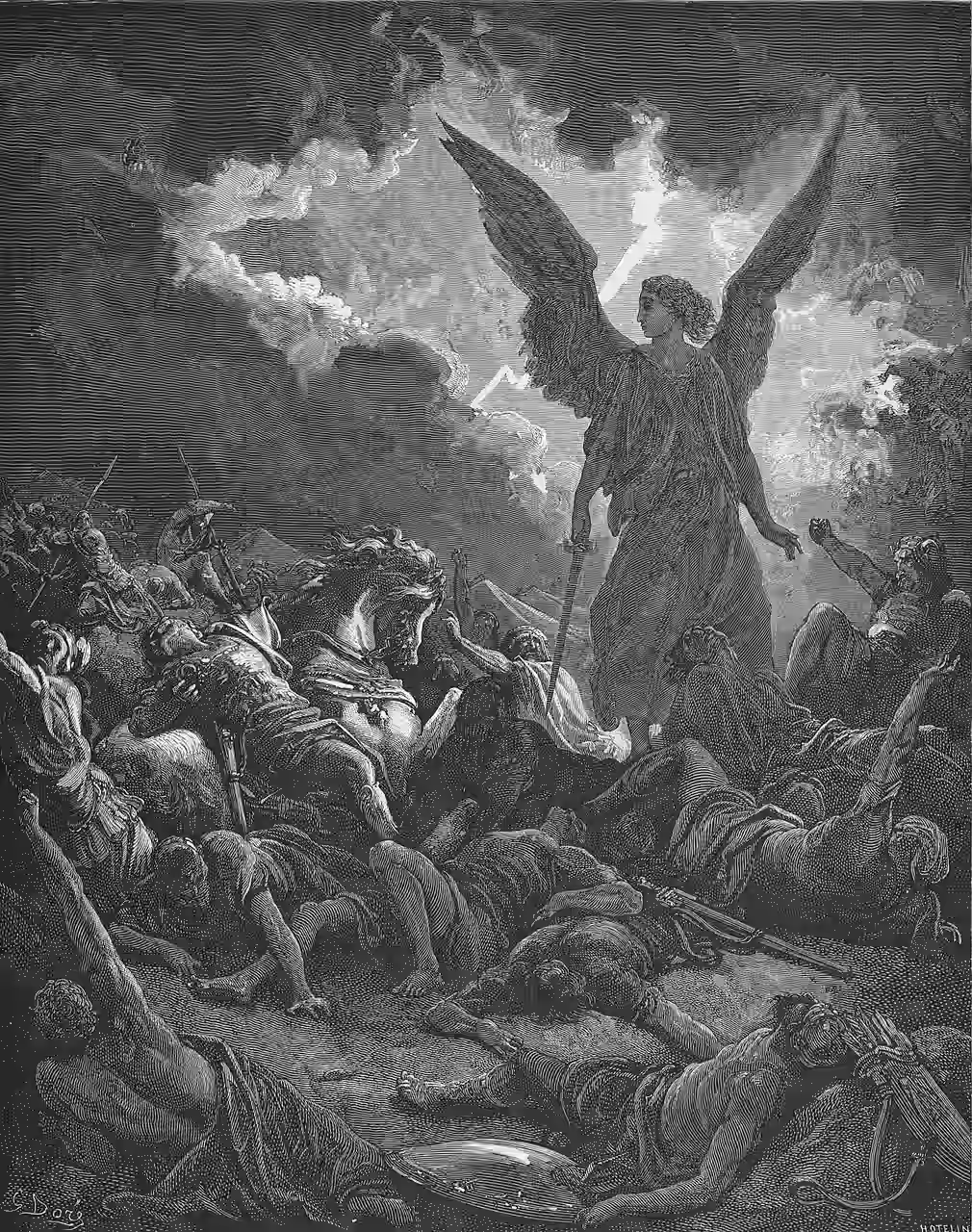
35That night, Yahweh’s angel went out, and struck one hundred eighty-five thousand in the camp of the Assyrians. When men arose early in the morning, behold, these were all dead bodies. 36So Sennacherib king of Assyria departed, and went and returned, and lived at Nineveh. 37As he was worshiping in the house of Nisroch his god, Adrammelech and Sharezer struck him with the sword; and they escaped into the land of Ararat. Esar Haddon his son reigned in his place.
More notes6

Sennacherib’s Fall Prophesied

Jamieson–Fausset–Brown

19:20

Then Isaiah . . . sent--A revelation having been made to Isaiah, the prophet announced to the king that his prayer was heard. The prophetic message consisted of three different portions:--First, Sennacherib is apostrophized (Kg2 19:21-28) in a highly poetical strain, admirably descriptive of the turgid vanity, haughty pretensions, and presumptuous impiety of the Assyrian despot. Secondly, Hezekiah is addressed (Kg2 19:29-31), and a sign is given him of the promised deliverance--namely, that for two years the presence of the enemy would interrupt the peaceful pursuits of husbandry, but in the third year the people would be in circumstances to till their fields and vineyards and reap the fruits as formerly. Thirdly, the issue of Sennacherib's invasion is announced (Kg2 19:32-34).

Source · Public Domain (CC Public Domain Mark 1.0)

Jamieson–Fausset–Brown

19:33

shall not come into this city--nor approach near enough to shoot an arrow, not even from the most powerful engine which throws missiles to the greatest distance, nor shall he occupy any part of the ground before the city by a fence, a mantelet, or covering for men employed in a siege, nor cast (raise) a bank (mound) of earth, overtopping the city walls, whence he may see and command the interior of the city. None of these, which were the principal modes of attack followed in ancient military art, should Sennacherib be permitted to adopt. Though the army under Rab-shakeh marched towards Jerusalem and encamped at a little distance with a view to blockade it, they delayed laying siege to it, probably waiting till the king, having taken Lachish and Libnah, should bring up his detachment, that with all the combined forces of Assyria they might invest the capital.…

Read the full note

So determined was this invader to conquer Judah and the neighboring countries (Isa 10:7), that nothing but a divine interposition could have saved Jerusalem. It might be supposed that the powerful monarch who overran Palestine and carried away the tribes of Israel, would leave memorials of his deeds on sculptured slabs, or votive bulls. A long and minute account of this expedition is contained in the Annals of Sennacherib, a translation of which has recently been made into English, and, in his remarks upon it, COLONEL RAWLINSON says the Assyrian version confirms the most important features of the Scripture account. The Jewish and Assyrian narratives of the campaign are, indeed, on the whole, strikingly illustrative of each other [Outlines of Assyrian History].

Source · Public Domain (CC Public Domain Mark 1.0)

Jerusalem Delivered from the Assyrians

Matthew Henry

19:35–37

Sometimes it was long ere prophecies were accomplished and promises performed; but here the word was no sooner spoken than the work was done. I. The army of Assyria was entirely routed. That night which immediately followed the sending of this message to Hezekiah, when the enemy had just set down before the city and were preparing (as we now say) to open the trenches, that night was the main body of their army slain upon the spot by an angel, Kg2 19:35. Hezekiah had not force sufficient to sally out upon them and attack their camp, nor would God do it by sword or bow; but he sent his angel, a destroying angel, in the dead of the night, to make an assault upon them, which their sentinels, though ever so wakeful, could neither discover nor resist.…

Read the full note

It was not by the sword of a mighty man or of a mean man, that is, not of any man at all, but of an angel, that the Assyrians army was to fall (Isa 31:8), such an angel as slew the first-born of Egypt. Josephus says it was done by a pestilential disease, which was instant death to them. The number slain was very great, 185,000 men, and Rabshakeh, it is likely, among the rest. When the besieged arose, early in the morning, behold they were all dead corpses, scarcely a living man among them. Some think the 76th Psalm was penned on this occasion, where we read that the stout-hearted were spoiled and slept their sleep, their last, their long sleep, Kg2 19:5. See how great, in power and might, the holy angels are, when one angel, in one night, could make so great a slaughter. See how weak the mightiest of men are before almighty God: who ever hardened himself against him and prospered? The pride and blasphemy of the king are punished by the destruction of his army. All these lives are sacrificed to God's glory and Zion's safety. The prophet shows that therefore God suffered this vast rendezvous to be made, that they might be gathered as sheaves into the floor, Mic 4:12, Mic 4:13. II. The king of Assyria was hereby put into the utmost confusion. Ashamed to see himself, after all his proud boasts, thus defeated and disabled to pursue his conquests and secure what he had (for this, we may suppose, was the flower of his army), and continually afraid of falling under the like stroke himself, He departed, and went, and returned; the manner of the expression intimates the great disorder and distraction of mind he was in, Kg2 19:36. And it was not long before God cut him off too, by the hands of two of his own sons, Kg2 19:37. 1. Those that did it were very wicked, to kill their own father (whom they were bound to protect) and in the act of his devotion; monstrous villany! But, 2. God was righteous in it. Justly are the sons suffered to rebel against their father that begat them, when he was in rebellion against the God that made him. Those whose children are undutiful to them ought to consider whether they have not been so to their Father in heaven. The God of Israel had done enough to convince him that he was the only true God, whom therefore he ought to worship; yet he persists in his idolatry, and seeks to his false god for protection against a God of irresistible power. Justly is his blood mingled with his sacrifices, since he will not be convinced by such a plain and dear-bought demonstration of his folly in worshipping idols. His sons that murdered him were suffered to escape, and no pursuit was made after them, his subjects perhaps being weary of the government of so proud a man and thinking themselves well rid of him. And his sons would be looked upon as the more excusable in what they had done if it be true (as bishop Patrick suggested) that he was now vowing to sacrifice them to his god, so that it was for their own preservation that they sacrificed him. His successor was another son, Esarhaddon, who (as it should seem) did not aim, like his father, to enlarge his conquests, but rather to improve them; for he it was that first sent colonies of Assyrians to inhabit the country of Samaria, though it is mentioned before (Kg2 17:24), as appears, Ezr 4:2, where the Samaritans say it was Esarhaddon that brought them thither.

Source · CC0-1.0 / Public Domain

Jamieson–Fausset–Brown

19:35

AN ANGEL DESTROYS THE ASSYRIANS. (Kg2 19:35-36) in the morning . . . they were all dead corpses--It was the miraculous interposition of the Almighty that defended Jerusalem. As to the secondary agent employed in the destruction of the Assyrian army, it is most probable that it was effected by a hot south wind, the simoon, such as to this day often envelops and destroys whole caravans. This conjecture is supported by Kg2 19:7 and Jer 51:1. The destruction was during the night; the officers and soldiers, being in full security, were negligent; their discipline was relaxed; the camp guards were not alert, or perhaps they themselves were the first taken off, and those who slept, not wrapped up, imbibed the poison plentifully.…

Read the full note

If this had been an evening of dissolute mirth (no uncommon thing in a camp), their joy (perhaps for a victory), or "the first night of their attacking the city," says JOSEPHUS, became, by its effects, one means of their destruction [CALMET, Fragments].

Source · Public Domain (CC Public Domain Mark 1.0)

Jamieson–Fausset–Brown

19:36

So Sennacherib king of Assyria . . . went and returned--the same way as he came (Kg2 19:33). The route is described (Isa 10:28-32). The early chariot track near Beyrout is on the rocky edge of Lebanon, which is skirted by the ancient Lycus (Nahr-el Kelb). On the perpendicular face of the limestone rock, at different heights, are seen slabs with Assyrian inscriptions, which having been deciphered, are found to contain the name of Sennacherib. Thus, by the preservation of these tablets, the wrath of the Assyrian invaders is made to praise the Lord. dwelt at Nineveh--This statement implies a considerable period of time, and his Annals carry on his history at least five years after his disastrous campaign at Jerusalem. No record of his catastrophe can be found, as the Assyrian practice was to record victories alone. The sculptures give only the sunny side of the picture.

Source · Public Domain (CC Public Domain Mark 1.0)

Jamieson–Fausset–Brown

19:37

SENNACHERIB SLAIN. (Kg2 19:37) as he was worshipping in the house of Nisroch--Assarae, or Asshur, the head of the Assyrian Pantheon, represented not as a vulture-headed figure (that is now ascertained to be a priest), but as a winged figure in a circle, which was the guardian deity of Assyria. The king is represented on the monuments standing or kneeling beneath this figure, his hand raised in sign of prayer or adoration. his sons smote him with the sword--Sennacherib's temper, exasperated probably by his reverses, displayed itself in the most savage cruelty and intolerable tyranny over his subjects and slaves, till at length he was assassinated by his two sons, whom, it is said, he intended to sacrifice to pacify the gods and dispose them to grant him a return of prosperity.…

Read the full note

The parricides taking flight into Armenia, a third son, Esar-haddon, ascended the throne. Next: 2 Kings Chapter 20

Source · Public Domain (CC Public Domain Mark 1.0)

From the commentaries

Drawn from the public-domain commentaries and Spurgeon sermons that cover this passage · about 947 words.

Matthew Henry

Sennacherib, in his letter, had appealed to what Hezekiah had heard (Kg2 19:11): Thou hast heard what the kings of Assyria have done; but, in answer to that, he is reminded of what God has done for Israel of old, drying up the Red Sea, leading them through the wilderness, planting them in Canaan. The city was shut up, none went out or came in; but now the remnant in Jerusalem and Zion shall go forth freely, and there shall be none to hinder them, or make them afraid, Kg2 19:31. Great destruction had been made both in city and country, bit in both there was a remnant that escaped, which typified the saved remnant of Israelites indeed (as appears by comparing Isa 10:22, Isa 10:23, which speaks of this very event, with Rom 9:27, Rom 9:28), and they shall go forth into the glorious liberty of the children of God. 4. If God save them, he will not starve them, nor let them die by famine, when they have escaped the sword: "Eat you this year that which groweth of itself, and you shall find enough of that. He thought himself the terror of the daughter of Zion, that chaste and beautiful virgin, and that by his threats he could force her to submit to him: "But, being a virgin in her Father's house and under his protection, she defies thee, despises thee, laughs thee to scorn. "You have reason to think yourselves unworthy that such great things should be done for you; but God's own zeal will do it." His zeal, (1.) For his own honour (Kg2 19:34): "I will do it for my own sake, to make myself an everlasting name." God's reasons of mercy are fetched from within himself. (2.) For his own truth: "I will do it for my servant David's sake; not for the sake of his merit, but the promise made to him and the covenant made with him, those sure mercies of David." Thus all the deliverances of the church are wrought for the sake of Christ, the Son of David. I gave thee thy power, gave thee thy success, and made thee what thou art, raised thee up to lay waste fenced cities and so to punish them for their wickedness, and therefore their inhabitants were of small power." What a foolish insolent thing was it for him to exalt himself above God, and against God, upon that which he had done by him and under him. Is it not the Holy One of Israel, whose honour is dear to him, and who has power to vindicate it, which the gods of the heathen have not?" Meno me impune lacesset - No one shall provoke me with impunity. 3. The God of Israel had done enough to convince him that he was the only true God, whom therefore he ought to worship; yet he persists in his idolatry, and seeks to his false god for protection against a God of irresistible power.

Jamieson–Fausset–Brown

Secondly, Hezekiah is addressed (Kg2 19:29-31), and a sign is given him of the promised deliverance--namely, that for two years the presence of the enemy would interrupt the peaceful pursuits of husbandry, but in the third year the people would be in circumstances to till their fields and vineyards and reap the fruits as formerly. Then Isaiah . . . sent--A revelation having been made to Isaiah, the prophet announced to the king that his prayer was heard. Though the army under Rab-shakeh marched towards Jerusalem and encamped at a little distance with a view to blockade it, they delayed laying siege to it, probably waiting till the king, having taken Lachish and Libnah, should bring up his detachment, that with all the combined forces of Assyria they might invest the capital. shall not come into this city--nor approach near enough to shoot an arrow, not even from the most powerful engine which throws missiles to the greatest distance, nor shall he occupy any part of the ground before the city by a fence, a mantelet, or covering for men employed in a siege, nor cast (raise) a bank (mound) of earth, overtopping the city walls, whence he may see and command the interior of the city. If this had been an evening of dissolute mirth (no uncommon thing in a camp), their joy (perhaps for a victory), or "the first night of their attacking the city," says JOSEPHUS, became, by its effects, one means of their destruction [CALMET, Fragments]. So Sennacherib king of Assyria . . . went and returned--the same way as he came (Kg2 19:33). Thus, by the preservation of these tablets, the wrath of the Assyrian invaders is made to praise the Lord. dwelt at Nineveh--This statement implies a considerable period of time, and his Annals carry on his history at least five years after his disastrous campaign at Jerusalem. The king is represented on the monuments standing or kneeling beneath this figure, his hand raised in sign of prayer or adoration. his sons smote him with the sword--Sennacherib's temper, exasperated probably by his reverses, displayed itself in the most savage cruelty and intolerable tyranny over his subjects and slaves, till at length he was assassinated by his two sons, whom, it is said, he intended to sacrifice to pacify the gods and dispose them to grant him a return of prosperity. SENNACHERIB SLAIN. (Kg2 19:37) as he was worshipping in the house of Nisroch--Assarae, or Asshur, the head of the Assyrian Pantheon, represented not as a vulture-headed figure (that is now ascertained to be a priest), but as a winged figure in a circle, which was the guardian deity of Assyria.

Up next: Day 472 · 2 Kings 20:1–21

Read Day 472 →

Hansen Bible Study is free and has no ads. If it helps you, you can support it for $3 a month. (opens in a new tab)

An angel passing over the camp of Sennacherib's army. Gustave Doré's engraving for 2 Kings 19.
Gustave Doré, Sennacherib's Army Is Destroyed, 1866. Public domain.Source
Chapter introductions1

Matthew Henry

ch. 19

Jerusalem's great distress we read of in the foregoing chapter, and left it besieged, insulted, threatened, terrified, and just ready to be swallowed up by the Assyrian army. But in this chapter we have an account of its glorious deliverance, not by sword or bow, but by prayer and prophecy, and by the hand of an angel. I. Hezekiah, in great concern, sent to the prophet Isaiah, to desire his prayers (Kg2 19:1-5) and received from him an answer of peace (Kg2 19:6, Kg2 19:7). II. Sennacherib sent a letter to Hezekiah to fright him into a surrender (Kg2 19:8-13). III. Hezekiah thereupon, by a very solemn prayer, recommended his case to God, the righteous Judge, and begged help from him (Kg2 19:14-19). IV. God, by Isaiah, sent him a very comfortable message, assuring him of deliverance (Kg2 19:20-34). V.…

Read the full note

The army of the Assyrians was all cut off by an angel and Sennacherib himself slain by his own sons (Kg2 19:35-37). And so God glorified himself and saved his people.

Source · CC0-1.0 / Public Domain

Alongside this reading

Church history for this calendar day, and reports that mention this passage.

On this day · 1937

“And they were all filled with the Holy Ghost, and began to speak with other tongues, as the Spirit gave them utterance.” Acts 2:4

Agnes Ozman, First to Speak in Tongues at Topeka, Dies

November 29, 2026 · Los Angeles, California

Agnes Ozman LaBerge died in Los Angeles on 29 November 1937. In the fall of 1900 she had gone to Charles Parham's Bible school in Topeka, Kansas, where students kept up prayer day and night and sought the baptism in the Holy Spirit.

Read the devotional

Source · Quote public domain

Tied to this passage

The Woman and the Goose

biblicalarchaeology.org · Nov 18

Carrying out excavations at a prehistoric village overlooking the Sea of Galilee, archaeologists from the Hebrew University of Jerusalem uncovered a small clay figurine unlike […] The post The Woman and the Goose appeared first on Biblical Archaeology Society .

Canaanite Folk Worship at Megiddo

biblicalarchaeology.org · Nov 16

Conducting salvage excavations at the ancient site of Megiddo—famously known as Armageddon in the New Testament’s Book of Revelation—archaeologists with the Israel Antiquities Authority (IAA) […] The post Canaanite Folk Worship at Megiddo appeared first on Biblical Archaeology Society .

All discoveries